COVID-19 Real Economy Crisis
Manufacturing Operating Rate Plummets to 70.7
Lowest Since 2009 Financial Crisis
Inventory Rate Highest in 21 Years 5 Months
COVID-19 Impacts South Korea's Growth Rate by -0.68%P
Credit Rating Agencies Downgrade Growth Forecasts Simultaneously
[Asia Economy Reporters Kwangho Lee and Eunbyul Kim] The prolonged outbreak of the novel coronavirus infection (COVID-19) is pushing the South Korean economy to the brink. The economic shock is so severe that it is difficult to gauge its intensity due to the contraction of domestic economic activities and the slowdown in growth among major countries. On the ground, 'shutdowns' (temporary work stoppages) are increasing indiscriminately across industries, spreading comprehensively from self-employed individuals and small business owners to medium-sized and large corporations. Some global economic analysis institutions have warned that if this spread continues, South Korea's economic growth rate could plummet to -12.2% this year.
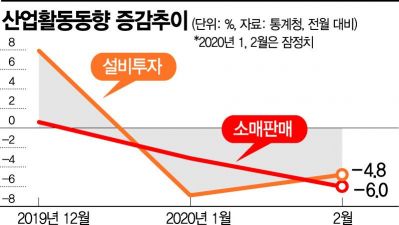
◆All indicators of production and expenditure decline= According to the 'February Industrial Activity Trends' released by Statistics Korea on the 31st, concerns about the economic shock caused by the spread of COVID-19 are becoming a reality. Key indicators such as production, consumption, and investment all retreated simultaneously. Last month, the overall industrial production index (seasonally adjusted, excluding agriculture, forestry, and fisheries) fell 3.5% compared to the previous month, with all indicators declining including mining and manufacturing (-3.8%), services (-3.5%), retail sales (-6.0%), and construction performance (-3.4%). The government explained, "In February, industrial activity saw decreases in all indicators related to production (mining and manufacturing, services) and expenditure (consumption, facility and construction investment) due to the impact of COVID-19."
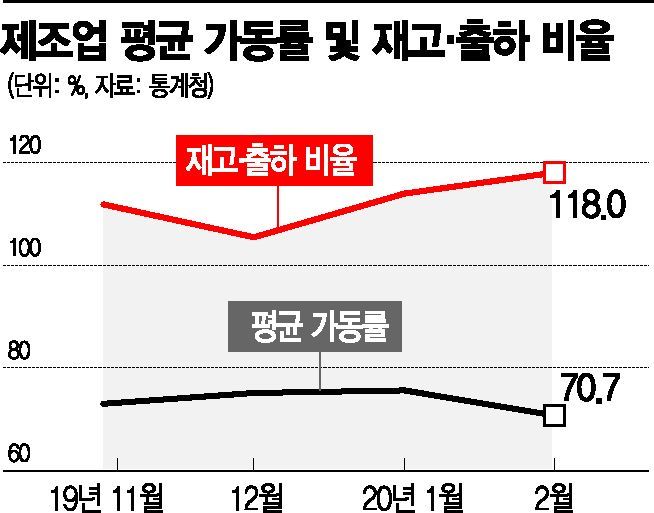
In particular, the manufacturing operating rate dropped sharply as factories halted due to the COVID-19 shock. The manufacturing operating rate in February was 70.7, down 4.9% from the previous month. This is the lowest level in 10 years and 11 months since March 2009 (69.9) during the financial crisis. As consumption contracted rapidly, manufacturing shipments decreased and inventories accumulated. Last month, manufacturing shipments fell 3.3%, centered on automobiles (-23.7%), machinery equipment (-5.2%), and rubber and plastics (-8.7%). Domestic shipments plunged 6.2%. Manufacturing inventories increased by 0.2% from the previous month, and the inventory ratio (inventory/shipment) rose 4.1 percentage points to 118.0%. This is the highest level in 21 years and 5 months since September 1998 (122.9%).
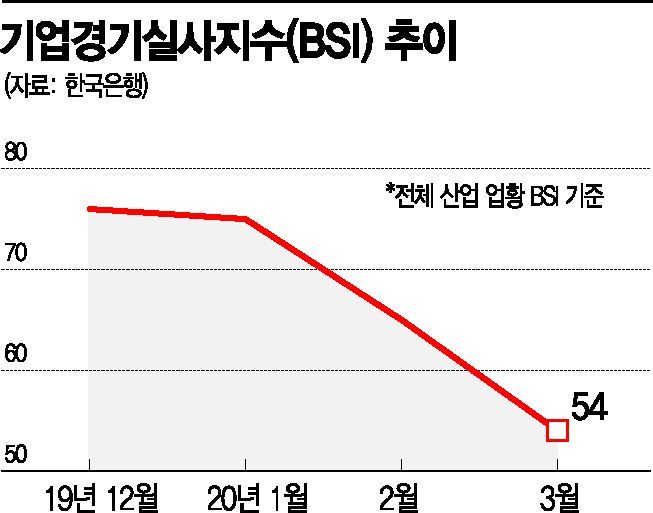
The business sentiment felt by companies also plummeted. The 'March Business Survey Index (BSI)' released by the Bank of Korea on the same day was 54, down 11 points from the previous month. The business sentiment in March fell to the level seen during the financial crisis, with a general deterioration across all company sizes and industries. The manufacturing BSI recorded 56, down 9 points from 65 in the previous month. This is the lowest manufacturing BSI since March 2009 (56).
By company size, large enterprises (-7 points), small and medium enterprises (-12 points), export companies (-9 points), and domestic companies (-10 points) all fell simultaneously compared to the previous month. Sales, profitability, and financial conditions all deteriorated, indicating not only poor current sales but also difficulties in raising funds in the market. Manufacturing companies cited uncertain economic conditions (27.5%) and sluggish domestic demand (22.6%) as their biggest management difficulties. This reflects the greatest concern about how long the economic damage caused by COVID-19 will continue. As domestic demand took a direct hit, the non-manufacturing business performance BSI fell even below the level during the financial crisis (56). Declines were centered on wholesale and retail trade (-14 points), information and communication (-21 points), and professional, scientific, and technical services (-20 points).
◆Government also says "No one knows when it will end"= The problem is the bleak uncertainty about when this situation will end. With no signs of the COVID-19 crisis abating, the domestic economic outlook for this year is becoming increasingly grim. If the situation prolongs contrary to initial expectations, the possibility of an L-shaped economic recession cannot be ruled out. Hong Nam-ki, Deputy Prime Minister and Minister of Economy and Finance, expressed concern the day before, saying, "The situation is prolonging longer than initially expected, and it is becoming more difficult to predict when our economy will normalize."
The National Assembly Budget Office assessed that the impact of COVID-19 on South Korea's economic growth rate this year is -0.68 percentage points. The office first estimated that as COVID-19 spreads and major countries' economic growth slows, South Korea's economic growth rate will decrease by 0.29 percentage points. The weighted average economic growth rate of nine major countries including the U.S., China, Japan, Germany, the U.K., France, Italy, India, and Canada, announced by the OECD earlier this month (2.44%), is 0.4 percentage points lower than the figure announced in November last year (2.84%) before the COVID-19 outbreak. Additionally, the negative impact of COVID-19 on South Korea's economic activities was calculated at -0.39 percentage points. This figure was derived based on the 'residual' after subtracting the impact of the slowdown in the nine major countries' economic growth from the adverse effects on the Korean economy during the Middle East Respiratory Syndrome (MERS) outbreak in the second quarter of 2015.
Global economic analysis institutions are also consecutively lowering their forecasts for South Korea's economic growth rate. Credit rating agency Moody's downgraded South Korea's economic growth rate from 1.4% to 0.1% on the 26th. S&P lowered it to -0.6%, and the British economic analysis firm Capital Economics cut it to -1.0%. The Japanese securities firm Nomura Securities projected South Korea's economic growth rate this year to be between -12.2% and -5.5%. Previously, Nomura had forecasted South Korea's economic growth rate between 0.2% and 1.4%. Nomura predicted, "If the number of COVID-19 infections rises sharply next month, the global financial market will face a severe credit crunch, and South Korea's economic growth rate could plunge to -12.2%."
© The Asia Business Daily(www.asiae.co.kr). All rights reserved.
![Clutching a Stolen Dior Bag, Saying "I Hate Being Poor but Real"... The Grotesque Con of a "Human Knockoff" [Slate]](https://cwcontent.asiae.co.kr/asiaresize/183/2026021902243444107_1771435474.jpg)

















