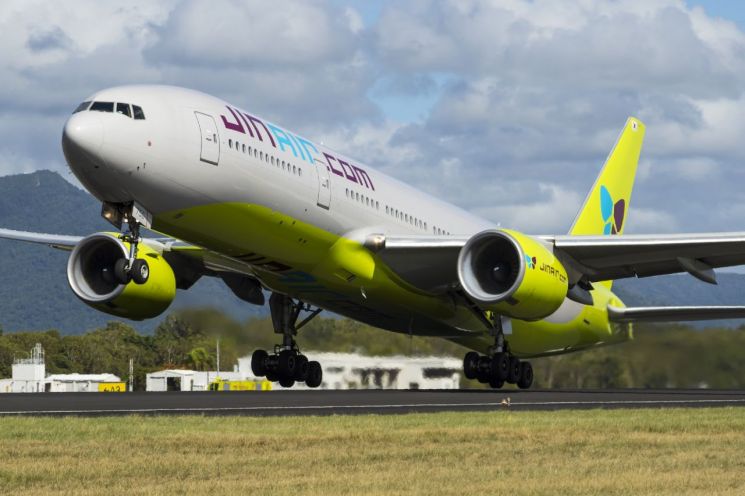
[Asia Economy Reporters Yu Je-hoon and Lee Chun-hee] Low-cost carrier (LCC) Jin Air has escaped government administrative sanctions triggered by the so-called 'water cup power abuse' incident after 20 months. With this, Jin Air has been able to overcome the uncertainty of management sanctions and lay the foundation for business normalization. However, industry insiders predict that it will take a long time before full-scale business normalization, given that the novel coronavirus disease (COVID-19) is severely impacting the domestic aviation industry.
The Ministry of Land, Infrastructure and Transport (MOLIT) announced on the 31st that it held a license advisory committee meeting and decided to lift administrative sanctions against Jin Air. Jin Air had been under management sanctions since August 2018, including denial of new transport rights, restrictions on aircraft registration, and prohibition of irregular flight operations, after it was revealed that former Vice President Cho Hyun-min (currently Executive Director of Hanjin KAL) served as a registered executive while holding foreign nationality.
At that time, MOLIT set conditions for lifting these management sanctions, including ▲ excluding group affiliate executives from approval processes ▲ strengthening the authority of outside directors ▲ supplementing the in-house grievance handling system. Jin Air met these requirements by passing a governance improvement plan containing these measures at the shareholders' meeting on the 25th. Kim Sang-do, Director of the Aviation Policy Office at MOLIT, said, "Since Jin Air has prepared the promised management culture improvement measures, we expect and will monitor that Jin Air operates accordingly and becomes a trusted airline company."
Thus, Jin Air has laid the groundwork for business normalization. Even during the LCC industry's 'boom period' before COVID-19 and the boycott of travel to Japan, Jin Air suffered considerable damage to profitability due to management sanctions. Jin Air commented on the decision, saying, "We consider it fortunate that the lifting of sanctions occurred amid the unprecedented difficulties faced by the aviation industry. We will maintain a transparent and trusted management system through the independent management system establishment, compliance management, and horizontal organizational culture that we have been pursuing."
However, due to the recent COVID-19 pandemic causing a sharp decline in air passenger demand, it is expected that Jin Air's business normalization will take considerable time. Currently, Jin Air is barely maintaining three international routes along with domestic flights. It is difficult to find routes suitable for operating irregular flights immediately.
Jin Air is struggling to survive. As passenger flights have decreased, it has adjusted manpower through unpaid leave and a rotating vacation system, while recently increasing domestic flights and deploying the mid-to-large-sized B777-200ER aircraft for cargo operations. This is a desperate measure to find revenue sources in a situation where attracting international passengers, the main source of income, is virtually impossible.
Professor Lee Hwi-young of Inha Technical College said, "The lifting of sanctions will have a positive effect on Jin Air by removing various uncertainties and enabling proactive responses to upcoming situations," but added, "The immediate challenge is to survive based on the capital and capabilities accumulated so far, amid the uncertainty of when the COVID-19 crisis will end."
© The Asia Business Daily(www.asiae.co.kr). All rights reserved.
![Clutching a Stolen Dior Bag, Saying "I Hate Being Poor but Real"... The Grotesque Con of a "Human Knockoff" [Slate]](https://cwcontent.asiae.co.kr/asiaresize/183/2026021902243444107_1771435474.jpg)















