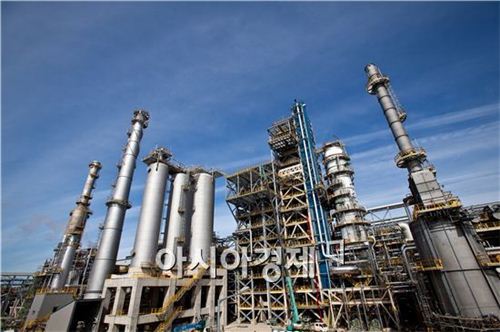
 ▲Hyundai Oilbank Refinery Plant Overview
[Asia Economy Reporters Sohyeon Park, Yoonju Hwang] "What is the current situation?" On the 23rd, SK Group Chairman Chey Tae-won ordered the heads of affiliates to conduct an emergency management diagnosis due to the COVID-19 pandemic during a video conference on management issues and strategies. The meeting was held in a more urgent atmosphere than the strategic meeting held last July in response to Japan's export restrictions. As international oil prices plummeted due to the COVID-19 crisis, SK Group, which focuses on refining and chemicals, is experiencing its greatest crisis since the 2003 SK Innovation Sovereign incident. Analysts in the securities industry predict that SK Innovation's operating losses could exceed 1 trillion won. Other oil companies are facing similar situations. S-Oil's global long-term credit rating outlook was downgraded from 'stable' to 'negative.' A source from the refining industry said, "In my decades of experience in the refining industry, this is the first time I have seen a situation where oil price collapse and demand reduction overlap," adding, "Rather than tariff exemptions, it would be better if the government could practically purchase even reserve oil."
◇ Refining Margins Negative for Two Consecutive Weeks... The More They Sell, The More They Lose = According to the refining industry on the 31st, the Singapore complex refining margin for the fourth week of March recorded -$1.1 per barrel. This marks the second consecutive week of negative margins following last week. The refining margin, a key profitability indicator for refiners, refers to the amount left after subtracting crude oil purchase costs and transportation expenses from the prices of petroleum products such as gasoline. The refining margin, which was around $3.7 per barrel in the second week of March, sharply reversed to -$1.9 in the third week due to the global spread of COVID-19. Usually, when oil prices fall sharply, demand increases due to price effects, but the COVID-19 crisis has caused a sharp drop in demand, putting refiners in an unprecedented situation. An industry insider said, "In my decades in the refining industry, this is the first time I have experienced a global decline in petroleum product demand."
◇ Limits to Surviving by Dumping... Direct Hit from COVID-19 Demand Drop = The refining industry's sense of crisis due to demand contraction caused by the COVID-19 pandemic is more severe than expected. Initially, the industry coped by urgently dumping surplus domestic jet fuel within the region as flight cancellations and reductions decreased jet fuel demand. However, with gasoline and diesel demand also plummeting, the refining industry is facing a situation where it cannot survive on its own.
The industry estimates that domestic gasoline demand in January and February this year decreased by up to 20% compared to the same period last year. Considering the rapid spread of COVID-19 in Korea from late February, the demand decline in March is expected to be much larger. This is due to reduced demand not only from private drivers but also from decreased cargo volume caused by factory shutdowns. In particular, the Daegu and Gyeongbuk regions, where COVID-19 is spreading most rapidly, are expected to see about a 40% drop in gasoline demand in March. Additionally, due to the economic downturn, petroleum product sales to general industries have decreased, and marine fuel demand has dropped due to reduced shipping volumes, making it inevitable to reduce refinery operating rates.
SK Energy, the top player in the refining industry, has lowered its operating rate by 15% since this month. Additional production cuts are reportedly under consideration for next month. Reducing operating rates by more than 15% due to the global decline in petroleum product demand without scheduled maintenance or process management is the first since the 2008 financial crisis. S-Oil, a subsidiary of Aramco, is considering voluntary retirement for the first time in its history. Despite having invested over 5 trillion won in facilities, S-Oil has lowered its operating rate to the 80% range. GS Caltex has advanced the scheduled maintenance of its crude distillation unit (CDU) to March this year.
◇ Crude Oil Transportation Costs Double... Government Support Zero (0) = The crude oil transportation fee from the Middle East to Korea, which was less than $2 per barrel at the beginning of last year, has now exceeded $4 per barrel, more than double. This is also a significant burden for refiners. The freight cost for crude oil coming from the U.S. has surpassed $7 per barrel, more than double compared to early last year. There are growing calls for drastic measures to support the refining industry caught in a structural crisis with no way out, but policy support is almost zero because they are large corporations. The refining industry has made various policy proposals to the government, including zero tariffs on crude oil as a non-oil-producing country, improving fairness in petroleum import levies, and maintaining fairness in naphtha allocation tariffs, but none have been accepted. An industry official said, "If the large and influential refining industry collapses, it could lead to a global crisis beyond a national burden," adding, "Since all crude oil is imported, a comprehensive review of crude oil import tariffs is necessary."
© The Asia Business Daily(www.asiae.co.kr). All rights reserved.
![Clutching a Stolen Dior Bag, Saying "I Hate Being Poor but Real"... The Grotesque Con of a "Human Knockoff" [Slate]](https://cwcontent.asiae.co.kr/asiaresize/183/2026021902243444107_1771435474.jpg)















