[Asia Economy Reporter Kang Nahum] As the conflict between the Democratic Party of Korea and the Justice Party over proportional representation parties sharpens, prospects for an alliance in the general election seem to be fading. There are also predictions that if unification between the two parties does not occur in each constituency, the Justice Party may fail to secure even a single seat in the constituencies.
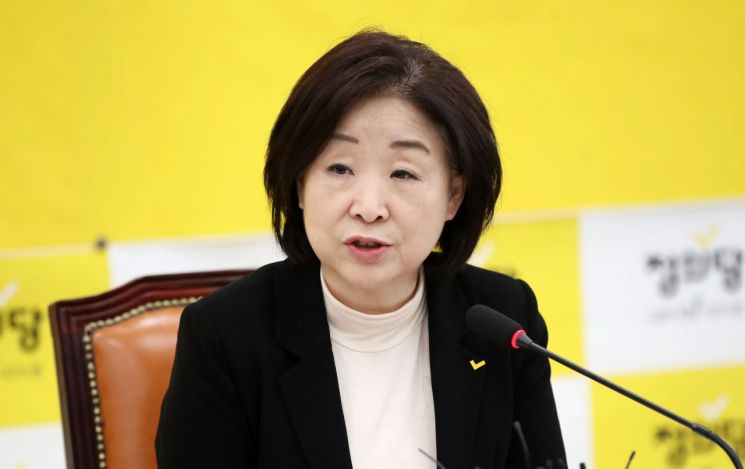
Shim Sang-jung, leader of the Justice Party, stated at a '21st General Election Press Conference' held at the National Assembly on the morning of the 30th, regarding unification of constituency candidates with the Democratic Party, "Since there is fierce competition even among proportional satellite parties, there will be no artificial unification between parties."
However, she left room for possibility by saying, "In cases like Changwon Seongsan in Gyeongnam, where many candidates with labor backgrounds have run, a small-scale unification might take place considering the regional characteristics."
The Changwon Seongsan constituency mentioned by Shim is the district of Justice Party lawmaker Yeo Young-guk. Yeo narrowly won the by-election in April last year by 503 votes against Kang Ki-yoon of the Liberty Korea Party. This was a hard-won result achieved through unification with Democratic Party candidate Kwon Min-ho at the time. In this general election, Yeo proposed unification to Democratic Party candidate Lee Heung-seok, but it is uncertain whether Lee will accept it.
If party-level negotiations for unification of constituency candidates do not proceed as such, the general analysis in political circles is that vote splitting in the progressive camp will be inevitable in many constituencies. Some even predict that the Justice Party might not only lose all constituency seats to the United Future Party but could be completely defeated in all constituencies where it fields candidates.
Excluding Changwon Seongsan, the constituencies where Justice Party candidates have a high chance of winning are Goyang Gap in Gyeonggi Province, where Shim Sang-jung is running, and Yeonsu Eul in Incheon, where lawmaker Lee Jeong-mi is running.
Goyang Gap is where Shim was elected in the 20th general election without unification. However, in a recent poll conducted by iSoftBank on the 8th (commissioned by Joongbu Ilbo, targeting 502 residents aged 18 and over in Goyang Gap, Gyeonggi Province, with a response rate of 3.1%, and a margin of error of ±4.4% at a 95% confidence level; details available on the Central Election Poll Deliberation Commission website), Shim received 26.3% support, trailing behind Lee Kyung-hwan of the United Future Party at 33.5% and Moon Myeong-sun of the Democratic Party at 26.5%. If unification is achieved, a smooth victory for the progressive candidate is expected, but if it fails, the seat could be lost to the United Future Party.
In the Yeonsu Eul poll (conducted by iSoftBank on the 23rd-24th, commissioned by Joongbu Ilbo, targeting 527 residents aged 18 and over in Yeonsu Eul, with a response rate of 2.7%, and a margin of error of ±4.3% at a 95% confidence level; details available on the Central Election Poll Deliberation Commission website), United Future Party lawmaker Min Kyung-wook received 44.1%, Democratic Party candidate Jung Il-young 25.8%, and Lee Jeong-mi 19%. The combined support for Jung and Lee barely surpasses Min's support.
Not only in constituencies but also capturing votes for proportional representation is challenging. The emergence of proportional parties has lowered the possibility of 'split voting' (voting for the Democratic Party in constituencies and the Justice Party in proportional representation), which had benefited the Justice Party in past elections.
According to a Realmeter poll released on the 30th (conducted from the 23rd to 27th, commissioned by YTN, targeting 2,531 voters aged 18 and over nationwide, with a response rate of 5.6%, and a margin of error of ±1.9 percentage points at a 95% confidence level; details available on the Central Election Poll Deliberation Commission website), the support rates for proportional representation parties were 29.8% for the Together Citizens' Party, 11.7% for the Open Democratic Party, and only 5.9% for the Justice Party.
RealMeter explained, "Among Democratic Party supporters, 60% supported the Citizens' Party, and 22.3% supported the Open Democratic Party, showing a split. Only 4.5% of Democratic Party supporters shifted to the Justice Party."
Regarding this, Shim said, "The Democratic Party's satellite parties are a strategy to gather Democratic-leaning voters who had previously split their votes by supporting the Justice Party back to the Democratic Party. While this will have a considerable impact, voters will, after much deliberation, ultimately support the Justice Party, which has fought against inequality and discrimination in our society."
© The Asia Business Daily(www.asiae.co.kr). All rights reserved.
![Clutching a Stolen Dior Bag, Saying "I Hate Being Poor but Real"... The Grotesque Con of a "Human Knockoff" [Slate]](https://cwcontent.asiae.co.kr/asiaresize/183/2026021902243444107_1771435474.jpg)
















