Experts Assess Low Likelihood of Disaster Relief Funds Entering Market
"In Emergencies, Savings Tend to Increase; Coupon Distribution May Reduce Cash Spending"
"If Jobs Collapse, All Support Becomes Useless" "Preemptive Response Before Corporate Restructuring Is Crucial"
"Need to Start Considering How to Cover Funding Shortfalls"
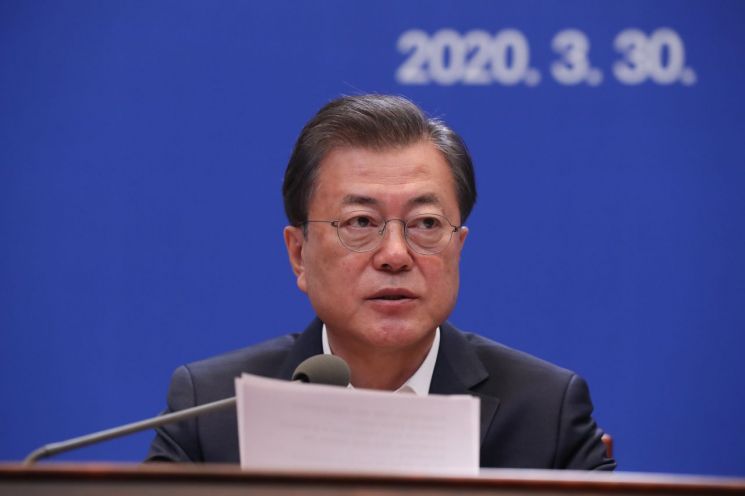
[Sejong=Asia Economy reporters Kim Hyunjung and Jang Sehee] As the government has decided to provide emergency disaster relief funds to households in the bottom 70% income bracket amid the spread of the novel coronavirus infection (COVID-19), experts are evaluating that the effect will be minimal compared to the large-scale fiscal expenditure. This is because the possibility that cash support will lead to increased consumption is very low in a situation where not only the income of small business owners and self-employed individuals is decreasing but also corporate restructuring is feared. There are also opinions that ways to prepare ammunition to be used when the COVID-19 situation begins to calm down should be considered together.
◆ "When uncertainty is high, the likelihood of saving rather than consumption increases" Concerns about effectiveness = On the 30th, President Moon Jae-in presided over the 3rd Emergency Economic Meeting at the Blue House and announced support measures in response to COVID-19. According to this plan, the government will provide emergency disaster relief funds of up to 1 million won for a family of four in cash and local currency to the bottom 70% income group. To this end, related ministries and the National Assembly will accelerate the preparation of the 2nd supplementary budget, and most of the related funds will be secured through government budget adjustments. Actual payments are expected to be made within next month after the National Assembly's approval around mid-April, right after the general election.
The key to the effectiveness of such support funds is whether the released fiscal funds will be spent directly in the market as intended by the government, but experts see this possibility as very low. This means that most will go into savings due to the ongoing endless disaster situation and employment instability. Joo Won, head of the Economic Research Office at Hyundai Research Institute, explained, "Direct government support usually leads to consumption only under normal economic cycles," adding, "When uncertainty about everything is high as it is now, there is a strong tendency to save or stockpile." He further emphasized, "Even if the funds are provided as vouchers or local currency with an expiration date, people are likely to use them for immediate living expenses and then reduce cash spending by the same amount," concluding, "Ultimately, the scale of consumption will not increase."
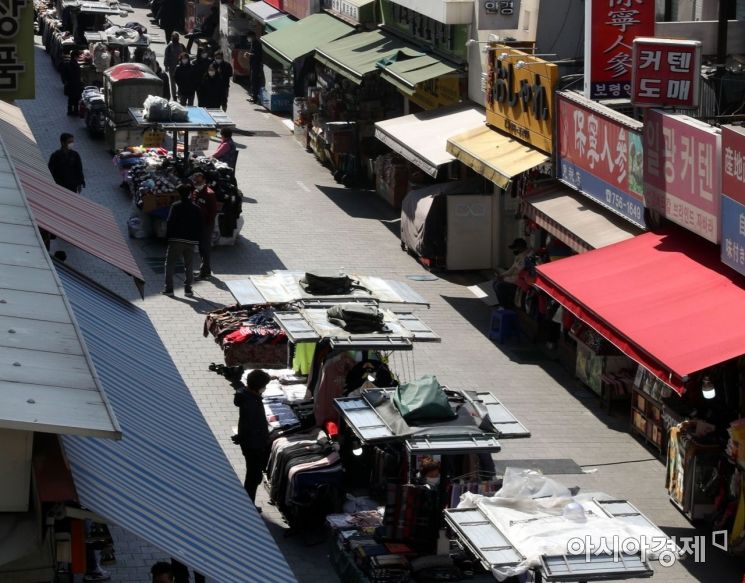 On the 8th, marking the weekend, Namdaemun Market, Seoul's representative traditional market, showed a deserted appearance due to the impact of COVID-19. Photo by Yoon Dong-joo doso7@
◆ "If jobs collapse, cash support is useless" = There are also criticisms that the government's fiscal support purpose should be clearer. It should have been clarified in advance whether the goal is to revive the domestic market through consumption activation or to provide welfare for low-income groups facing livelihood crises. Experts generally agree that the target of the bottom 70% income bracket sends a vague message. Furthermore, there is consensus that priority should be given to proactive measures to prevent companies from entering restructuring rather than cash support.
Professor Kim Taegi of Dankook University’s Department of Economics pointed out, "The government is trapped in the frame of 'basic income' in its support method," adding, "It should emphasize either simple income compensation or resolving employment instability." Professor Kim stressed, "Rather than releasing money that may not be spent immediately, it is urgent to focus on companies and employment issues that become uncontrollable if they collapse, and the fiscal policies of major countries like the U.S. and Germany are directed toward this," emphasizing, "If jobs disappear, cash support is useless." He continued, "The core is for the government to act as a safety net by actively providing payment guarantees and taking extraordinary measures to keep companies stable and maintain jobs," arguing, "Only when the employment market stabilizes will psychology and income be resolved." Joo also emphasized, "If the purpose of the government's current measures is to stimulate domestic demand, it is a wrong judgment, and if it is from a welfare perspective, the target should have been more narrowly defined," adding, "Preventing unemployment is the most effective mid- to long-term domestic demand stimulation measure."
In a structurally inevitable situation of preparing the 2nd supplementary budget, the shortage of ammunition to accelerate recovery is also cited as a problem. Professor Kim Sangbong of Hansung University’s Department of Economics emphasized, "While consumption coupons and others have already been distributed in the 1st supplementary budget, it is now necessary to have a basic plan on how to use the funds and how to replenish them."
© The Asia Business Daily(www.asiae.co.kr). All rights reserved.
![Clutching a Stolen Dior Bag, Saying "I Hate Being Poor but Real"... The Grotesque Con of a "Human Knockoff" [Slate]](https://cwcontent.asiae.co.kr/asiaresize/183/2026021902243444107_1771435474.jpg)
















