'Excluding High Earners' Fairness Controversy
Moon Requests Understanding from Those Who Can Endure
[Asia Economy Reporter Jang Sehee] The Democratic Party of Korea, the government, and the Blue House engaged in heated debates over the 'Emergency Disaster Relief Fund,' but it was decided to provide 1 million KRW to households in the bottom 70% income bracket, which is higher than the government's initial proposal of 100% of the median income. This decision is analyzed to reflect both the inevitable economic impact of the novel coronavirus infection (COVID-19) and the political situation surrounding the general election.
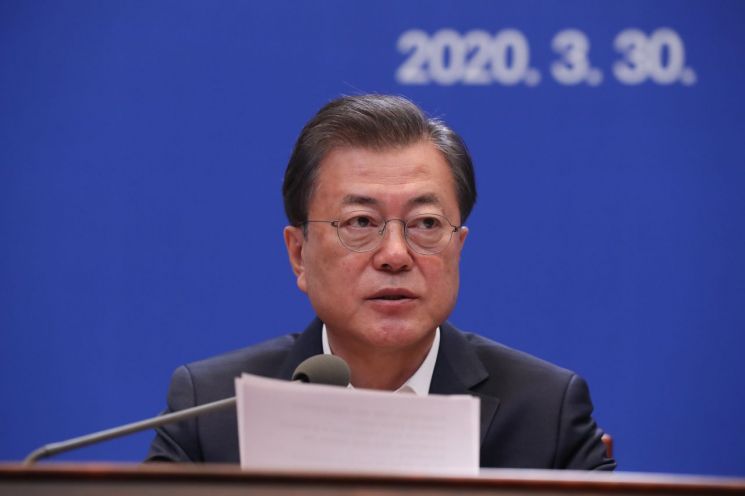
On the 30th, President Moon Jae-in announced in his opening remarks at the Emergency Economic Measures Meeting that, to proactively respond to the economic crisis caused by the spread of COVID-19, an emergency disaster relief fund of 1 million KRW (based on a four-person household) will be provided to households in the bottom 70% income bracket.
Households with 1 to 3 members are expected to receive less than 1 million KRW, while those with 5 or more members will receive more. The bottom 70% income bracket corresponds to households earning less than 150% of the median income, which accounts for 14 million households out of the total 21 million households in South Korea.
The 150% median income by household size is as follows: ▲1-person household 2,635,791 KRW ▲2-person household 4,487,970 KRW ▲3-person household 5,805,865 KRW ▲4-person household 7,123,751 KRW ▲5-person household 8,441,656 KRW ▲6-person household 9,759,552 KRW. A four-person household earning more than 7,123,761 KRW per month is excluded from receiving the 1 million KRW payment.
According to the Ministry of Strategy and Finance, the draft proposals for the emergency disaster relief fund presented at the Blue House Emergency Economic Meeting included four options based on a four-person household: 100% median income with 1 million KRW payment, 150% median income with 1 million KRW, bottom 70% income with 1 million KRW, and 70-80% of the entire population with 500,000 KRW. The Democratic Party had previously insisted on providing 500,000 KRW per person to 70-80% of the entire population, arguing that at minimum, support should be given to 50% of the total population.
The government had considered providing emergency disaster livelihood support of up to 1 million KRW (based on a four-person household) to 10 million households, which corresponds to 50% of all households earning less than 100% of the median income, but ultimately largely accepted the ruling party's proposal. A government official explained, "Given the uncontrollable spread of the COVID-19 situation, the government intends to actively respond as long as resources allow."
However, high-income earners are excluded from this emergency disaster relief fund, raising some concerns about fairness. For example, in Gyeonggi Province, residents of Yeoju, Gwangmyeong, and Icheon can receive both the 100,000 KRW support from Gyeonggi Province and additional support from their respective local governments, while residents in other areas can only receive the 100,000 KRW from Gyeonggi Province. Some netizens posted negative comments on articles about the government's emergency disaster relief fund announcement, such as "They say they are collecting my money to help those in need," and "Just give 1 million KRW unconditionally to all citizens. That's the answer."
In this regard, President Moon said, "I ask those who are economically more resilient to widely understand and make concessions for those with lower incomes."
© The Asia Business Daily(www.asiae.co.kr). All rights reserved.
![Clutching a Stolen Dior Bag, Saying "I Hate Being Poor but Real"... The Grotesque Con of a "Human Knockoff" [Slate]](https://cwcontent.asiae.co.kr/asiaresize/183/2026021902243444107_1771435474.jpg)















