Non-bank Deposit-taking Institutions' Loans Reach 52.4 Trillion Won at Year-end, Up 13%
Concerns Grow Over Delinquency in Secondary Financial Sector Centered on Mutual Finance as Commercial Vacancy Rates Rise
[Asia Economy Reporter Kwon Haeyoung] As the spread of the novel coronavirus infection (COVID-19) deals a direct blow to the self-employed business sector, concerns are rising over the deterioration of the soundness of commercial real estate collateral loans. This is due to a combination of the balloon effect caused by stricter regulations on retiree startups and mortgage loans, and the sharp decline in sales of self-employed businesses due to the impact of COVID-19, which has led to an increase in closures and vacancies. In particular, signs of a significant increase in non-performing loans are emerging mainly in the secondary financial sector, such as Nonghyup, Suhyup, Shinhan Credit Cooperative, and Saemaeul Geumgo, where commercial real estate loans have rapidly increased recently.
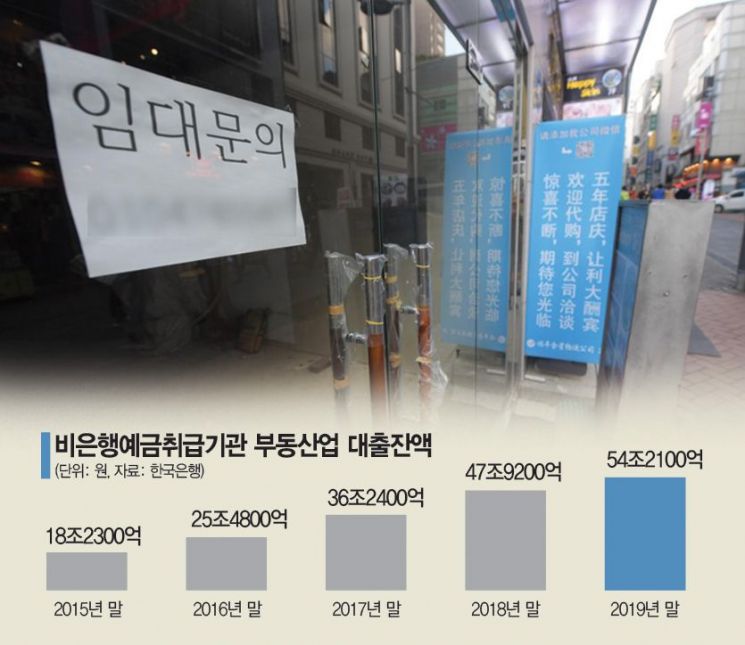
According to the Bank of Korea and financial authorities on the 30th, the outstanding loans for real estate business by non-bank deposit-taking institutions stood at 54.2126 trillion won at the end of 2019, up 13.1% from 47.9204 trillion won at the end of 2018.
For deposit-taking institutions such as banks, the outstanding loans for real estate business increased by 10.1%, from 231.8599 trillion won at the end of 2018 to 255.4639 trillion won at the end of 2019. The growth rate of real estate business loans in the secondary financial sector, including mutual finance and savings banks, was steeper compared to banks.
The problem is that as the real economy rapidly cools due to the impact of COVID-19, closures of self-employed businesses and vacancies in commercial properties may increase further. According to the Korea Appraisal Board, the vacancy rate of small-scale commercial properties nationwide rose from 5.3% in the first quarter of 2019 to 6.2% in the fourth quarter, and the vacancy rate of medium-to-large commercial properties increased from 11.3% to 11.7%. The vacancy rate of small-scale commercial properties rented by small self-employed businesses rose regionally: Seoul from 2.9% to 3.9%, Daegu from 3% to 4.8%, Ulsan from 4.3% to 5.6%, Jeonbuk from 9.6% to 12.5%, and Jeonnam from 6.1% to 7.7%, indicating that the economic downturn in local areas is much more severe. The rise in vacancy rates is due to the decline of regional key industries → employment contraction → consumption slump and real estate price drops, compounded by the COVID-19 pandemic.
Commercial real estate loans have short maturities and a high proportion of lump-sum repayments, which means that delinquencies and defaults may increase mainly among borrowers with low to medium credit ratings. According to the Bank of Korea, as of the end of June 2019, 49.6% of commercial real estate loans from eight domestic banks had maturities of less than three years. The proportion of loans where only interest is paid without principal repayment is 86.9%, which is higher than that of mortgage loans (38.5%), and the proportion of borrowers with high credit ratings (grades 1 to 3) is 41.9%, only about half of that for mortgage loans (85.6%). If loan maturities for commercial real estate loans are not extended amid the sharp downturn in the self-employed business sector, borrowers may face difficulties in repaying their debts.
Accordingly, there are calls for soundness management of commercial real estate loans. The Financial Supervisory Service ordered mutual finance institutions at the end of last year to manage delinquency rates amid economic slowdown and real estate downturn. It also urged careful scrutiny of loans with high potential risks, such as real estate development loans and large loans jointly handled by multiple cooperatives.
A financial industry official said, "If rent arrears occur in commercial real estate due to the slowdown in the self-employed business sector caused by COVID-19, it could lead to delayed interest payments to landlords and non-performing bank collateral loans." He added, "Especially in regions where the economy is rapidly deteriorating, financial companies need to strengthen soundness management."
© The Asia Business Daily(www.asiae.co.kr). All rights reserved.

















