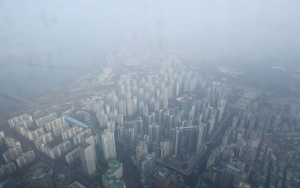
Rushed Announcement of Funding Support Policy
Execution Details Lack Completeness
Promise of 300 Billion Won Support for LCCs, KDB Has Not Implemented for a Month
[Asia Economy reporters Kangwook Cho, Hyunjung Kim (Sejong), Chulhyun Kim, Gimin Lee] In response to the spread of the novel coronavirus infection (COVID-19), the government has launched large-scale financial support targeting affected industries and companies, but the 'warmth of money (錢)' is not being properly delivered on the ground. While the government is accelerating policy announcements with amounts ranging from hundreds of billions to trillions of won, there are criticisms that the completeness of the detailed plans is lacking. In particular, since most of the risks associated with the support are borne by financial institutions, there are growing calls for additional government measures.
According to the business and financial sectors on the 26th, the support measures for COVID-19 affected industries and companies announced by the government one after another are not being properly executed at the frontline financial institutions. A representative example is the support for low-cost carriers (LCCs). The government announced on the 17th of last month that it would provide 300 billion won to the LCC industry, which was on the brink of a complete suspension of operations, but the Industrial Bank of Korea (IBK), the support entity, has not decided on the specific amount or timing even after a month. On the 17th of this month, it announced that it had completed 40 billion won in financial support to three companies including T'way Air, but some criticized this as mere showmanship unrelated to the government's promised 300 billion won support. Meanwhile, Eastar Jet became the first in the industry to enter a 'shutdown' on the 24th.
The controversy over unconditional unsecured operating fund support remains. Initially, it was known that emergency funds would be injected unsecured when the government announced support, but IBK's current support is a general corporate loan provided after its own screening. If collateral is provided, it is interpreted that loan conditions such as interest rates and repayment periods may be raised. Accordingly, LCC companies have issued urgent appeals requesting significantly relaxed conditions such as fully unsecured and long-term low-interest support.
IBK is also in a difficult position. This emergency support for LCC companies is being carried out independently by IBK without government contributions, and there are complaints that the government is setting the 300 billion won support and shifting the subsequent responsibility and criticism onto IBK. An IBK official who requested anonymity said, "It has not been policy-wise decided to be completely unsecured, but we are not demanding collateral from LCC companies," adding, "However, since we are supporting companies with which we have had no prior transactions using IBK funds without government contributions, we inevitably have to go through individual screening processes."
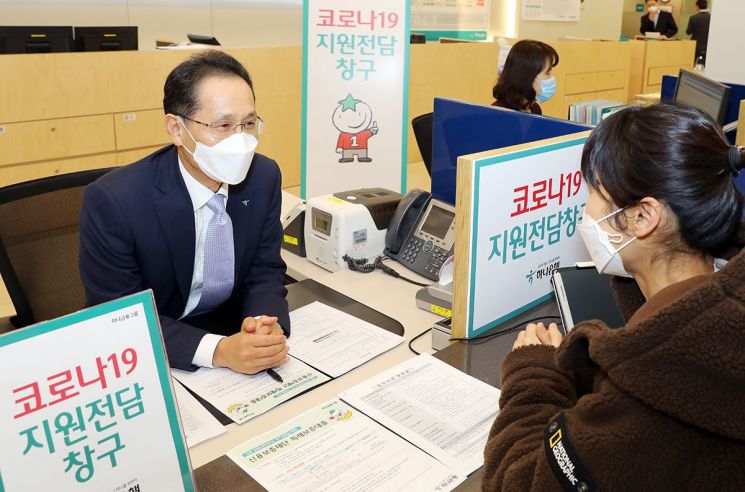
Recently, the government's unprecedented bond and securities market stabilization measures to quell financial market instability have raised concerns about the decline in capital adequacy ratios and increased losses for financial holding companies. In the case of the Stabilization Fund, financial holding companies argue that regulatory relief, specifically the easing of the Basel Committee on Banking Supervision (BIS) ratio, should come first. Under current regulations, investing 1 trillion won in the Stabilization Fund is subject to a 300% risk weight, which is considered to increase risk-weighted assets by 3 trillion won, leading to a decline in the BIS ratio, credit downgrades, and increased funding costs, forcing banks to increase their capital. Investments in affiliates such as securities and insurance companies, which are already challenging, also face a double burden.
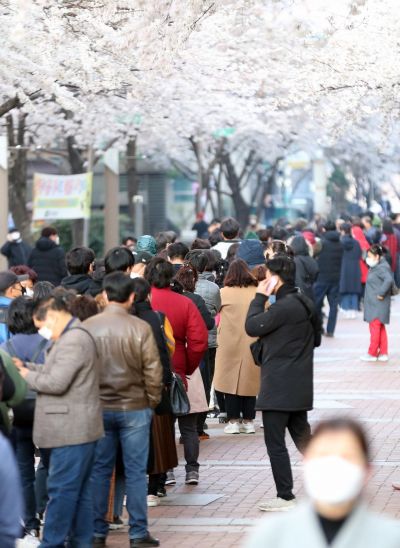
The actual execution speed of emergency loans for small and medium enterprises (SMEs) and ventures affected by COVID-19 is also slow. SMEs and small business owners complain that the process of receiving policy funds is complicated and time-consuming. Small business owners must first obtain a confirmation from the Small Enterprise and Market Service (SEMAS), then get a guarantee from the Credit Guarantee Foundation before applying for a loan at financial institutions. Due to the current influx of applications, waiting times have extended to 2-3 months. The poor linkage system and lack of personnel make even consultations difficult. The loan execution rate for loans passing through the Credit Guarantee Foundation under the small business management stabilization fund system remains in the 20% range. Given this situation, the reception for the pilot operation of direct loans for small business management stabilization funds, which started on the 25th, was crowded with small business owners seeking emergency loans from early morning. This system allows SEMAS regional centers to provide loans of up to 10 million won within five days without a guarantee.
Regarding this, Juwon Joo, head of the Economic Research Department at Hyundai Research Institute, emphasized, "Most of the current financial support is not funded by the government itself, so financial institutions bear the risk," adding, "There is a need to share the risk by providing guarantees in writing or other forms against future problems."
The industrial sector is demanding swift policy execution. Kim Muntae, head of the Economic Policy Team at the Korea Chamber of Commerce and Industry, pointed out, "At this point, there are parts that companies feel are insufficient," and stressed, "Rapid on-site application is necessary." A representative from the Federation of Korean Industries also said, "Although there was a recent announcement of emergency liquidity support measures covering companies of all sizes, since the speed of fund procurement is crucial, the fastest possible policy execution is needed for companies to feel the effects."
© The Asia Business Daily(www.asiae.co.kr). All rights reserved.
![User Who Sold Erroneously Deposited Bitcoins to Repay Debt and Fund Entertainment... What Did the Supreme Court Decide in 2021? [Legal Issue Check]](https://cwcontent.asiae.co.kr/asiaresize/183/2026020910431234020_1770601391.png)