Airlines Practically Shut Down, Eastar Jet Becomes First in Industry to Enter Shutdown
Large Corporations Also Appeal for Support Policies Amid Cliffhanger with Flexible Work Hours Extension and Investment Tax Credits
[Asia Economy Reporters Changhwan Lee, Jehun Yoo] The basic financial strength of major domestic companies is rapidly deteriorating due to the spread of the novel coronavirus infection (COVID-19). Cash inflows have completely stopped not only for small and medium-sized enterprises but also for large corporations, especially in industries directly hit by COVID-19 such as aviation, tourism, automotive, and distribution.
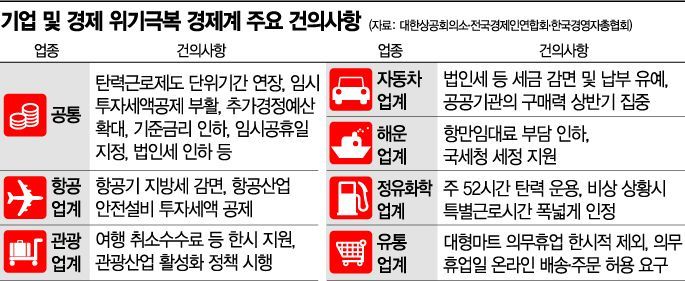
Companies unanimously agree that the government and political circles need to take more proactive and speedy 'targeted support' measures. There are urgent calls for effective policies such as extending the unit period of the flexible working hours system, reviving temporary investment tax credits, expanding supplementary budgets, and reducing corporate and inheritance taxes, as well as direct support like supplying cash liquidity.
◆Companies with weakened strength face real bankruptcy risks= According to the business community on the 23rd, the aviation industry is on the brink of collapse due to COVID-19. Most airlines have practically ceased operations as domestic and international routes have been suspended.
With flights halted and cash inflows cut off, they are facing liquidity crises. Low-cost carrier (LCC) Eastar Jet has taken the drastic measure of a shutdown due to a lack of immediate operating funds. Last month, the company paid only 40% of employees' wages, and the payment of wages for March and April remains uncertain.
The situation is no better for full-service carriers (FSCs). As of the 22nd, Korean Air and Asiana Airlines operated only 43 and 28 international flights respectively, compared to the same period last year, representing about a 70% decrease each.
Professor Hee-young Heo of Korea Aerospace University said, "I believe airlines, regardless of LCC or FSC, can only survive without cash inflows for about two months," adding, "The government should provide emergency funds directly to airlines and facilitate financing through payment guarantees."
The liquidity crisis in the shipping industry is also severe due to a significant drop in cargo volume caused by COVID-19. Heung-A Shipping, the fifth-largest domestic shipping company, entered a workout (corporate rehabilitation process) on the 10th. This is attributed to worsening management difficulties due to last year's US-China trade dispute and this year's COVID-19-induced economic downturn. The Baltic Dry Index (BDI), an indicator of shipping market conditions, hit its lowest point in four years this month.
The automotive industry is on high alert as the spread of COVID-19 intensifies in the US and Europe. Hyundai Motor Company has currently shut down factories worldwide, including in the US, Europe, and India, due to the impact of COVID-19.
The parts industry is in an even more critical state. The average operating rate of auto parts manufacturers is only around 50-70%. The problem is that if the COVID-19 situation continues for another month or two, there is a high possibility of a wave of bankruptcies among small and medium-sized enterprises with relatively poor cash flow.
The electronics industry is also shutting down overseas factories one after another. Samsung Electronics and LG Electronics' factories in India have stopped operations from today in accordance with government guidelines responding to COVID-19. Samsung Electronics also halted operations at its European factory in Slovakia last week.
Moreover, liquidity crises are spreading across industries and company sizes, including travel, tourism, distribution, petrochemicals, and electronics. A business community official said, "Large corporations are also struggling," adding, "If COVID-19 continues for several months, a wave of corporate bankruptcies will follow."
◆Business community: "Large corporations are struggling too; please actively extend flexible working hours and introduce investment tax credits" The business community is increasingly calling for more active support from the government and political circles to help Korean companies pushed to the brink.
The Korea Employers Federation (KEF) submitted 40 legislative improvement tasks related to the economy and labor to the National Assembly today, reflecting the demands of the business sector. KEF argued that to revitalize corporate vitality and enhance global competitiveness, the top corporate tax rate should be reduced to the OECD average of 22%. They also urged the abolition of the minimum corporate tax system, mandatory closure days for large supermarkets, and restrictions on online shopping business hours.
The Federation of Korean Industries (FKI) demanded the expansion of exceptions to the 52-hour workweek, extension of the flexible working hours system unit period, and revival of temporary investment tax credits. They requested labor flexibility so that companies expected to face production disruptions due to COVID-19 can respond more agilely to the crisis.
The Korea Chamber of Commerce and Industry (KCCI) strongly advocates for expanding the supplementary budget. They argue that the currently planned supplementary budget of 11.7 trillion won by the government is insufficient to overcome the economic crisis. The growth rate decline defense effect of 11.7 trillion won is only 0.2 percentage points, which is inadequate to prevent the expected economic growth rate decline of less than 1%.
Woo Tae-hee, head of KCCI's COVID-19 task force (executive vice president), said, "The economic shock of COVID-19 is very broad, severe, and prolonged," urging, "It is time to take bold measures such as interest rate cuts, revival of temporary investment tax credits, and expansion of supplementary budgets to provide swift support for overcoming corporate management difficulties and to get the stalled economy moving vigorously again."
© The Asia Business Daily(www.asiae.co.kr). All rights reserved.

















