[Monthly Defense Times Editor-in-Chief An Seung-beom] When thinking of the Air Force, various aircraft such as fighter jets, transport planes, early warning control aircraft, and aerial refueling tankers come to mind. However, to operate these aircraft, various support equipment is necessary. The Air Force operates numerous support equipment to assist its aircraft, including target drones, aircraft guidance vehicles, runway sweepers, and snow removal equipment. The equipment introduced here are support vehicles that work behind the scenes to ensure smooth operations and mission execution for our Air Force.
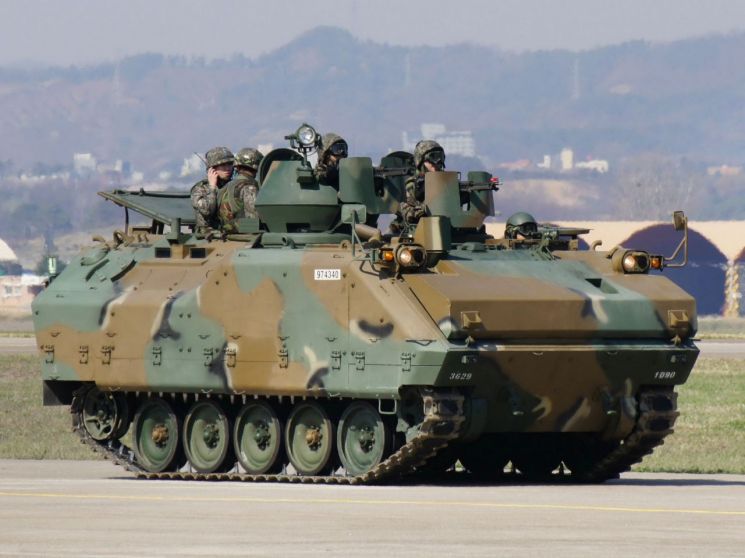
Due to runway protection concerns, the Air Force operated the wheeled KM900 armored vehicle for base defense, but as the equipment aged and replacement became necessary, there were no suitable replacement vehicles domestically. Therefore, in 1996, the military authorities initiated the "Air Force-type Combat Armored Vehicle" project. After competing with vehicles from three foreign companies, the tracked K200A1 armored vehicle, which was the only domestically produced armored vehicle at the time, was selected as the successor base defense armored vehicle and was deployed in 1997.
When the decision to adopt the K200A1 as the successor vehicle was first announced, there were concerns that the tracked armored vehicle might damage the runway. It was considered unsuitable as a base defense vehicle. Therefore, the Air Force-type K200A1 armored vehicle was designed with rubber pads on the tracks 1 cm thicker than those used by the Army and had the water wading cleats on the tracks removed to prevent runway damage.
The vehicle was equipped not only with the existing K6 50 caliber medium machine gun and one M60 machine gun but also added an M60 machine gun with ballistic plates on the rear hatch. It did not have smoke grenade launchers but was additionally equipped with a searchlight, side mirrors, turn signals, and communication headsets allowing all occupants to communicate, enhancing safety during base driving and convenience during operations.
The Air Force K200A1 armored vehicles were all produced from the start with the A1 specifications. Aside from the Air Force-specific features mentioned above, the basic specifications are the same as those of the Army and Marine Corps armored vehicles.
They are operated by the Military Police Battalion's Mobile Platoon or Combat Armored Vehicle Platoon at the air wings. Depending on the unit, the K6 medium machine gun may not be mounted. Instead, 2 to 3 M60 machine guns are installed.
Currently, the K200A1 armored vehicle is operating smoothly, contrary to initial concerns. The 1 cm thicker rubber pads on the tracks were later applied to the Army's K200 armored vehicles as well. However, tracked armored vehicles have limitations in rapid mobility within the base, leading to discussions about replacing them with wheeled vehicles.
© The Asia Business Daily(www.asiae.co.kr). All rights reserved.

















