[Asia Economy Honam Reporting Headquarters Reporter Park Seon-gang] Gwangju Metropolitan City announced on the 11th that it will revise the "Gwangju Metropolitan City Multi-family Housing Architectural Review Standards" to improve the uniform design of apartments and the high-rise, high-density screen-type apartments, and to create a safe and pleasant residential environment.
In the Gwangju area, apartments account for 66% of housing types, but so far, quantitative supply focused on economic efficiency has created a uniform residential environment with simple repetitive forms.
Accordingly, Gwangju City prepared improvement measures reflecting various opinions through seven advisory meetings with experts and chief architects, two rounds of opinion gathering from the city council, autonomous districts, and related associations, and three architectural committee reviews. The newly revised multi-family housing review standards will be announced in mid-March and will be implemented one month after the announcement date.
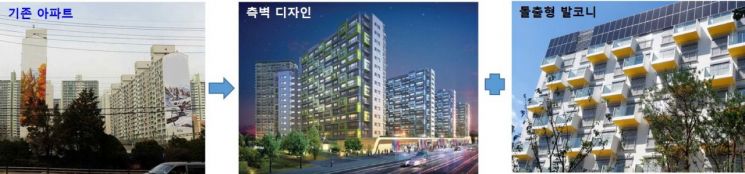
The revised review standards first improve the uniform apartment design.
The box-shaped flat facade form will be transformed by introducing three-dimensional design elements (protruding balconies, sidewall balconies, sidewall designs, etc.) to create diverse facade designs.
Also, depending on the scale of the complex, the form and number of floors of residential buildings will be diversified into 2 to 4 types, and differentiated specialized design residential buildings will be placed in complexes located on major gateway roads of Gwangju to create various skylines.
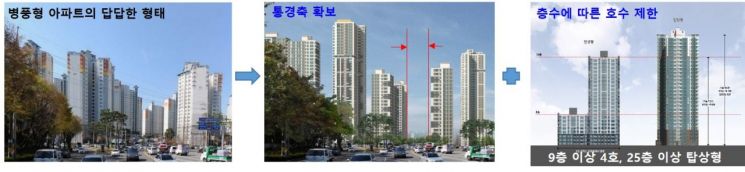
Second, improve high-rise, high-density screen-type apartments.
To relieve the feeling of confinement caused by high-rise, high-density slab-type apartments and secure views, the ratio of building facade area (facade shielding rate) will be limited, the number of units per floor will be limited to four, and for buildings over 25 floors, tower-type structures will be recommended to secure ventilation axes.
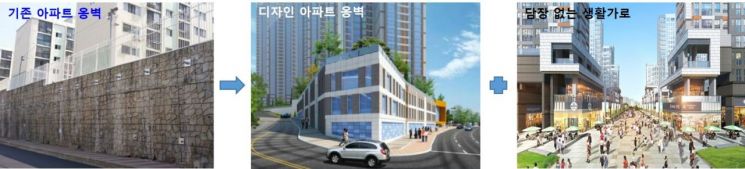
Third, improve isolated and closed apartments to connect with the surroundings.
Remove fences around complexes and create open complexes by placing commercial facilities and public open spaces to enable communication with the surroundings.
Additionally, retaining walls over 3 meters that create an oppressive feeling for pedestrians will be designed as decorative retaining walls or terraced retaining walls (flower beds).
Fourth, improve safety, barrier-free, and eco-friendly elements.
Universal design and crime prevention design will be mandated so that anyone, regardless of disability or age, can use the facilities comfortably and safely, and fire truck guidance routes will be installed to create a safe and comfortable residential environment.
In this regard, Gwangju City plans to apply green building design standards to promote eco-friendly and energy-saving designs.
In complexes adopting these standards, incentives will be provided to shorten the project approval period. In addition, if an apartment’s design is evaluated and recognized as an excellent design multi-family housing by the architectural committee, various reviews will be integrated and operated.
Kim Jong-ho, head of the Architecture and Housing Division of the city, said, “With the revision of the multi-family housing architectural review standards for the first time in over 10 years, the apartment supply policy focused on development is expected to shift to an apartment policy for citizens and residents,” adding, “As apartment designs change dramatically, the cityscape will improve, and citizens will be able to live in a more comfortable and safe residential environment.”
© The Asia Business Daily(www.asiae.co.kr). All rights reserved.



















