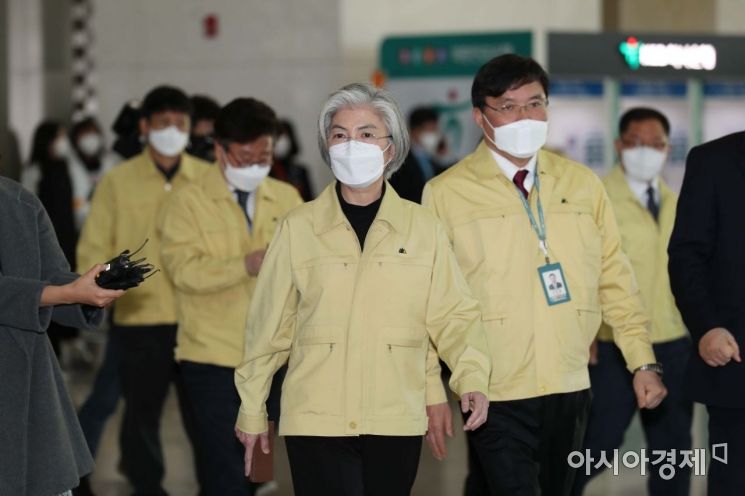
 Foreign Minister Kang Kyung-wha is moving on the 5th to meet the rapid response team formed to support Korean nationals quarantined in Vietnam due to COVID-19 prevention measures at Terminal 1 departure hall of Incheon International Airport. / Photo by Moon Ho-nam munonam@
High Dependence on Japanese Parts and Equipment
Concerns Over Loss of Competitiveness in Next-Generation Fields
[Asia Economy Reporter Park Soyeon] As South Korea and Japan strengthened entry restrictions against each other starting from the 9th, citing the response to the novel coronavirus infection (COVID-19), the entry of essential Japanese technical personnel required for operating domestic manufacturing production lines has effectively been halted. Given the high dependence of Korean industries on Japanese parts and equipment, the expansion of entry restrictions raises concerns that it could severely undermine the global competitiveness of Korean companies in core fields such as next-generation semiconductors.
According to industry sources, major domestic companies such as Samsung, SK, and LG are deeply worried about potential disruptions in the introduction of new essential Japanese equipment and its maintenance and repair due to the mutual entry restrictions between Korea and Japan. Experts are particularly concerned about the normal operation of Samsung Electronics’ next-generation semiconductor production line using extreme ultraviolet (EUV) lithography, which is critical in the technology leadership and order competition with Taiwan’s TSMC. While the EUV lithography equipment, a core component of the EUV process, can be replaced by Dutch-made equipment without major issues, other essential equipment such as the EUV mask defect inspection device, pre- and post-exposure coating apparatus, and impurity removal cleaning devices are Japanese-made and difficult to substitute.
Major electronics conglomerates and their partners plan to handle urgent tasks through the Korean branches of Japanese companies, but they are also preparing contingency plans in case the situation prolongs. Last year, Japan accounted for 33.8% of the total imports of semiconductor manufacturing equipment. Especially in core semiconductor and display equipment, many are Japanese-made, and initially, engineers need to visit factories to conduct testing and adjustments.
However, going forward, Japanese technical personnel entering Korea must undergo special entry procedures, and when returning to Japan, they must quarantine for 14 days, making it difficult to deploy Japanese technicians within Korea. This situation is the same for machine tool sectors (machines that manufacture machines or machine parts) with high dependence on Japanese core components such as numerical control panels. If the Korean government takes countermeasures and the standoff between Korea and Japan prolongs, it is highly likely to become a serious negative factor for the entire domestic manufacturing industry, following last year’s Japanese export restrictions on core semiconductor and display items.
Lee Ji-pyeong, a Japan expert and full-time advisory committee member at LG Economic Research Institute, said, "There are several devices in the next-generation semiconductor production technology EUV process that are impossible to operate without Japanese technicians." He added, "Installation and maintenance must be performed, and if difficulties arise due to entry restrictions, it will have a significantly negative impact on the global competition in the time-sensitive next-generation semiconductor field." Lee also noted, "Small and medium-sized enterprises and all industries have a high dependence on Japanese machinery, so if personnel exchanges are blocked, problems could immediately arise at industrial sites."
© The Asia Business Daily(www.asiae.co.kr). All rights reserved.
![Clutching a Stolen Dior Bag, Saying "I Hate Being Poor but Real"... The Grotesque Con of a "Human Knockoff" [Slate]](https://cwcontent.asiae.co.kr/asiaresize/183/2026021902243444107_1771435474.jpg)















