OPEC+ Agreement Fails, Saudi Arabia Decides to Increase Production Instead of Cutting
Interpreted as Saudi Arabia's Retaliation Against Russia
Questions Arise Over Saudi Arabia's Ability to Handle Low Oil Prices
[Asia Economy Reporter Naju-seok] "This year, oil prices will head toward $20."
Signs of a 'chicken game' are emerging in the crude oil market. As oil-producing countries failed to reach a production cut agreement, the possibility of increased production led by Saudi Arabia has grown. Accordingly, the forecast that oil prices will slump to the $20 per barrel range within the year is gaining traction.
On the 8th (local time), according to CNBC, Ali Khederi, who previously advised on Middle East affairs at ExxonMobil, said after hearing the news of the failed production cut agreement at the OPEC+ meeting held in Vienna, Austria, "(This failure) has significant geopolitical implications," adding, "Oil prices will plunge to the $20 per barrel range."
OPEC had been pushing for a production cut of 1.5 million barrels per day in response to the global demand decline caused by COVID-19. However, the oil market showed a sharp decline as Russia did not agree to the cuts within OPEC+.
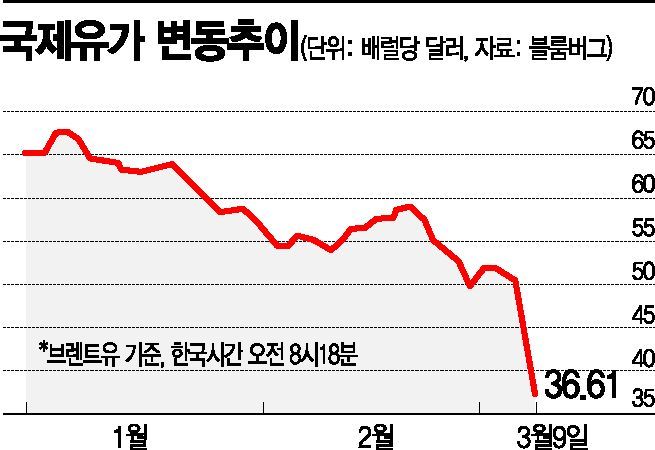
In particular, when Saudi Arabia's state-owned oil company Aramco announced it would increase its daily crude oil production from the current 9.7 million barrels to 10 million barrels starting next month, oil prices plummeted by more than 20%, marking the largest drop since the Gulf War. When analyses suggested Saudi Arabia could increase daily production to 12.5 million barrels, Brent crude fell to $35.72 per barrel (10 a.m. Korean time on the 9th).
Some analysts suggest that, having failed to stabilize prices through production cuts, oil-producing countries are trying to meet fiscal needs by selling more oil. Saudi government officials stated in media interviews, "Why should only Saudi Arabia cut production when other countries are not?" and "Saudi Arabia has the right to sell more to compensate for losses caused by the oil price decline."
However, considering the oversupply situation, the analysis that this is a move to punish Russia gains credibility. It is seen as an exertion of power to break the previously stable oil supply and demand system. The opposition to production cuts by Russia is believed to have political motives. Russia initially opposed the cuts to damage the U.S. economy. The U.S. produces oil and natural gas through shale, and by triggering an oil price war, Russia aims to push the industry to its limits and cause its collapse. In fact, Russia's state-owned oil company Rosneft pointed out, "Every time OPEC+ decides to cut production, U.S. shale companies have replaced the market."
There are also forecasts that Saudi Arabia will eventually abandon the plan to increase production, as it may not withstand low oil prices. Adam Crisafulli, founder of Vital Knowledge, noted, "Saudi Arabia's government, which needs high oil prices to balance its budget, cannot endure low prices." He added, "Now that Aramco is publicly listed, the Saudi government will also be cautious about oil prices falling below $30 per barrel."
On the 8th, Aramco's stock price fell to 30 riyals, below the IPO price of 32 riyals, for the first time since the public offering.
Ultimately, there is also analysis that Saudi Arabia and Russia will find a compromise. Ihab Kamel, a crisis management consultant at Eurasia Group, said, "The most likely outcome after the OPEC+ agreement failure is a limited oil price war before Saudi Arabia and Russia find a compromise," adding, "The probability of reaching an agreement is over 60%."
© The Asia Business Daily(www.asiae.co.kr). All rights reserved.
![Clutching a Stolen Dior Bag, Saying "I Hate Being Poor but Real"... The Grotesque Con of a "Human Knockoff" [Slate]](https://cwcontent.asiae.co.kr/asiaresize/183/2026021902243444107_1771435474.jpg)















