Operation Plan for 'Seoul-si Quarantine Supplies Task Force' to be Announced on the 8th
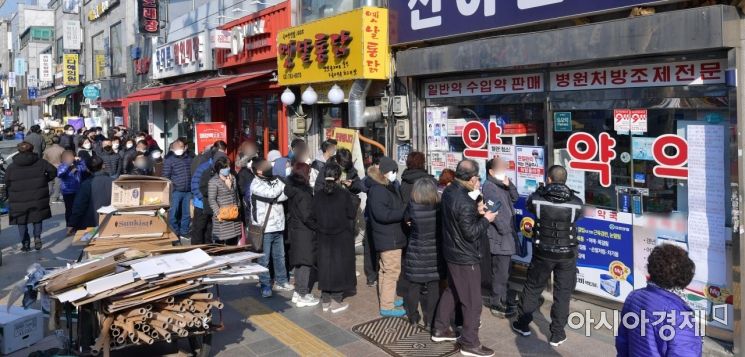 On the 6th, citizens lined up at a pharmacy near Jongno 5-ga, Seoul, to purchase masks. From this day onward, a duplicate purchase verification system has been established at pharmacies nationwide, requiring customers to present identification to buy masks. The purchase limit per person has been reduced from 5 masks to 2 masks. Photo by Kim Hyun-min kimhyun81@
[Asia Economy Reporter Kim Ji-hee] The Seoul Metropolitan Government is launching a support project to deliver 15,000 masks to vulnerable groups such as residents of jjokbangchon (small-room villages) who have difficulty purchasing masks due to the spread of the novel coronavirus infection (COVID-19). Additionally, it will develop alternative filters and produce masks using them to resolve the shortage of MB filters, which hinders the increase in mask production.
Seoul announced the operation plan for the "Seoul Metropolitan Government Quarantine Supplies Countermeasures Headquarters" on the 8th, which is based on these measures. The countermeasures headquarters will be composed of five divisions and six task forces, with the Deputy Mayor for Administration 2 serving as the head. Through this, the city plans to establish a system to directly secure and supply quarantine supplies in preparation for the prolonged COVID-19 situation.
First, the city will start the "Visiting Mask Support Project" targeting vulnerable groups who have difficulty purchasing masks. Seoul Metropolitan Government, the Seoul branch of the Korean Red Cross, and the Jjokbang Counseling Center will directly visit five jjokbangchon areas, including Donui-dong and Changsin-dong, to deliver a total of 15,000 masks to 3,085 people. They will also provide 46,000 masks to mobile worker organizations such as Rider Union and Quick Service Labor Union.
To support the purchase of quarantine supplies in the public sector, a Quarantine Supplies SOS Center has been established, and supplies will be distributed according to the priority of stockpile quantities upon SOS requests. The plan is to conduct relay or purchase agency services using the quantities from partner companies currently supplying the city.
Furthermore, the city is promoting the production of masks with replaceable filters by utilizing sewing companies located in Seoul. Since domestic mask production faces limitations in increasing quantities due to the shortage of MB filters, the city has begun developing mask filters that can serve as alternatives. The Seoul Institute of Technology is discovering alternative filters, and the Health and Environment Research Institute is verifying their effectiveness by experimenting with various raw materials.
If the effectiveness of the alternative filters is verified and sufficient raw materials are secured, production of masks with replaceable filters will begin at sewing factories located in Seoul.
If existing general sewing companies wish to switch their business to manufacturing health masks, the city will support manufacturing equipment. Companies that can secure installation space for additional manufacturing equipment will be prioritized, and the quantities produced with the supported equipment will be supplied to public supply sources such as the Seoul Metropolitan Government.
The city will also support social enterprises producing health masks. Currently, two locations in Seoul, Gangseo-gu and Yeongdeungpo-gu, are producing health masks. The city plans to increase production by supporting production personnel and will also support existing social enterprises that wish to transition to mask manufacturing.
Kim Hak-jin, Director of the Seoul Metropolitan Government Safety General Office, said, "We will continuously carry out the visiting mask support project focusing on vulnerable groups who have difficulty obtaining masks," and added, "We will produce and distribute cloth masks at sewing factories and strive to prepare countermeasures such as developing alternatives to MB filters."
© The Asia Business Daily(www.asiae.co.kr). All rights reserved.
![Clutching a Stolen Dior Bag, Saying "I Hate Being Poor but Real"... The Grotesque Con of a "Human Knockoff" [Slate]](https://cwcontent.asiae.co.kr/asiaresize/183/2026021902243444107_1771435474.jpg)















