Pet Dog of COVID-19 Patient in Hong Kong 'Infected'
Experts: "Detection of Virus in Hong Kong Pet Dog Is Too Early to Discuss Infection"
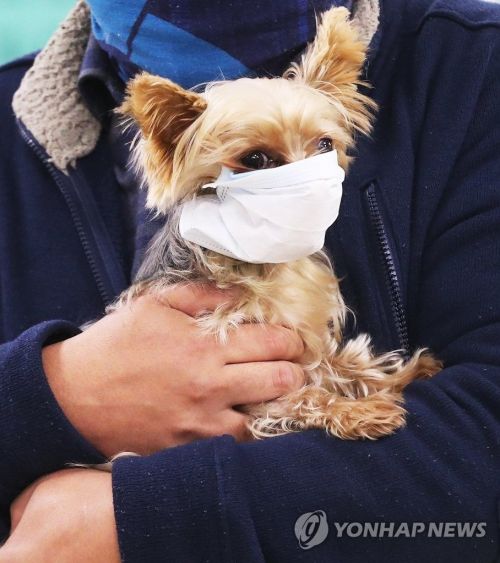 Due to concerns over the spread of the novel coronavirus infection (COVID-19), on the morning of January 28, a dog wearing a mask was held in its owner's arms at Pyeongtaek Port International Passenger Terminal in Poseung-eup, Pyeongtaek-si, Gyeonggi-do.
 Photo by Yonhap News
[Asia Economy Reporter Suwan Kim] Anxiety among pet owners is growing as it has been officially confirmed that a pet dog of a COVID-19 patient in Hong Kong has been infected with the novel coronavirus (COVID-19).
According to the South China Morning Post and foreign media on the 5th, Hong Kong authorities announced that they officially confirmed that a pet dog, which showed a weak positive reaction in a COVID-19 test last month, was infected with COVID-19.
According to reports, Hong Kong authorities explained that this pet dog is expected to be recorded as the first case of COVID-19 transmission between humans and animals.
Sophia Chan, Hong Kong Secretary for Health, said at a regular COVID-19 briefing, "(The dog) tested positive and is infected, so it is in quarantine. Additional tests will be conducted, and the quarantine will not be lifted until a negative result is confirmed."
Earlier last month, the Hong Kong Agriculture, Fisheries and Conservation Department announced that a pet dog owned by a COVID-19 patient showed a 'low level' in virus testing. The dog was quarantined on the 28th of last month and is reported to show no symptoms.
However, it is unclear whether the pet dog was actually infected with COVID-19 or if its mouth and nose were contaminated by the surrounding environment, so the dog has been quarantined in a separate facility for further testing.
Because the exact infection route of the pet dog's COVID-19 infection has not been revealed, pet owners' anxiety is increasing. Especially, the World Health Organization (WHO) previously stated that there is no evidence yet that pets such as dogs and cats can be infected with COVID-19. WHO recommends caution in contact with pets and washing hands thoroughly with soap after contact, although evidence of pets being infected is not yet clear.
As a result, pet owners living with their pets are expressing anxiety. This is because unavoidable situations arise where they must go out with their dogs, such as for walks or visits to the hospital.
 Citizens are taking a walk with their pets at World Cup Park in Mapo-gu, Seoul.
 Photo by Yonhap News
B (28), an office worker who owns a 10-year-old dog, said, "Because the dog I am raising is elderly, more special care is needed," and added, "I hope measures will be established as soon as possible."
Another pet owner in their 50s, C, said, "I feel that I need to be more careful," and pointed out, "Since I can't avoid going out for walks, shouldn't the price of dog masks be lowered?"
Experts point out that the detection of the virus in the Hong Kong pet dog is an early case to discuss infection.
Professor Daeseop Song of Korea University College of Pharmacy (PhD in Virology and Veterinary Medicine) said on MBC Radio's 'The World and Us,' "The positive case in the Hong Kong pet dog has caused a lot of controversy and concern in the veterinary community," adding, "A very low level of positive virus was detected. It is too hasty to conclude that the virus was transmitted from humans to pets, and unless there are multiple consecutive pet cases, it is still too early to discuss infection in pets."
Professor Song added, "Even if infected, there have been cases in the past, such as SARS, where the virus was not transmitted to other pets at a level that could spread," and "I think we need to be very cautious about overinterpreting the fact that the virus was weakly detected in pets."
On the 3rd (local time), CNN in the United States also reported that the possibility of 'animal infection' with COVID-19 is unlikely amid controversy over a pet dog of a COVID-19 patient in Hong Kong testing positive for the virus.
CNN cited analyses from multiple experts, stating, "The idea that pets can be vectors of COVID-19 infection is close to speculation."
It continued, "While a pet dog may test positive for the virus, that does not necessarily mean it is infected," and pointed out, "Even if dogs or cats are not actually infected with COVID-19, the virus can exist on the surface of these animals."
© The Asia Business Daily(www.asiae.co.kr). All rights reserved.
![Clutching a Stolen Dior Bag, Saying "I Hate Being Poor but Real"... The Grotesque Con of a "Human Knockoff" [Slate]](https://cwcontent.asiae.co.kr/asiaresize/183/2026021902243444107_1771435474.jpg)
















