Deterioration of Japan Trade Relations and COVID Impact Cause Sharp Decline in China Exports
Consumption Slumps as Culture of Avoiding Company Dinners Spreads Domestically
KOFA Partners with Sajo and Dongwon for Half-Price Discounts at Marts and Department Stores
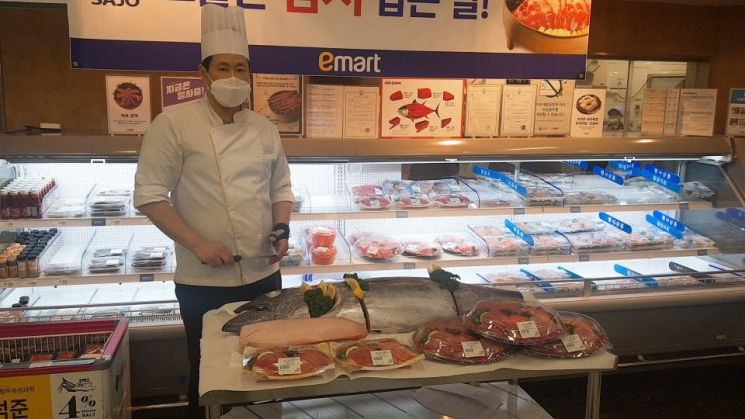
[Asia Economy Reporters Choi Saeng-hye, Cha Min-young] The distribution industry has stepped up efforts to save tuna, whose export route to Japan has been blocked due to the novel coronavirus disease (COVID-19). According to related industries on the 6th, ahead of Tuna Day on the 7th, special corporations such as the Korea Overseas Fisheries Association (KOFA), offshore shipping companies including Dongwon Industries and Sajo Seafood, and distribution companies like E-Mart have launched campaigns to boost tuna consumption. Tuna Day is a day designated by the Ministry of Oceans and Fisheries and the Korea Overseas Fisheries Association to promote seafood sales.
◆Export routes blocked and consumption shrinking= The distribution industry has conducted marketing campaigns every year targeting Tuna Day to encourage consumption, but this year’s situation is exceptional. First, since July last year, trade relations with Japan deteriorated, causing export volumes to decline, and exports to China also plummeted due to the impact of COVID-19. According to the Ministry of Oceans and Fisheries, from January 1 to February 25, seafood export value was $305 million (approximately 361.3 billion KRW), down 13.8% compared to the same period last year. In particular, exports to China, where COVID-19 first emerged, dropped by 38.5%. This was due to customs and logistics disruptions and reduced consumption.
Total tuna exports decreased by 6.2% compared to the same period last year. Since last month, as domestic COVID-19 cases surged, Japan banned truck combined transport (a method of loading cargo onto trucks and shipping them without vehicle changes) due to the high risk of transmission, leading to a decline in exports to Japan. Korea’s tuna export value to Japan has been continuously decreasing since July last year. According to the Korea Customs Service, tuna export volume to Japan fell by 31.3% in August and 33.1% in September compared to the previous year. Although the decline seemed to slow after October, it expanded again to 24.8% in January this year amid the spread of COVID-19. Since tuna is distributed in a frozen state, if it is not sold within the expiration period, it must be discarded entirely. Consumption is not proceeding smoothly due to the spread of a culture of refraining from gatherings amid COVID-19 concerns, not only in Japan, the main consumer country, but also domestically.
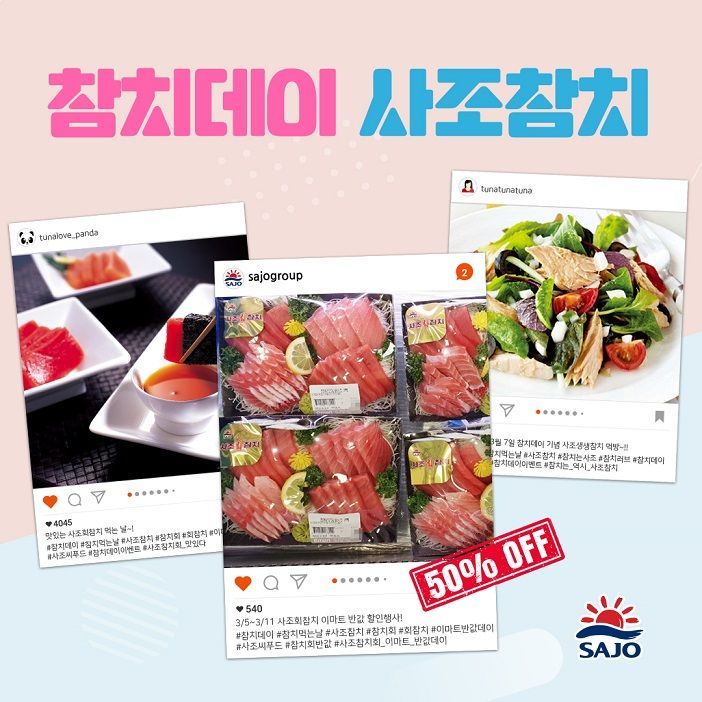
◆Government and distribution industry saving tuna= The government is supplying emergency management funds to the fisheries industry and strengthening support for non-face-to-face marketing such as online, television, and delivery apps, focusing on the U.S., China, Japan, and ASEAN markets. KOFA is also conducting tuna promotion events through department stores and large supermarkets for a week from the 5th to the 11th, together with offshore shipping companies like Dongwon Industries and Sajo Seafood to help tuna fishermen in difficulty.
Sajo Seafood is holding a "half-price tuna event," selling sashimi-grade bigeye tuna (around 360g) for 14,900 KRW at 66 E-Mart stores (including Seongsu, Yongsan, Jayang, Sanbon, and Seongnam branches). Dongwon Industries is selling the same product at 55 E-Mart stores (including Yeongdeungpo, Gayang, Cheonggyecheon, Gimhae, and Changwon branches) during the same period. In January, E-Mart sold the same weight of tuna sashimi at double the price of 29,800 KRW. The volume of tuna sold at E-Mart is a record high of 35 tons.
Additionally, Dongwon Industries is offering sashimi-grade tuna at a 30% discount at 10 Hyundai Department Store branches (Main, Trade, Mokdong, Cheonho, Mia, Jungdong, Sinchon, Kintex, Pangyo, and D-Cube branches), and Sajo Seafood is doing the same at Shinsegae Department Store (Gangnam and Centum branches) from the 6th to the 8th.
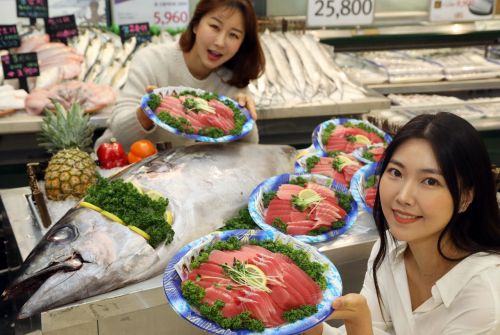
◆Full force on '○○ Day' marketing= Due to the impact of COVID-19, as social distancing has become full-scale and the number of telecommuters has increased, the distribution industry is putting all its efforts into 'Day Marketing.' It is difficult to attract customers without a '○○ Day.' For example, on March 3, 'Samgyeopsal Day,' the distribution industry enjoyed marketing effects for the first time in a while by selling samgyeopsal (pork belly) at a dramatic discount amid rapidly declining consumption. Market Kurly’s sales of products related to the 'Our Pork Week' event increased by 168% compared to the same period the previous week from February 28 to March 5. At E-Mart, samgyeopsal sales during the marketing period increased by 13.5% compared to the same period last year, and at Hanaro Mart Yangjae Nonghyup branch, samgyeopsal sales rose by 13% compared to the previous week. Along with samgyeopsal, sales of vegetables for wraps, various sauces, and convenience foods also increased, raising the distribution industry’s expectations for 'Tuna Day.'
© The Asia Business Daily(www.asiae.co.kr). All rights reserved.
![Clutching a Stolen Dior Bag, Saying "I Hate Being Poor but Real"... The Grotesque Con of a "Human Knockoff" [Slate]](https://cwcontent.asiae.co.kr/asiaresize/183/2026021902243444107_1771435474.jpg)

















