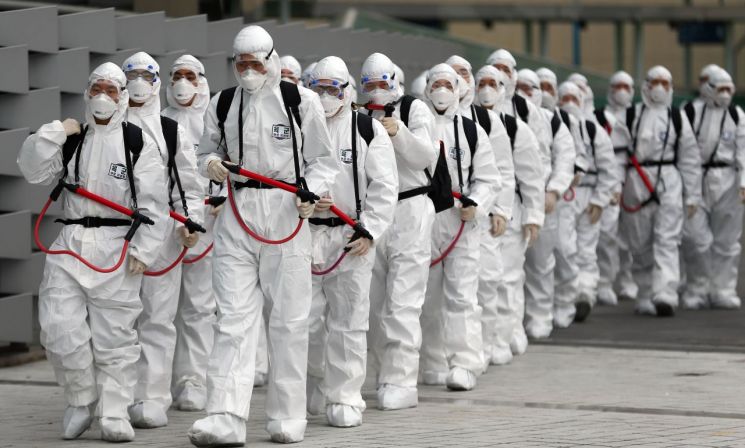
[Asia Economy Reporter Park So-yeon] Starting from the 2nd of next month, employees at POSCO Center, the headquarters of POSCO, will implement shift work to prevent the spread of the novel coronavirus infection (COVID-19). This is a very unusual measure for POSCO, a key industry company known for maintaining a conservative corporate culture.
Major companies have introduced remote work or flexible commuting hours to prevent damage caused by the spread of COVID-19.
Although these are preemptive measures to avoid business site paralysis, they differ from the past culture that emphasized attendance.
Companies that have already promoted flexible work environments by introducing shared seating systems and remote work systems seem to be better prepared and have responded quickly this time.
Some companies have all employees working remotely, and even if the office is closed, there is little noise.
However, small and medium-sized enterprises without a proper foundation are struggling and find it difficult to respond. In some cases, forced use of annual leave has caused backlash.
Hyundai and Kia Motors have started voluntary remote work for employees working in Seoul and Gyeonggi areas, including headquarters, from the 27th. This will last until the 6th of next month for now.
Hyundai Mobis, an affiliate, divides general employees in half and implements alternate-day remote work. This is the first time since its founding, and it did not happen during SARS (Severe Acute Respiratory Syndrome) or MERS (Middle East Respiratory Syndrome).
SK Group has started remote work from the 25th at SK Inc., SK Innovation, SK Telecom, SK E&S, SK Networks, SK Siltron, etc., excluding essential personnel. SK Hynix granted special leave for two weeks until the 8th of next month to pregnant employees.
Samsung Group allows pregnant employees to work remotely at all affiliates until the 1st of next month.
LG Group allows pregnant employees to work remotely without a fixed period and permits employees with young children to use care leave.
Also, each affiliate sets the period and form according to their circumstances, and LG Sangsa has 90% of its headquarters employees working remotely from the 27th until the 4th of next month.
Lotte Holdings will implement remote work for three weeks from the 27th until the 18th of next month. Teams are divided into three groups, with two-thirds of each team coming to the office.
Korean Air will also implement remote work from the 27th until the 4th of next month. It is mandatory for pregnant employees and voluntary for general employees.
Doosan Group will expand flexible work systems such as voluntary commuting hours until the 6th of next month and encourage remote work where possible. Pregnant employees and those with underlying conditions are already working remotely.
Hyundai Engineering will have all headquarters employees work remotely voluntarily from today until March 6th.
Hyundai Construction is reviewing remote work for pregnant employees, staggered commuting, and flexible lunch hours.
GS Construction will divide employees into two groups and stagger commuting from the 27th. Pregnant employees and those who need to care for young children will be allowed to work from home upon application.
Daelim Industrial has started remote work for pregnant employees from the 25th. Meetings are also conducted using messenger or video systems as much as possible.
Shinhan Bank started remote work at the headquarters by forming groups of 4 to 5 people, and Kookmin Bank will have about 15% of headquarters employees working remotely from the 27th.
Gas Corporation, headquartered in Daegu, instructed employees living outside Daegu not to return to headquarters and to work remotely for about two weeks starting the 24th. Employees working in nearby areas will also work remotely for the time being. Production and supply headquarters field workers are divided into two groups to reduce infection risk and work remotely.
The IT industry is also quick to experiment with work systems. Naver has all employees working remotely except essential personnel, and Kakao is also working remotely.
Some game companies are even taking days off. NCSoft will have all employees on paid leave from the 27th until March 2nd, and Smilegate will have all employees on paid leave for three days in the first week of March.
Additionally, game companies such as Nexon, Netmarble, NHN, Pearl Abyss, Wemade, and Com2uS are operating remote work systems.
In the distribution industry, Lotte Homeshopping, GS Homeshopping, and CJ O Shopping are implementing full remote work except for essential personnel for the time being.
11st allows all pregnant employees to work remotely until the first week of March and permits employees who need to care for family due to school delays to work remotely until school resumes. General employees can also work remotely until the 28th if they wish.
© The Asia Business Daily(www.asiae.co.kr). All rights reserved.
![Clutching a Stolen Dior Bag, Saying "I Hate Being Poor but Real"... The Grotesque Con of a "Human Knockoff" [Slate]](https://cwcontent.asiae.co.kr/asiaresize/183/2026021902243444107_1771435474.jpg)
















