[Asia Economy (Suwon) = Reporter Lee Young-gyu] Gyeonggi Province conducted an urgent full-scale survey of 33,809 Shincheonji Church of Jesus followers in the province, confirming that 740 individuals showed symptoms of the novel coronavirus infection (COVID-19).
Considering that 80% of symptomatic Shincheonji followers in Daegu were confirmed positive, the province judged the situation as "serious" and decided to focus all efforts on securing available hospital beds and medical personnel in preparation for a large-scale outbreak of confirmed cases.
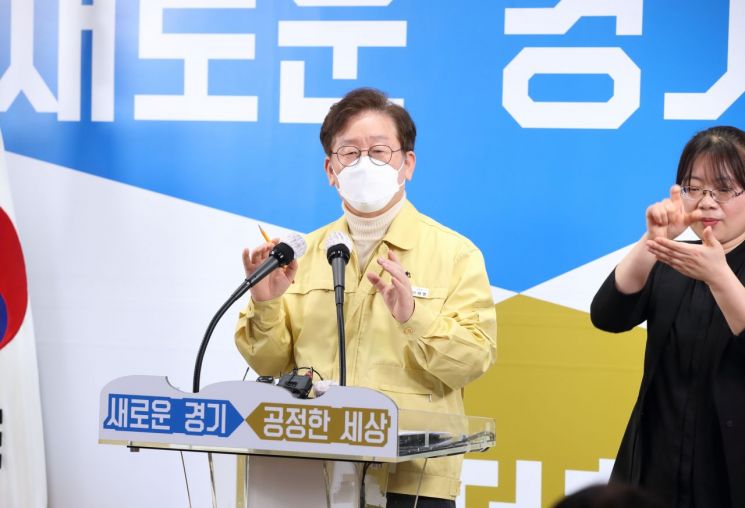
On the 28th, Gyeonggi Governor Lee Jae-myung held an emergency press conference at the Gyeonggi Provincial Government Office in Suwon, revealing the results of the full survey of Shincheonji followers obtained by the province and explaining the province's response plan.
Earlier, on the 25th, through a forced epidemiological investigation of the Shincheonji headquarters in Gwacheon, the province secured a list of 33,582 Shincheonji followers in the province, 9,930 attendees of the Gwacheon worship service on the 16th, and 22 residents who attended the Daegu gathering.
The province conducted an urgent full survey over two days, on the 26th and 27th, targeting a total of 33,809 individuals after excluding duplicates and residents from other regions from the list and additional lists received from the Korea Centers for Disease Control and Prevention (KCDC).
Among them, the survey was completed for 30,814 individuals, excluding 2,995 who had no contact information or could not be reached. The survey identified 740 symptomatic individuals.
This corresponds to 2.4% of those surveyed. Among them, 356 attendees of the Gwacheon worship service accounted for 46.7% of the symptomatic individuals. By age group, those in their 20s and 30s numbered 466, making up 63% of all symptomatic individuals.
Among 84 people tested by the 27th, 5 had already been confirmed positive.
Notably, while the KCDC reported 20 Shincheonji followers as Daegu visitors, the province's forced investigation identified 22 Daegu visitors, who were completely different individuals from the 20 reported by the KCDC. Nearly 20% of these, 6 individuals, were symptomatic.
The province has taken measures to ensure all symptomatic individuals undergo infection testing. Even if test results are negative, they will maintain self-quarantine for 14 days. The remaining followers will be subject to active monitoring for 14 days.
Additionally, the 2,995 followers who could not be contacted by the 27th are being re-surveyed. Among them, 1,702 have contact information but could not be reached, and 1,035 have newly obtained contact information and are being contacted.
For 258 followers who are unreachable due to incorrect numbers and those still unreachable as of this day, the province has requested police cooperation to locate them.
Among the Shincheonji followers who responded to the full survey, 15 reported overseas travel history, including 3 to China and 2 to Japan. However, the province suspects that some may not have truthfully disclosed their overseas travel history and plans to request immigration records from the Ministry of Justice.
Governor Lee said, "Considering that about 80% of symptomatic Shincheonji followers in Daegu were confirmed positive, it is a very serious situation where more than 600 confirmed cases could occur among Shincheonji followers residing in Gyeonggi Province alone," emphasizing, "Immediate judgment and response are most important," and explained the province's future response measures.
The province will relocate the Gyeonggi COVID-19 Emergency Response Team office, currently operating within the Disaster Headquarters, next to the governor's office. This is to enable the fastest decision-making on expert opinions collected and immediate reflection on the field.
Since recognizing the large-scale Shincheonji worship service held in Gwacheon on the 16th, the province has been focusing all efforts on securing available hospital beds and medical personnel in preparation for a large-scale outbreak of confirmed cases.
Currently, there are a total of 100 negative pressure isolation beds in the province: 24 beds in tertiary general hospitals and 76 beds at Gyeonggi Medical Center. Among these, 40 beds are occupied by confirmed patients, and 60 beds are currently available. Among the hospitalized patients are 3 severe cases from Daegu and Gyeongbuk regions. Earlier, Daegu Mayor Kwon Young-jin called Governor Lee to request hospital admission for mild patients, but Governor Lee conveyed that while severe patients would be accepted, mild patients would be difficult to accommodate.
The province plans to expand negative pressure isolation beds to 161, including 124 at Gyeonggi Medical Center and 13 at Seongnam Medical Center. To expand negative pressure isolation rooms, a budget of 700 million KRW will be invested to purchase and install 243 mobile negative pressure devices and 32 screen doors.
For general hospital beds, 270 beds have been secured at Gyeonggi Medical Center. In preparation for a large number of patients, the province plans to secure additional beds through cooperation with private medical institutions. Plans are also underway to secure beds by utilizing the Gyeonggi Human Resources Development Institute and idle facilities within the province.
Hospital beds will be allocated and patients admitted according to the medical risk level of confirmed patients. Severe patients will be prioritized for isolation treatment at tertiary general hospitals. Moderate patients, the second priority, will receive negative pressure isolation treatment at seven Gyeonggi Medical Center hospitals. Mild patients will be admitted to single rooms in general wards of medical centers if negative pressure isolation beds are insufficient. However, if a patient's condition worsens, they will be promptly transferred to tertiary general hospitals for treatment.
Additionally, the soon-to-be-opened Seongnam Medical Center will operate as a specialized treatment hospital for vulnerable groups such as infants, pregnant women, and dialysis patients.
The province will also establish large-scale screening clinics. Due to the rapid increase in the number of people to be tested, drive-through screening clinics will be set up, one each in southern and northern Gyeonggi. For cities and counties wishing to establish additional clinics, the province will support 50% of the installation costs.
The province will also focus on securing reserve medical personnel through volunteer centers and medical-related organizations. As the demand for COVID-19-related medical care increases, potentially affecting emergency medical treatment, the province plans to consider forming an emergency medical council to ensure no gaps in medical services.
Governor Lee stated, "How we respond in the coming days will determine the outcome of the fight against the infectious disease," urging, "Religious facilities, including churches, should refrain from gatherings until the situation calms down, and residents should pay attention to personal hygiene with the mindset of protecting themselves, their families, and neighbors."
He added, "Until the day we report victory to the residents, I will fulfill my given responsibilities with an unwavering attitude."
© The Asia Business Daily(www.asiae.co.kr). All rights reserved.
![Clutching a Stolen Dior Bag, Saying "I Hate Being Poor but Real"... The Grotesque Con of a "Human Knockoff" [Slate]](https://cwcontent.asiae.co.kr/asiaresize/183/2026021902243444107_1771435474.jpg)















