WTI Intraday Drops to $45.88 per Barrel
Weakness Expected to Continue Due to Sluggish Demand in China
Losses Increase with Every Sale... Direct Hit to Shale Companies
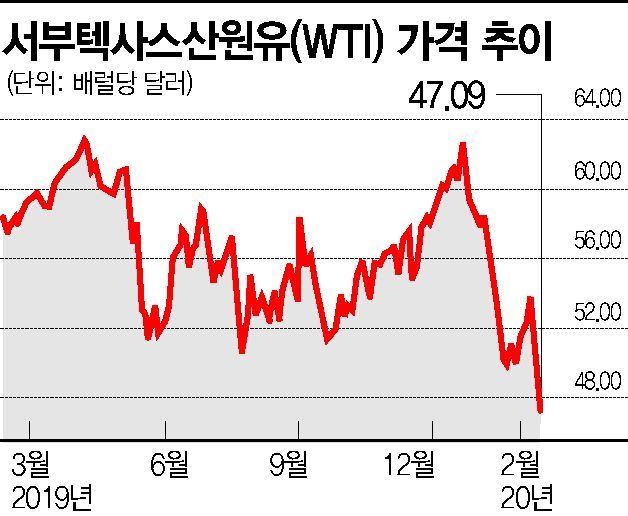
[Asia Economy Reporter Kwon Jaehee] The fear that the novel coronavirus infection (COVID-19) could escalate into a global pandemic has shaken international oil prices. The $50 per barrel level has collapsed for the first time in over a year, raising concerns about a wave of bankruptcies among oil companies.
On the 27th (local time) at the New York Mercantile Exchange (NYMEX), April delivery West Texas Intermediate (WTI) crude oil closed at $47.09 per barrel, down 3.4% ($1.64) from the previous day. Intraday, it even dropped to as low as $45.88 per barrel. WTI recorded its lowest level since January last year, when concerns about an economic recession due to the US-China trade dispute were rising. On the same day, April Brent crude futures on the London ICE Futures Exchange closed at $52.18.
The decisive cause of the oil price decline is weak demand from China. China is the world's largest oil consumer, but demand has dropped by more than 20% due to the impact of COVID-19. Anthony Grisanti, founder of GRZ Energy, said in an interview with CNBC that "oil demand weakness is expected to continue."
As international oil prices plummeted, North American oil companies also faced a wave of bankruptcies. According to The New York Times (NYT), Teck Resources, Canada's largest mining development company, announced on the 23rd (local time) that it would halt oil sands well development in western Alberta. The company had invested 20.6 billion Canadian dollars (approximately 19 trillion KRW) over the past decade in oil sands development, but the recent sharp drop in international oil prices made profitability low, leading to the suspension of the project.
In the United States, the world's largest shale gas producer, bankruptcies among oil companies continue. According to a report by the US law firm Hynes & Byrne, 42 oil and gas companies in North America (US and Canada) went bankrupt last year alone. This represents an increase of about 50% compared to the previous year.
Credit rating agency Moody's stated, "The sharp drop in international oil prices is a direct blow to shale companies," adding, "especially the recent rapid decline in international oil prices over the past few days due to the spread of COVID-19 has been a decisive factor."
Experts believe the impact of COVID-19 will push oil companies into even deeper crisis. Until last year, bankruptcies were influenced by financial difficulties and environmental controversies arising during drilling processes, but now the reduction in oil demand due to economic activity contraction is expected to shake oil-related companies. Generally, the breakeven point for oil companies is around $60 per barrel. With international oil prices falling below $50, the profitability of oil extraction not only from sand oil but also from oil fields is inevitably deteriorating.
The Organization of the Petroleum Exporting Countries (OPEC) and non-member oil-producing countries will hold a meeting in Vienna, Austria on the 5th and 6th of next month to discuss supply and demand measures. While OPEC member countries, including Saudi Arabia, are in favor of production cuts, non-member countries such as Russia still oppose them.
© The Asia Business Daily(www.asiae.co.kr). All rights reserved.
![Clutching a Stolen Dior Bag, Saying "I Hate Being Poor but Real"... The Grotesque Con of a "Human Knockoff" [Slate]](https://cwcontent.asiae.co.kr/asiaresize/183/2026021902243444107_1771435474.jpg)















