Ministry of Education, Ministry of Health and Welfare, Ministry of Employment and Labor, Ministry of Gender Equality and Family Joint Government Cooperation to Minimize 'Care Gap'
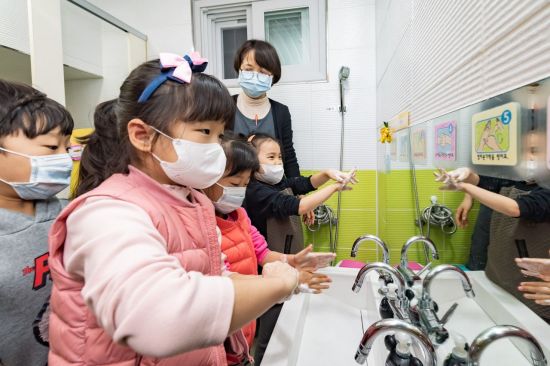
[Asia Economy Reporter Jo In-kyung] Due to concerns over the spread of the novel coronavirus infection (COVID-19), the start of the new semester for all kindergartens and elementary, middle, and high schools nationwide has been postponed to the 9th of next month, and it is expected that 120,000 kindergarten and elementary school students will use 'emergency care.'
The Ministry of Education, Ministry of Health and Welfare, Ministry of Employment and Labor, and Ministry of Gender Equality and Family announced on the 28th that they have decided to mobilize all immediately implementable measures through inter-ministerial cooperation to alleviate parents' concerns and worries caused by daycare center closures or school semester delays.
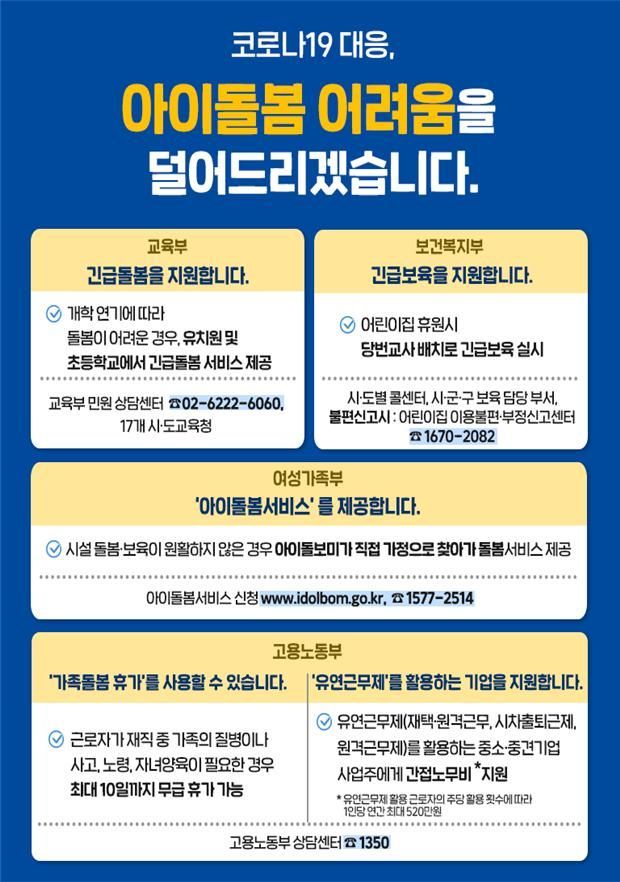
Accordingly, the Ministry of Education and 17 metropolitan and provincial offices of education nationwide will conduct emergency care for 71,353 kindergarten children and 48,656 elementary school students nationwide for one week from the 2nd to the 6th of next month based on a survey of parental demand. This corresponds to 11.6% of kindergarten students and 1.8% of elementary school students nationwide.
The education authorities explained that to operate safe emergency care, they are providing operational guidelines and manuals on-site, establishing a staff response system at the school level, disinfecting and sanitizing facilities and environments, stocking hygiene supplies such as masks and disinfectants, and thoroughly preparing emergency contact networks. Emergency care will be conducted under the responsibility of the school principal with the participation of all staff, and operating hours will be until 5 p.m., similar to regular school hours. Care classrooms will be organized with a minimum number of students per class considering the characteristics of the infectious disease, recommending placement of about 10 students per class.
In particular, experienced staff will be assigned to help new students entering kindergarten and elementary school adapt and to provide more meticulous care so that parents can feel reassured.
The Ministry of Health and Welfare will conduct emergency childcare and care through normal work or a duty system for workers at village care institutions such as daycare centers, Dahamkke Care Centers, local children's centers, and other municipal care centers to actively respond to urgent childcare needs of parents even if these institutions are closed. Especially in daycare centers, duty teachers will be assigned to provide emergency childcare for children who have difficulty receiving care at home.
Emergency childcare is principally provided until 7:30 p.m., as usual, and there are no restrictions on the reasons for use. Any inconveniences related to the use of daycare centers that do not provide emergency childcare can be reported to call centers by city/province, childcare departments of city/county/district offices, or daycare center inconvenience and fraud reporting centers.
All daycare centers must restrict entry of outsiders during the emergency childcare period and take infection prevention measures such as disinfecting childcare rooms and teaching materials once daily and frequently disinfecting high-contact areas like door handles.
The Ministry of Employment and Labor will guide workers with young children to use family care leave and actively encourage its actual use in the field.
To this end, emails requesting cooperation to ensure smooth use of family care leave to prevent the spread of COVID-19 will be sent to employers of companies employing workers who have used maternity protection and work-family balance systems such as prenatal and postnatal leave and parental leave in the past two years.
Additionally, workers who have received maternity protection benefits in the past five years will be informed that they can use family care leave to care for their children.
To provide practical support to workers who need to care for children at home, indirect labor costs will be supported for employers of workers who use family care leave. The support amount is 50,000 KRW per worker for 1-2 uses per week and 100,000 KRW for 3 or more uses per week, with a maximum support limit of 5.2 million KRW per year.
The Ministry of Employment will also grant additional points (10 points out of 1,000) to companies that implemented flexible work measures in response to COVID-19 during the 2020 'Work Innovation Incentive Program.'
The Ministry of Gender Equality and Family plans to ensure no disruption in the operation of child care services. Even if service providers that connect caregivers and users are closed due to confirmed case visits, they will continue service connection tasks through telecommuting, and to prepare for increased demand, caregivers who have not been active for a long time will be allowed to resume activities immediately after completing only essential training such as child abuse prevention.
Also, the procedure requiring parents of infants and toddlers to apply for government support before using the service has been improved to allow parents to use the service more quickly.
In addition, the Ministry of Gender Equality and Family will actively support filling care gaps caused by the suspension of programs at local youth after-school academies, youth counseling and welfare centers, and out-of-school youth support centers.
© The Asia Business Daily(www.asiae.co.kr). All rights reserved.
![Clutching a Stolen Dior Bag, Saying "I Hate Being Poor but Real"... The Grotesque Con of a "Human Knockoff" [Slate]](https://cwcontent.asiae.co.kr/asiaresize/183/2026021902243444107_1771435474.jpg)

















