Stable Distribution to Consumers, Distribution Channels, and Society
[Asia Economy Reporter Oh Hyung-gil] 'Do life insurance companies spend more on customers, agents, or society?'
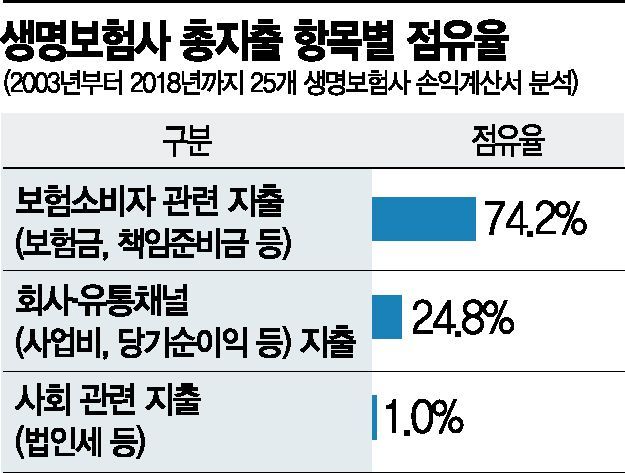
It has been found that life insurance companies' expenditures are stably distributed in a ratio of 7:2:1 among insurance consumers, insurance companies and distribution channels, and society. The balanced spending among stakeholders surrounding insurance is interpreted as meaning that life insurance companies have continuously strived for a tripartite public interest.
According to the report "A Study on the Balance of Income and Expenditure and Tripartite Public Interest of Life Insurance Companies" recently published by the Korea Insurance Academic Society, the share of expenditures related to insurance consumers, such as insurance payments and reserve liabilities, averaged 74.2% from 2003 to 2018. The share of expenditures related to insurance companies and distribution channels, such as operating expenses and net income, was 24.8%, and the share of expenditures related to society, such as corporate taxes, was 1.0%.
The report stated, "The share of expenditures by category of life insurance companies has been very stable over the past 16 years," diagnosing that the life insurance industry is achieving 'tripartite public interest.'
Tripartite public interest is a type of 'win-win' strategy through transactions among market participants. It means that the balance is maintained among stakeholders such as life insurance consumers, companies and distribution channels, and society, without being biased toward any one side.
The top companies in insurance consumer expenditures were KB Life, NH Nonghyup Life, DGB Life, ABL Life, IBK Life, Hana Life, and Kyobo Lifeplanet. On the other hand, PCA Life (merged with Mirae Asset Life), LINA Life, MetLife, DB Life, Chubb Life, AIA Life, and Mirae Asset Life had low consumer expenditures. Low insurance consumer expenditures imply a potential loss of trust from consumers.
The top companies in distribution channel expenditures were Mirae Asset Life, LINA Life, DB Life, Kyobo Lifeplanet, MetLife, and Chubb Life. These companies have a high proportion of operating expenses or high net income levels.
Conversely, 11 companies including Kyobo Lifeplanet, Chubb Life, ABL Life, Fubon Hyundai, KDB Life, NH Nonghyup Life, Heungkuk Life, PCA Life, Tongyang Life, and KB Life had low expenditures related to society. It was analyzed that companies with poor profitability did not pay corporate taxes, resulting in a low share.
In particular, the report noted, "In 2003, the share of insurance business revenue was larger, but in 2018, the share of expenditures related to insurance consumers was greater," and judged that "life insurance companies are using more of the income generated from investment business revenue for expenditures related to insurance consumers, showing continuous efforts for tripartite public interest."
MetLife, PCA Life, and LINA Life were pointed out as having high insurance business revenue but low insurance consumer expenditures, indicating relatively large expenditures on the company and shareholders.
Dr. Kim Hyun-min of Kyung Hee University, who conducted the study, said, "When expenditures related to consumers are high, it is difficult to secure financial stability due to challenges in appropriate operating expenses or net income generation," and warned, "If expenditures on insurance distribution channels are large or net income is high, there is a risk of losing trust from insurance consumers, so caution is needed."
© The Asia Business Daily(www.asiae.co.kr). All rights reserved.
![Clutching a Stolen Dior Bag, Saying "I Hate Being Poor but Real"... The Grotesque Con of a "Human Knockoff" [Slate]](https://cwcontent.asiae.co.kr/asiaresize/183/2026021902243444107_1771435474.jpg)
















