One Month into the COVID-19 Crisis... Related News Increase
Some Citizens Report Anxiety and Fatigue, Reducing News Viewing
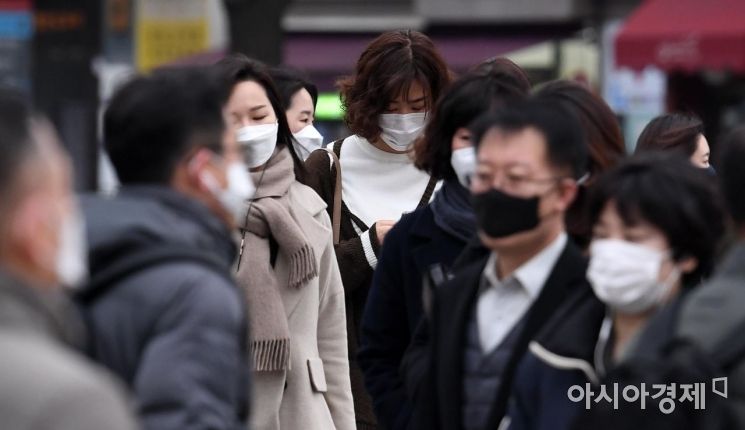 On the 28th, as the spread of the novel coronavirus disease (COVID-19) continued, commuters near Gwanghwamun in Seoul hurried along wearing masks on their way to work. Photo by Hyunmin Kim kimhyun81@
[Asia Economy Reporter Han Seung-gon] "I'm actually avoiding COVID-19 news. I just hear about it from acquaintances."
As the novel coronavirus infection (COVID-19) situation continues for over a month and related news increases, some citizens are expressing fatigue. Especially with confirmed cases surpassing 1,500 as of 4 p.m. on the 27th, anxiety about when and where one might get infected is also growing.
Overall, this can be seen as another negative social phenomenon resulting from the COVID-19 crisis. There are even concerns that we might need to worry about post-traumatic stress disorder (PTSD).
A man in his 40s, office worker A, who used to keep up with COVID-19 news but now only hears updates from acquaintances, said, "I used to check every morning where confirmed cases were reported and how patients were doing, but now I’m a bit tired." He added, "However, I can’t completely avoid the news, so I reduce fatigue by reading news shared by acquaintances in group chats."
Another office worker in his 30s, B, said, "Since confirmed cases keep pouring out every day, the anxiety is indeed significant," and added, "The spread of COVID-19 is a problem, but not knowing when this anxious daily life will end is also a big issue."
Amid the growing anxiety caused by the COVID-19 outbreak, a survey found that 6 out of 10 adults feel anxious about various disasters.
According to a survey conducted by the job portal Saramin on 1,931 adult men and women in 2015 about whether they feel anxiety about disasters, 59.9% answered that they do feel anxious.
Regarding the level of anxiety, 68.2% reported feeling "anxiety at a level of paying attention and being cautious," which was the most common, followed by "always tense and alert" at 23.6%, and "fearful because it could happen anytime" at 8.2%.
As anxiety grows, some citizens complain that they cannot focus on work. C, an office worker in his mid-30s, said, "I can’t help but keep up with COVID-19 news," adding, "I check related news intermittently even while working." He continued, "But because of this, I can’t concentrate on work, and as a result, I end up feeling very tired."
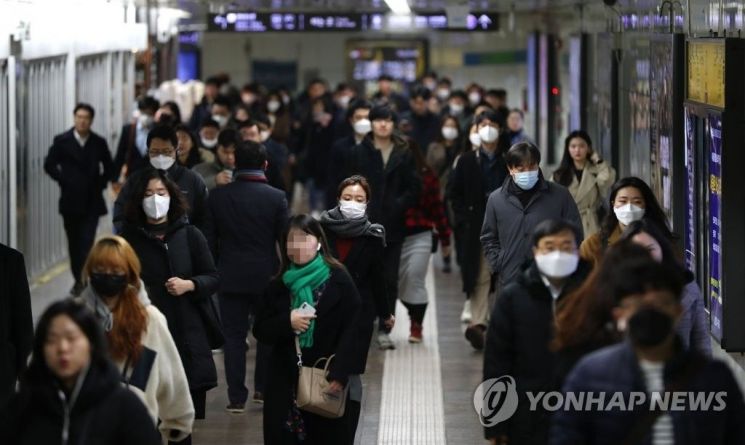 Amid concerns over the spread of the novel coronavirus disease (COVID-19), on the morning of the 29th of last month, citizens wearing masks are walking at Gwanghwamun Station on Seoul Subway Line 5. [Image source=Yonhap News]
The situation is the same for infected patients. As anxiety grows due to the infectious disease, it leads to anger and severe stress.
According to the United Christian Hospital in Hong Kong, among 1,394 patients who experienced Severe Acute Respiratory Syndrome (SARS), about half (47.8%) suffered from PTSD symptoms.
The same was true during the Middle East Respiratory Syndrome (MERS) outbreak in Korea in 2015. According to a research paper published by the Korean Society of Epidemiology on 1,692 MERS survivors, 47.2% of confirmed patients experienced anxiety, and 52.8% experienced anger.
The research team stated, "If anxiety and anger caused by disasters are treated early, mental health can be protected, but if neglected, it can lead to PTSD," and recommended, "Anxiety and anger should be treated appropriately and promptly."
Experts explain that when sudden disasters or similar situations occur, people inevitably experience extreme stress.
Dr. Lee Da-young, a psychiatrist at the National Center for Mental Health, analyzed in an interview with 'EBS' that "Because the virus causing the infectious disease is invisible and anyone can be exposed without knowing, anxiety and fear can be greater than in typical disasters."
She added, "Anyone can feel temporary anxiety, depression, irritation, or lethargy, so it is important to accept one’s emotions and manage them with healthy coping methods such as hobbies you usually enjoy, light exercise, relaxation, and meditation."
© The Asia Business Daily(www.asiae.co.kr). All rights reserved.
![Clutching a Stolen Dior Bag, Saying "I Hate Being Poor but Real"... The Grotesque Con of a "Human Knockoff" [Slate]](https://cwcontent.asiae.co.kr/asiaresize/183/2026021902243444107_1771435474.jpg)

















