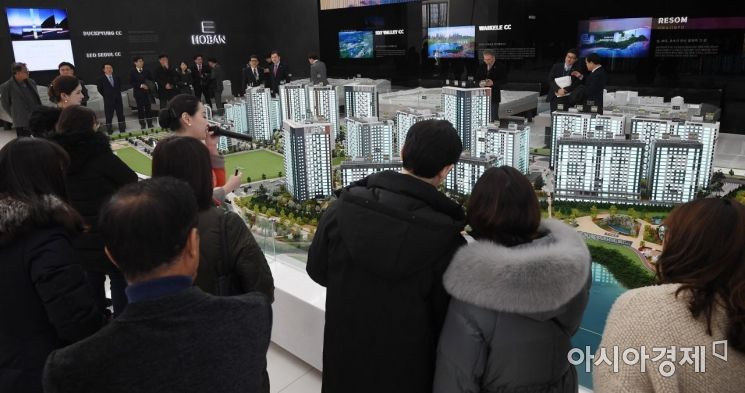
[Asia Economy Reporter Lee Chun-hee] The Ministry of Land, Infrastructure and Transport will lower the basic construction cost, which serves as the standard for calculating the sale price of apartments under the price ceiling system, by 2.7% to 6.34 million KRW per 3.3㎡ starting next month. At the same time, it plans to put a stop to the industry's practice of including the cost of built-in furniture when expanding balconies.
The Ministry announced on the 27th that it has prepared improvement measures for the sale price calculation standards based on these points. This improvement plan reflects the results of the Board of Audit and Inspection's audit on the operation of the price ceiling system. Previously, the Board of Audit pointed out several issues in last year's audit, including ▲ no construction cost applicable to high-rise housing over 41 floors ▲ incentive-type additional costs not distinguished from basic quality costs ▲ inconsistent standards for construction additional costs by region ▲ inclusion of built-in furniture regardless of balcony expansion, which could lead to excessive calculation of expansion costs.
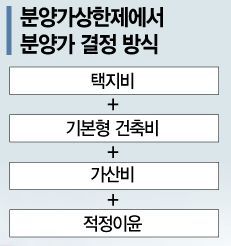
Currently, housing sold in areas where the price ceiling system applies must undergo price review by local governments. At this time, the sale price is limited to the sum of land cost and construction cost or less. For public land, the land cost is calculated based on the supply price, while for private land, it is calculated by adding a land additional cost to the appraised value. Construction cost is calculated by adding the basic construction cost and construction additional cost. The Ministry will apply the improvement measures to the basic construction cost and the land and construction additional costs.
Accordingly, starting next month, the upper limit of the basic construction cost per 3.3㎡ will be lowered by 2.69%, from 6.511 million KRW to 6.336 million KRW. The Ministry announces the basic construction cost twice a year, in March and September.
The Ministry significantly increased the sample size in calculating the basic construction cost this time. Until now, the basic construction cost was based on only one sample project in the metropolitan area, which was applied nationwide, leading to criticism regarding representativeness. The Ministry decided to calculate the construction cost by selecting two samples in the metropolitan area and one each in the central and southern regions outside the metropolitan area, weighted by the supply volume in each region over the past three years.
A new basic construction cost for high-rise housing will also be established. The current basic construction cost has been uniformly applied to buildings "36 floors and above." Reflecting the Board of Audit's recommendations, the Ministry will create new categories for 41?45 floors and 46?49 floors. The construction costs for these categories will be set at 106.2% and 109.5%, respectively, compared to the standard floors (16?25 floors).
The standards for calculating construction additional costs will also be improved. Considering the increasing demand for flat slab structures rather than the traditional wall-type structures due to changes in living patterns, an additional cost rate (3%) will be newly introduced for wall-type mixed flat slab structures with high space utilization. Also, housing performance grade evaluation items with incentive characteristics will be adjusted to avoid overlap with other additional costs.
The Ministry will also put a stop to the practice of calculating expansion costs by including built-in furniture when expanding balconies. It plans to improve the review reference standards so that expansion costs are calculated by comparing before and after expansion for each balcony area such as living room, kitchen, and bedroom, excluding built-in furniture. A Ministry official said, "We expect balcony expansion costs to decrease by 15?30% due to this improvement in review reference standards."
The newly decided basic construction cost will be announced on the 1st of next month and applied to complexes that apply for resident recruitment approval after that date. The Ministry also plans to distribute the improved balcony expansion cost review reference standards to local governments by the end of this month and implement them on the same day.
The Ministry will also establish specific review standards to ensure consistent additional cost reviews at local government price review committees. The price review process for housing under the price ceiling system has been continuously troubled. For example, the "Prugio Bellarte" in S6 Block of the Knowledge Information Town in Gwacheon, Gyeonggi Province, originally scheduled for sale in May last year, has been delayed due to disagreements over the sale price between Gwacheon City and the Daewoo Construction consortium. The "Wirye Hoban Summit Songpa," supplied in December last year, was also delayed by about seven months due to disagreements over the sale price.
A Ministry official stated regarding this, "We will periodically revise and distribute the sale price review guidelines to local governments and conduct regular training," and "We will create a sale price review result management program and conduct regular inspections" as part of the improvement direction.
© The Asia Business Daily(www.asiae.co.kr). All rights reserved.
![Clutching a Stolen Dior Bag, Saying "I Hate Being Poor but Real"... The Grotesque Con of a "Human Knockoff" [Slate]](https://cwcontent.asiae.co.kr/asiaresize/183/2026021902243444107_1771435474.jpg)















