KOTRA '2019 H2 Trends in Import Restrictions Against Korea and 2020 H1 Outlook' Report
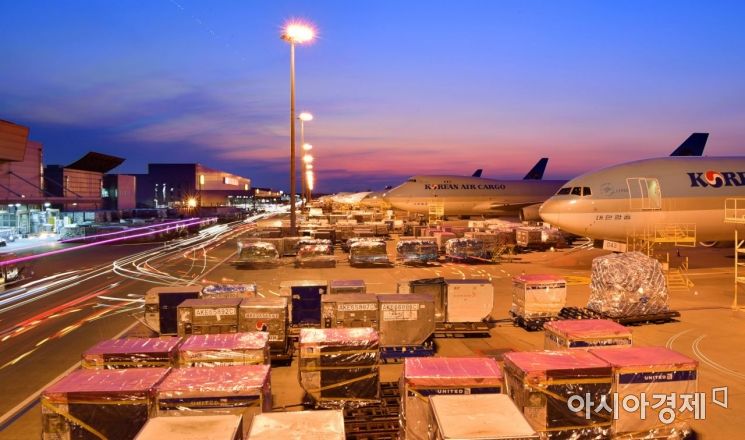 As the year of the Earth Pig (Giheonyeon) comes to an end, export goods made in Korea, destined to spread worldwide, await loading onto a Korean Air cargo plane at the Incheon International Airport cargo terminal. / Yeongjongdo - Photo by Kim Hyunmin kimhyun81@
[Asia Economy Reporter Moon Chae-seok] At the end of last year, the number of import restrictions against South Korea reached a record high of 210 cases. This year, as protectionism spreads worldwide, centered on the United States and Europe, there are concerns that import barriers against Korean products may increase further.
On the 27th, KOTRA announced in a report on import restriction trends in the second half of last year and prospects for the first half of this year that as of the end of last year, a total of 210 import restrictions against South Korea were implemented by 29 countries. Import restrictions include anti-dumping, countervailing duties, and safeguards, including cases under investigation.
Import restrictions against South Korea have steadily increased since 2006, when there were 110 cases, reaching a record high of 210 last year. This is an increase of 16 cases compared to the previous year.
By type, last year’s import restrictions consisted of 153 anti-dumping cases, 48 safeguard (emergency import restriction) cases, and 9 countervailing duty cases.
Before the mid-2000s, anti-dumping accounted for more than 90% of cases, but since the mid-2000s, safeguards have gradually expanded.
The share of safeguards among all import restrictions increased from 2.6% in 2006 to 22.9% in 2019.
By country, the United States had the most cases with 40, followed by India with 32, China with 17, Turkey with 15, Canada with 13, Brazil with 10, and Indonesia with 8.
By product category, steel and metals (99 cases) and chemicals (49 cases) accounted for more than two-thirds, followed by plastics and rubber with 17 cases, textiles with 16, electrical and electronics with 7, and machinery with 3.
Before the mid-2000s, import restriction investigations were mostly on chemical products (including plastics and rubber), but since 2013, due to oversupply of steel, import restrictions on steel and metals have been strengthened in various countries.
Emerging countries such as China and India have a high proportion of import restrictions on chemical products, while North American countries such as the United States and Canada focus more on steel and metal product restrictions.
The trade environment surrounding South Korea remains challenging this year as well.
First, the United States is showing moves to strengthen import restrictions through the introduction of currency countervailing duties.
On the 3rd (local time), the U.S. Department of Commerce established regulations imposing countervailing duties by considering currency devaluation as an unfair subsidy.
The report advised, "Although the possibility of South Korea being designated as a currency manipulator is considered low, the currency countervailing duties investigated by the Department of Commerce can proceed independently of the Treasury Department’s designation of currency manipulators, so the Korean industry needs to be cautious."
China has significantly strengthened import restrictions on solid waste imports, and India has established a steel import monitoring system, potentially increasing import restrictions on foreign steel products.
The European Union (EU) is also raising trade barriers against emerging countries.
The EU Commission is preparing policies and regulations to protect domestic industries, and regulations that were previously focused on steel and chemicals may be expanded to food and general manufactured goods.
In particular, as European companies’ dissatisfaction grows over unfair competition with emerging country companies that are relatively free from public funding and regulations, there is a prospect that efforts to protect European domestic companies may intensify.
© The Asia Business Daily(www.asiae.co.kr). All rights reserved.
![Clutching a Stolen Dior Bag, Saying "I Hate Being Poor but Real"... The Grotesque Con of a "Human Knockoff" [Slate]](https://cwcontent.asiae.co.kr/asiaresize/183/2026021902243444107_1771435474.jpg)















