Economic Experts' Recommendations on COVID-19 Spread
Supplementary Budget Expected Around 10 Trillion Won
"Fiscal Measures Likely Ineffective... Medical Support Must Be Strengthened"
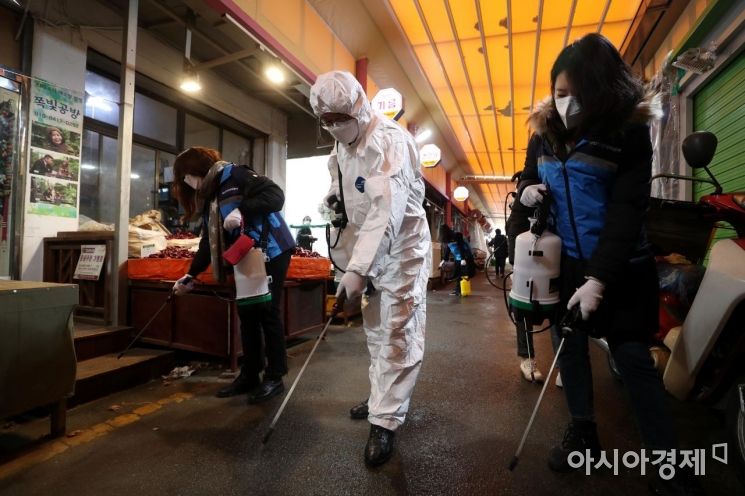 On the 26th, as the possibility of community spread of COVID-19 increases, officials are conducting disinfection at Myeongil Market in Gangdong-gu, Seoul. Photo by Mun Ho-nam munonam@
[Asia Economy reporters Kim Hyun-jung (Sejong), Jang Se-hee, Park Ji-hwan] As signs of a rapid economic contraction due to the spread of the novel coronavirus infection (COVID-19) emerge, the government is hastening preparations for large-scale fiscal spending, including the formulation of a supplementary budget. President Moon Jae-in has also repeatedly called for an active role of fiscal policy. However, experts point out that in a situation where the economy is cooling due to psychological contraction rather than liquidity shortage, the role of fiscal policy will be limited. They argue that rather than large-scale fiscal spending, focusing on quarantine efforts is the fastest way to economic recovery.
◆"Excessive fiscal spending only worsens fiscal soundness... Should be used only for infection control and support for affected businesses"= According to the Ministry of Economy and Finance on the 26th, the government plans to submit the COVID-19 supplementary budget bill to the National Assembly as early as the beginning of next month. The supplementary budget is expected to include measures such as issuing coupons to stimulate consumption, support for affected industries and sectors, and reduction of individual consumption tax on passenger cars. The key issue is the size of the supplementary budget, with political circles that triggered the budget formulation arguing that more than 10 trillion won is necessary considering the seriousness of the situation.
However, academia agrees that the supplementary budget should be selective, focusing mainly on preemptive quarantine budgets and excluding direct cash welfare projects. Professor Kim Sang-bong of Hansung University’s Department of Economics said, "Looking at cases overseas classified as advanced countries, there is no instance of pouring fiscal resources indiscriminately during national disasters or calamities," adding, "The effect would be minimal." He further stated, "Doing the utmost in comprehensive quarantine efforts is the fastest way to economic recovery." Professor Kim Tae-gi of Dankook University’s Department of Economics also pointed out, "Fiscal measures are desirable to be used under normal economic conditions or during economic downturns," and "If a supplementary budget is formulated, it should faithfully include public health and medical support."
There are also opinions that direct cash welfare projects should be excluded as much as possible. Professor Sung Tae-yoon of Yonsei University’s Department of Economics explained, "This supplementary budget must be strictly limited to infection spread control and directly affected businesses," adding, "If the supplementary budget expands and fiscal size increases, it may rather shrink the private sector than boost economic growth." It is pointed out that the government’s contribution of 1.5 percentage points to last year’s annual GDP growth rate of 2.0%, compared to the private sector’s 0.5 percentage points, reflects such side effects.
Concerns are also rising about the debt remaining after the government pours large-scale fiscal resources into COVID-19. A significant portion of the supplementary budget is expected to be financed through deficit bond issuance. According to the 2020 budget and the 2019-2023 National Fiscal Management Plan announced by the Ministry of Economy and Finance, the scale of deficit bonds to be issued this year is already 60.2 trillion won, a 75.5% increase compared to last year’s 34.3 trillion won.
There are also calls to prioritize the use of dormant disaster and calamity-related funds of local governments. According to the Nara Salrim Research Institute, as of the end of last year, the total amount available for use related to COVID-19 by 243 local governments nationwide reached 5.2 trillion won, consisting of 3.9 trillion won in disaster management funds and 1.3 trillion won in disaster relief funds, but as of the 23rd, only 72.6 billion won had been spent. Lee Sang-min, senior researcher at the Nara Salrim Research Institute, criticized, "It is customary for local government funds to be spent passively," and urged, "They should be actively allocated to stabilize the local economy."
◆Overseas forecasts predict negative growth rate in Q1= Overseas investment institutions are issuing pessimistic forecasts for the Korean economy reflecting the rapidly spreading COVID-19 impact. On the 24th, JP Morgan forecasted, "The COVID-19 outbreak in Korea will peak on February 20, with a maximum of 10,000 infected cases." This assumes that 3% of Daegu’s 2.4 million citizens are exposed to the virus and that secondary infections occur similarly to China. The domestic Q1 economic growth rate is expected to contract by 1% quarter-on-quarter, and the annual growth rate is revised down to 2.2% from the previous 2.3%.
In addition, ING Group lowered its growth forecast for Korea this year from 2.2% to 1.7% in December last year, and Oxford Economics also lowered it from 2.2% to 1.8%. Lloyd Chan, an Oxford economist, said, "COVID-19 has dealt a fundamental shock to China’s economic activities and is expected to cause supply chain disruptions in the near future," adding, "Korea’s export outlook, which is strongly linked economically to China, will also be dampened."
Some institutions forecast Korea’s economic growth rate to fall into the 0% range this year. Nomura Securities lowered its forecast from 2.1% to 1.8% on the 18th, diagnosing, "If China continues lockdown measures until the end of June due to COVID-19, Korea’s growth rate could fall to as low as 0.5%." Morgan Stanley also projected Korea’s growth rate range to be between a minimum of 0.4% and a maximum of 1.3%.
© The Asia Business Daily(www.asiae.co.kr). All rights reserved.
![Clutching a Stolen Dior Bag, Saying "I Hate Being Poor but Real"... The Grotesque Con of a "Human Knockoff" [Slate]](https://cwcontent.asiae.co.kr/asiaresize/183/2026021902243444107_1771435474.jpg)

















