[Asia Economy Reporter Choi Dong-hyun] Last year, 7.7 out of 10 nationwide housing transactions were apartment transactions.
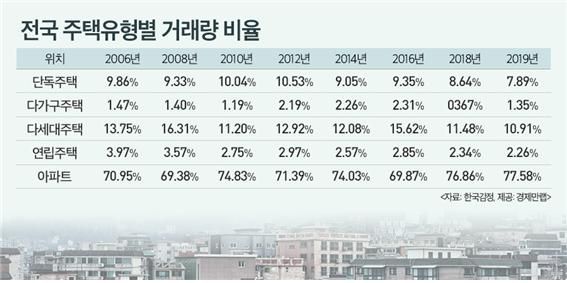
On the 26th, real estate information company Economy Man Lab analyzed the housing transaction status from the Korea Appraisal Board and found that out of 1,599,498 housing transactions last year, apartment transactions accounted for 1,217,661, or 77.58%. Although the volume of apartment transactions fell by 7.85% compared to 2018 (1,321,341 transactions), the proportion of apartment transactions reached an all-time high since the Korea Appraisal Board began compiling housing transaction statistics in 2006.
Last year, the proportion of detached house transactions nationwide was 7.89%, down 0.76 percentage points from 2018, while multi-family houses and row houses also decreased by 0.57 and 0.08 percentage points, respectively. The proportion of multi-unit house transactions last year was 1.35%, up 0.68 percentage points from 2018.
The proportion of apartment transactions in the metropolitan area housing market is also steadily increasing. In 2006, the share of apartment transactions in the metropolitan area was only 63.77%, but it has steadily risen each year, reaching 72.19% last year, meaning 7.2 out of 10 transactions were apartments, marking a record high. In particular, the proportion of apartment transactions in Gyeonggi-do was 81.34%, the highest in the metropolitan area. Seoul’s apartment transaction share was 61.46%, and Incheon’s was 73.78%.
The increasing share of apartment transactions in the housing market is analyzed to be due to price increases centered on apartments. Looking at KB Real Estate’s median housing prices, the nationwide median apartment price was 351.72 million KRW in January last year, rising to 364.26 million KRW in January this year, a 3.56% increase over one year. During the same period, detached houses rose 2.01% from 313.74 million KRW to 320.06 million KRW, and row houses increased only 0.81% from 170.23 million KRW to 171.61 million KRW. Additionally, apartments are generally located in prime locations with excellent transportation environments, offering comfort and convenience, which has increased apartment preference, suggesting that the proportion of apartments in the housing market will continue to grow.
Meanwhile, among the six major metropolitan cities last year, the highest proportion of apartment transactions was in Ulsan. Ulsan’s apartment transaction share was 90.53%, followed by Gwangju at 83.75%, Daejeon at 83.48%, Daegu at 82.35%, and Busan at 81.08%.
Oh Dae-yeol, head of the research team at Economy Man Lab, said, “The nationwide housing market is moving toward apartments, and as apartment prices have soared uniquely, many view apartments not just as living spaces but as investment assets, which appears to have significantly increased the proportion of apartment transactions.”
© The Asia Business Daily(www.asiae.co.kr). All rights reserved.