COVID-19 Suspected Patient Incident at a Coffee Shop in Jung-gu, Seoul
Police Reported Due to "Severe Coughing"... No Health Issues Found
Exponential Increase in Confirmed Cases Over the Weekend... Avoidance of Multi-use Facilities
[Asia Economy Reporter Lee Gwan-ju] On the afternoon of the 21st, police were dispatched following a report of a suspected COVID-19 patient at a coffee shop in Jung-gu, Seoul. A man in his 30s was coughing severely, prompting a customer at a nearby table to report him as a suspected COVID-19 patient. Upon arrival, the police checked his health condition and stated, "It does not seem to be a special problem," advising him to "observe proper coughing etiquette" before leaving.
As confirmed COVID-19 cases increase exponentially, 'infectious disease phobia' is also intensifying. Following the Shincheonji outbreak, a cluster of cases centered around Protestant churches has emerged, and patients are appearing across hospitals, taxis, and schools, fueling fears of infection.
COVID-19 fear has rapidly penetrated daily life over the past weekend. The cumulative number of confirmed cases tripled to surpass 600, and the death toll rose to six. On the morning commute, subways and buses appeared relatively empty. Office worker Lee Hyun-joo (34, female) said, "There used to be many elderly people on the subway during the commute, but today the priority seats for the elderly were completely empty." Another office worker, Lee Guk-hyun (39, female), said, "Since I heard the news that a taxi driver was confirmed positive over the weekend, I drove my own car to work instead of taking a taxi today."
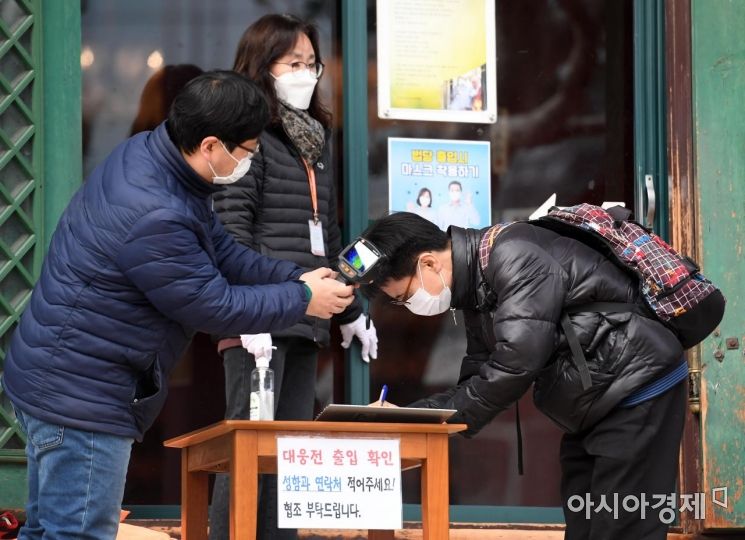 On the 24th, amid ongoing concerns about the community spread of the novel coronavirus disease (COVID-19), Buddhists are having their temperatures checked at the entrance of the Daeungjeon Hall of Jogyesa Temple in Jongno-gu, Seoul. The Jogye Order of Korean Buddhism announced the cancellation of all public events and gatherings, including the first-day Dharma assemblies held at temples nationwide, pilgrimages to sacred sites, and educational programs. Photo by Kim Hyun-min kimhyun81@
The religious community, which has gained the stigma of being a COVID-19 super-spreader, has begun suspending group events since last weekend. The Jogye Order canceled all scheduled Dharma assemblies, pilgrimages, educational events, and all gatherings involving the public, including the first-day Dharma assembly planned for that day. They urged temples in regions with widespread COVID-19 outbreaks to strictly follow guidelines and consider proactive measures such as temporary temple closures.
The Catholic Church issued guidelines on the 22nd, before the weekend, instructing those with suspected symptoms to refrain from attending Sunday Mass regardless of test results and instead engage in rosary prayer, scripture reading, and good deeds at home. The Catholic Church also decided to postpone the Confirmation Sacrament scheduled for the first half of this year in consultation with dioceses. In regions with many confirmed cases such as Daegu-Gyeongbuk and Gwangju, Masses have been suspended temporarily. The Andong Diocese in Gyeongbuk suspended Masses for three weeks until the 13th of next month, closed all 40 churches and facilities within the diocese, and began disinfection efforts. The Gwangju Archdiocese also decided to suspend Masses and all gatherings until the 5th of next month.
Gyms and swimming pools, which are privately operated, have not closed, but members are voluntarily refraining from visiting. Kim Ju-yeon (40), who lives in Doksan-dong, Guro-gu, Seoul, said, "I feel uneasy thinking that I might come into contact with a COVID-19 patient in the water, so I am not using the swimming pool for the time being."
© The Asia Business Daily(www.asiae.co.kr). All rights reserved.