Duty-Free Shops and Cosmetics Followed by Department Stores and Large Supermarkets as Consumer Spending Contracts
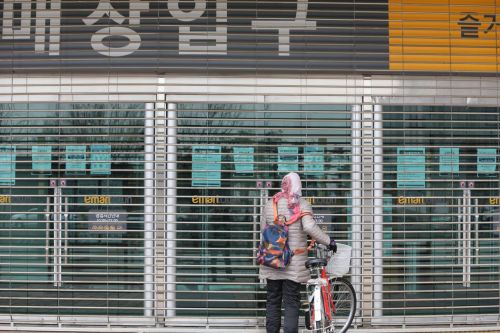 On the morning of the 21st, a resident is reading a temporary closure notice at the entrance of Emart Town KINTEX branch in Ilsan, Goyang, Gyeonggi Province. (Photo by Yonhap News)
[Asia Economy Reporter Geum Bo-ryeong] As the number of confirmed cases and deaths from the novel coronavirus infection (COVID-19) rapidly increases, uncertainty over the earnings of retail stocks is growing.
According to the Korea Exchange on the 24th, as of 10:15 a.m., the stock prices of Lotte Shopping and Emart fell to 99,500 KRW and 99,100 KRW respectively, both marking a 52-week low. At the same time, Hyundai Department Store's stock price also dropped 5.66% (4,100 KRW) from the previous day to 68,400 KRW. Considering it was 87,500 KRW on the 23rd of last month, it has fallen by 21.83% in just one month. During the same period, Shinsegae also declined by 19.58%, from 306,500 KRW to 246,500 KRW.
Initially, concerns were limited to duty-free shops and cosmetics sectors during the early stages of COVID-19, but now they have spread to department stores and large supermarkets due to reduced consumer spending. Domestic department store companies saw a 5% decline in same-store sales growth compared to the previous year earlier this month, but around the 15th, as the number of confirmed cases sharply decreased, they appeared to be recovering. However, since the 18th, the rapid increase in confirmed cases has heightened concerns over earnings. In the case of Lotte Department Store, the Sogong-dong main store, Jeonju branch, and Yeongdeungpo branch temporarily closed, and Shinsegae Department Store also closed the basement first-floor food hall of its Gangnam branch.
The situation is similar for large supermarkets. Emart temporarily suspended operations at its Seongsu, Gongdeok, Bucheon, Ilsan Kintex, and Gwacheon branches, while Lotte Mart temporarily closed its Songcheon branch due to a confirmed COVID-19 case visit.
Although online sales are likely to increase, it is pointed out that this is not very meaningful for department stores because their online sales ratio is low and the proportion of daily necessities is small. Emart's online sales growth can somewhat compensate for sales, but in terms of profit, the fixed cost burden is high, limiting its contribution.
Park Jong-dae, a researcher at Hana Financial Investment, said, "In the case of Lotte Shopping, combining department stores and marts results in a 7% to 15% decrease compared to the existing annual operating profit estimate, and if supermarkets, Hi-Mart, and cinemas are added, the profit reduction could be even greater." He added, "Home shopping business will somewhat compensate, but there are limitations in terms of business scale." He continued, "Hyundai Department Store could see a 17% to 28% decrease, and Emart, which has the largest number of stores and the highest fixed cost burden, could experience an annual operating profit impairment ranging from 16% to up to 32%."
© The Asia Business Daily(www.asiae.co.kr). All rights reserved.