[Asia Economy Reporter Oh Ju-yeon] As concerns over the novel coronavirus infection (COVID-19) rise again, market uncertainty has also expanded. An analysis suggests that the preference for safe-haven assets has resurfaced, leading to a notable increase in the prices of precious metals within the commodities sector.
According to Daishin Securities on the 23rd, since the beginning of this year, the commodity index (S&P GSCI) has fallen by 8.0% as of the 19th, but only the precious metals sector recorded a positive return, rising by 5.3%.
Researcher Kim So-hyun interpreted this as "the financial market's anxiety caused by the COVID-19 situation has acted as a driver for inflows into safe-haven assets."
Within the precious metals sector, the price increases of gold and palladium stood out.
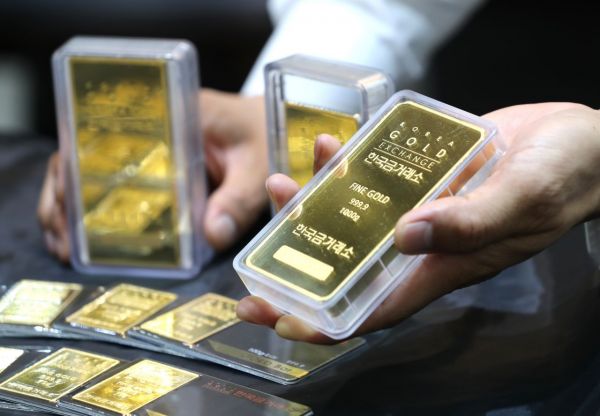
The price of gold surpassed $1,600 per ounce for the first time since March 2013, and palladium reached a record high of $2,717 per ounce. Compared to the beginning of the year, gold and palladium prices rose by 6.2% and 39.6%, respectively.
Researcher Kim said, "Gold price increases are driven by safe-haven demand amid a prolonged low-growth, low-inflation environment, compounded by the COVID-19 crisis and Middle East geopolitical risks. ETF gold holdings increased by 15.5% year-on-year to 83.86 million ounces. In the case of palladium, ongoing production disruptions in South Africa, the world's second-largest palladium producer, are contributing to the price rise."
She explained that gold prices could continue to rise even if the COVID-19 situation calms down.
Researcher Kim stated, "Although the preference for safe-haven assets may weaken, accommodative monetary policies and fiscal expansion measures aimed at recovering from the COVID-19 damage could lead to an increase in the price of real assets like gold. With the scale of negative-yield bonds already at a high level, additional liquidity supply will enhance gold's appeal."
She also mentioned that China's proactive economic stimulus policies are positive for physical gold demand, as demand for Chinese jewelry and physical gold bars and coins may increase due to the COVID-19 crisis. As of last year, China's demand for jewelry and physical gold accounted for 32% of global demand.
Accordingly, Researcher Kim raised the forecasted gold price range for this year to $1,510?$1,700 per ounce.
She also expects the palladium price increase to continue.
Researcher Kim explained, "Since 83% of total palladium demand is for automotive catalytic converters, the current excess demand environment is unlikely to be resolved in the short term. Although COVID-19 may reduce car sales in China, stricter vehicle emission standards in Europe and China this year are expected to increase palladium demand." She added that palladium supply is also unlikely to increase in the short term.
Researcher Kim diagnosed, "Despite expected demand growth last year, palladium supply decreased by 1.6% compared to the previous year. Furthermore, production disruption issues in South Africa are likely to persist."
© The Asia Business Daily(www.asiae.co.kr). All rights reserved.
![Clutching a Stolen Dior Bag, Saying "I Hate Being Poor but Real"... The Grotesque Con of a "Human Knockoff" [Slate]](https://cwcontent.asiae.co.kr/asiaresize/183/2026021902243444107_1771435474.jpg)















