"Volatility Likely to Increase Temporarily Depending on COVID-19 Situation"
"Most Asian Currencies Continue to Weaken"
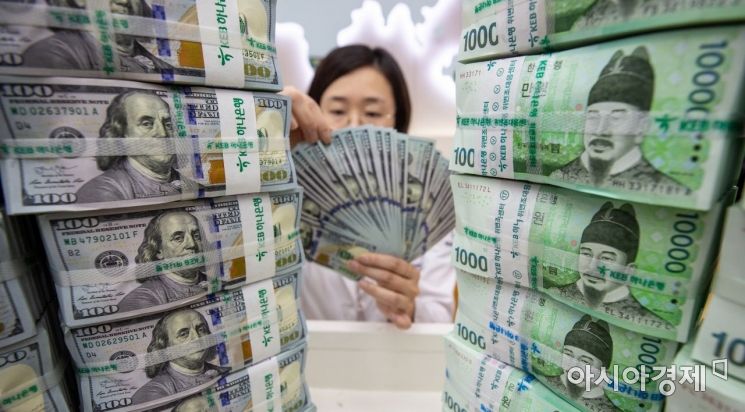
[Asia Economy Reporter Kim Eunbyeol] As the novel coronavirus infection (COVID-19) spreads not only in China but also domestically, the won-dollar exchange rate has surpassed 1,200 won. Although authorities will strengthen management after exceeding 1,200 won, it is analyzed that won depreciation is inevitable for the time being as the preference for safe assets is expected to continue.
On the 21st, in the Seoul foreign exchange market, the won-dollar exchange rate closed at 1,209.2 won, up 10.5 won from the previous trading day. This is the highest level since September 3 last year (1,215.6 won). It is the first time in about five months since the closing price exceeded 1,200 won on October 2 last year (1,206.0 won).
It is also the first time in seven months since August 5 last year (+17.3 won) that the exchange rate surged by more than 10 won. At that time, the exchange rate surged due to Japan's semiconductor-related export regulations and the intensification of the US-China trade dispute.
The reason the won-dollar exchange rate is showing an upward trend like this is that demand for the dollar, a safe asset in the global foreign exchange market, is expanding. Since the spread of COVID-19 has not subsided in Asia, including China, Asian currencies are relatively weak.
Gong Dongrak, a researcher at Daishin Securities, explained, "As COVID-19 spreads, the possibility of economic slowdown has increased, and there is a part where the exchange rate rises due to the judgment that policies such as the Bank of Korea's base rate cut may be implemented in response to that."
He added, "Since the previous high of the exchange rate is around 1,220 won, it depends on how long it will last and whether the impact of COVID-19 will continue, but it is expected to peak around February to March." Although the market will gradually regain composure, it may show volatility reacting to COVID-19-related news for the time being.
However, since financial authorities are paying attention to the foreign exchange market, management is expected to be strengthened above the 1,200 won level. This is because if the exchange rate continues to rise, anxiety may increase.
Most emerging market currencies are expected to weaken until the impact of COVID-19 is resolved. Zhou Hao, an economist at Germany's Commerzbank, predicted that the yuan's value against the dollar could fall to the 7.2 yuan level.
Meanwhile, if dollars flow out domestically, the won-dollar exchange rate rises, so export slowdown due to China's economic slowdown could also be a burden on the exchange rate. According to the Korea Customs Service, exports from the 1st to the 20th of this month amounted to 26.3 billion dollars, an increase of 12.4% compared to the same period last year. However, considering the number of working days this year (15.5 days), which was three days more than last year, the average daily export amount was 1.69 billion dollars, a decrease of 9.3% compared to the same period last year (1.87 billion dollars). As exports falter, it is pointed out that the domestic stock market and the won's value may continue to decline sharply for the time being.
© The Asia Business Daily(www.asiae.co.kr). All rights reserved.
![Clutching a Stolen Dior Bag, Saying "I Hate Being Poor but Real"... The Grotesque Con of a "Human Knockoff" [Slate]](https://cwcontent.asiae.co.kr/asiaresize/183/2026021902243444107_1771435474.jpg)
















