Credit Transaction Loan Balance Hits 9-Month High... Deposits Also Reach 2-Year Peak
[Asia Economy Reporter Minji Lee] Despite the impact of the novel coronavirus infection (COVID-19), the enthusiasm of individual investors for stock investment remains strong.
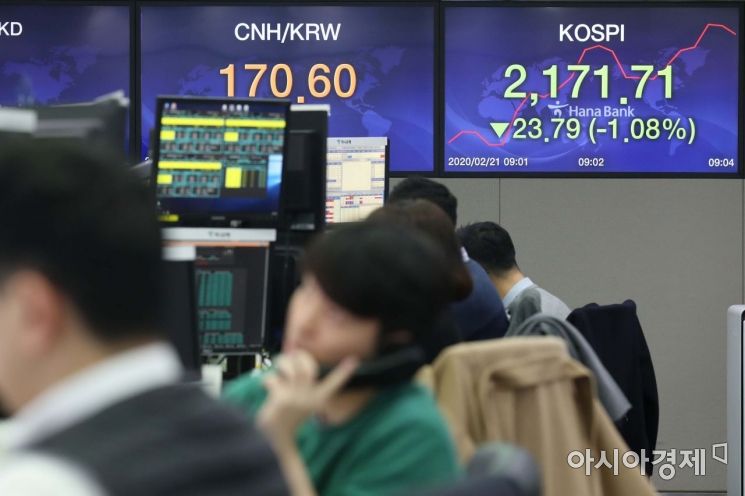 On the 21st, as the possibility of community spread of the novel coronavirus (COVID-19) increases, the KOSPI index opened lower at 2,165.65, down 29.85 points (1.36%) from the previous trading day. The won-dollar exchange rate started the session at 1,205.7 won, up 7.0 won. Dealers are working in the dealing room of Hana Bank in Euljiro, Seoul on this day. Photo by Moon Honam munonam@
According to the Korea Financial Investment Association on the 23rd, the balance of margin loans, where individual investors borrow money to buy stocks in the KOSPI and KOSDAQ markets, totaled 10.5141 trillion KRW as of the 20th. This is the highest level in over nine months since May 13 last year (10.5625 trillion KRW).
The balance re-entered the 10 trillion KRW range for the first time since July 25 last year (10.009 trillion KRW) at 10.0197 trillion KRW on the 28th of last month. After dropping to the high 9 trillion KRW range earlier this month, it has been steadily increasing in the 10 trillion KRW range since the 11th.
Compared to the margin loan balance of 9.2133 trillion KRW at the end of last year, the balance has increased by 1.3008 trillion KRW (14.1%) this year alone.
By market, the KOSDAQ balance rose by 706.4 billion KRW (13.7%) from 5.1609 trillion KRW at the end of last year to 5.8673 trillion KRW, while the KOSPI increased by 596.2 billion KRW (14.7%) from 4.0524 trillion KRW to 4.6468 trillion KRW.
The margin loan balance represents the amount individual investors borrow from securities firms to purchase stocks. Once they buy stocks on credit and make a profit, they repay the principal and interest on the loan and realize capital gains. A higher balance indicates that more individual investors are borrowing to buy stocks in anticipation of a price increase.
Since the COVID-19 outbreak fear escalated in late January, the domestic stock market has experienced unstable conditions immediately after the Lunar New Year holiday. In fact, from the 28th of last month, when the KOSPI plunged 3% due to the COVID-19 shock, through the 21st of this month, individual investors net purchased stocks worth 4.299 trillion KRW over 19 trading days in the KOSPI market. During this period, institutions and foreigners net sold 3.8783 trillion KRW and 137.9 billion KRW, respectively.
Along with the margin loan balance, investor deposits, another indicator reflecting individual investors' enthusiasm for stock investment, are also on the rise. On the 3rd of this month, investor deposits reached 31.2414 trillion KRW, the highest level in over two years since January 31, 2018 (31.2527 trillion KRW).
Looking at the month-end trends, investor deposits increased from 24.6711 trillion KRW in November last year to 27.3384 trillion KRW at the end of December and 28.7192 trillion KRW at the end of January this year. This month, deposits have remained in the 28 trillion to 31 trillion KRW range, standing at 28.618 trillion KRW as of the 20th.
Investor deposits are funds that investors have entrusted to securities firms to buy stocks or funds not withdrawn after selling stocks. An increase in deposits, which are standby funds for stock investment, indicates that market liquidity is flowing into the stock market.
The market expects that the impact of the epidemic issue on the market will not last long, and many investors are taking advantage of low prices to buy. Seokhyun Park, a researcher at KTB Investment & Securities, explained, "Although concerns about the economic shock from COVID-19 have some impact on corporate earnings forecasts, it is expected to be a temporary effect, so we do not believe it is causing a change in the overall positive trend of earnings forecasts."
However, he advised, "Until the factors driving the US dollar's strength subside, the recovery of emerging market stock prices to previous highs may be delayed, so an investment strategy focusing on phased buying during market corrections rather than chasing purchases is necessary."
© The Asia Business Daily(www.asiae.co.kr). All rights reserved.
![Clutching a Stolen Dior Bag, Saying "I Hate Being Poor but Real"... The Grotesque Con of a "Human Knockoff" [Slate]](https://cwcontent.asiae.co.kr/asiaresize/183/2026021902243444107_1771435474.jpg)















