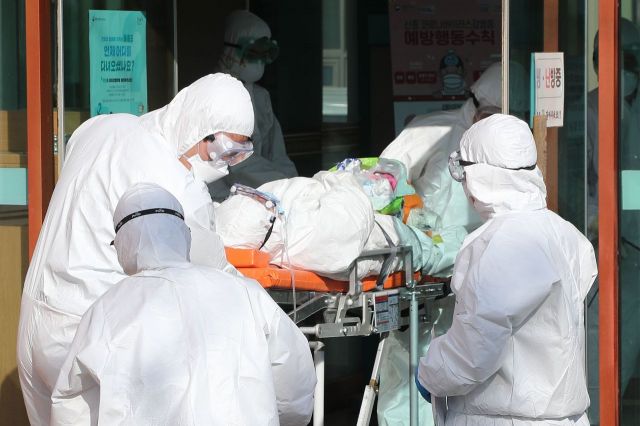
 On the afternoon of the 21st, when the second death from the novel coronavirus infection (COVID-19) occurred, a confirmed patient hospitalized at Cheongdo Daenam Hospital in Gyeongbuk was being transferred to Busan National University Hospital.
 [Asia Economy Reporter Choi Dae-yeol] The government announced on the 22nd that it will maintain the infectious disease crisis alert at the current "Warning" level. This is because preventing inflow from overseas, such as China, remains important, and it is not yet considered to be in a widespread nationwide transmission stage.
Kim Kang-lip, Deputy Head of the Central Disaster and Safety Countermeasure Headquarters for COVID-19, said at a briefing that "The government currently assesses this period as the early stage where the risk factor of overseas inflow of COVID-19 continues, and community transmission has begun in some limited areas."
According to the quarantine authorities, 142 new confirmed cases were identified this morning, bringing the total number of domestic patients to 346. The cases are rapidly increasing mainly in the Daegu and Gyeongbuk regions, centered around the Shincheonji Daegu Church and Cheongdo Daenam Hospital. The infectious disease crisis alert was initially lowered to the Interest level as cases increased in China, then raised to Caution on the 20th of last month when the first domestic case was confirmed. On the 24th of last month, when the fourth case was confirmed, it was raised to the higher Warning level, which is currently maintained. The level above this, Serious, was previously enacted during the 2009 H1N1 influenza outbreak.
Deputy Head Kim stated, "Currently, in some areas such as Daegu, Gyeongbuk, and Cheongdo, a large number of patients are concentrated around specific groups or facilities, and cases without confirmed epidemiological links have appeared, confirming that community transmission of the infectious disease is progressing." He added, "Community transmission has begun in some limited areas, and Daegu and Gyeongbuk are in a special situation." He also said, "We are managing Daegu and Gyeongbuk as special infectious disease control areas and conducting intensive quarantine management equivalent to the Serious level."
Since the quarantine and prevention resources to stop the spread of the infectious disease are limited, the authorities judge that preventing overseas inflow remains important at this time. If there were clear signs of nationwide spread, blocking overseas inflow would be more meaningful, but currently, it is still important to trace contacts of existing patients and identify infection sources to prevent further spread. Deputy Head Kim said, "During the Serious level of the 2009 H1N1 influenza, quarantine was reduced to a routine level, and epidemiological investigations of individual confirmed cases were stopped," adding, "Personnel and resources were focused on early diagnosis and treatment responses within the community."
© The Asia Business Daily(www.asiae.co.kr). All rights reserved.
![Clutching a Stolen Dior Bag, Saying "I Hate Being Poor but Real"... The Grotesque Con of a "Human Knockoff" [Slate]](https://cwcontent.asiae.co.kr/asiaresize/183/2026021902243444107_1771435474.jpg)















