Professor Joonmo Cho of Sungkyunkwan University 'Employment Policy Directions for an Innovative Economy'
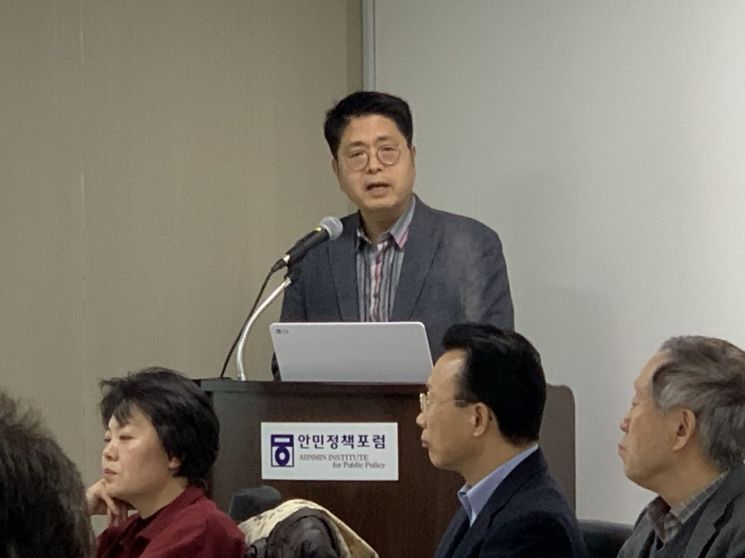 Professor Jo Jun-mo of the Department of Economics at Sungkyunkwan University is giving a lecture at the Anmin Policy Forum breakfast seminar on the 21st.
[Asia Economy Reporter Eunbyeol Kim] As technology advances and the nature of jobs changes, there have been calls for policies related to employment to also evolve. Excessive labor regulations aimed at protecting traditional labor forces such as full-time regular employees are, in fact, damaging national competitiveness.
Professor Joonmo Cho of the Department of Economics at Sungkyunkwan University stated at the Anmin Policy Forum breakfast seminar on the 21st, "With the emergence of the online platform market, labor behaviors are changing," adding, "As the closed internal labor market is being thoroughly dismantled, government policies that only aim to expand regular full-time positions go against industrial trends." He explained that the well-structured job system centered on large corporations is inevitably going to change, and labor reforms targeting only traditional job types will inevitably be less effective.
He said, "Labor reforms centered on regular employment have been pursued for over 20 years, but progress has not been made," and argued, "Now that employment types are changing, policies must also shift to focus on areas with potential."
Professor Cho pointed out recent characteristics seen in the labor market, including ▲ the expansion of non-regular external workers through outsourcing rather than regular employees, and ▲ voluntary contract workers (a thoroughly job-centered labor market).
He noted, "Because full-time regular jobs face various regulations, seniority-based wage systems, and rigid organizational cultures, they will reach their limits. Therefore, urgent government investment in infrastructure such as job information and training to develop the external labor market is necessary."
He also emphasized, "Excessive labor regulations aimed at protecting backward sectors will hinder the creation of future-oriented jobs and ultimately damage national competitiveness."
Among industries, he identified shipbuilding, automobile, and construction as 'industries requiring structural reorganization' due to declining global competitiveness. For these industries, it is necessary to establish a mid- to long-term roadmap for structural reform to ensure that rigid labor-management relations do not hinder structural reorganization.
As feasible labor market structural reforms the government could implement in the future, he cited ▲ flexibilization of working hours systems and wage structures ▲ expansion of labor system self-determination rights ▲ digitalization of social safety nets and vocational training.
He pointed out, "After the introduction of the 52-hour workweek regulation, the composition of working hours should change flexibly, but efforts to build public consensus on this are still insufficient." He also stressed, "It is necessary to break away from seniority-based elements in personnel systems and strengthen expertise through differentiated rewards for individual performance and effort."
He also criticized legal regulations such as ordinary wages and weekly holiday allowances as excessive. Professor Cho said, "A wage system governed by labor-management autonomy that can flexibly adjust to changes in the economic environment should be formed, and the wage system should be transformed into a future-oriented one through labor-management autonomous capabilities."
© The Asia Business Daily(www.asiae.co.kr). All rights reserved.

















