80,000 Won in 2010 → 5,000 Won in 2020... 95% Plunge in 10 Years
6 Consecutive Years of Losses Due to Poor Power Industry Conditions... Nuclear Phase-Out Policy as the 'Final Blow'
Also Seen as a Buying Opportunity at the Bottom
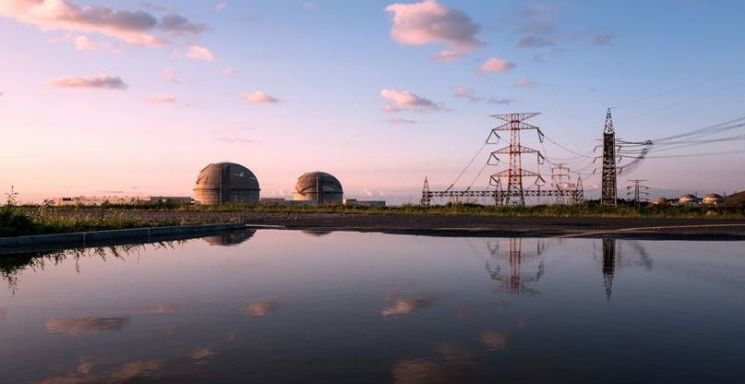
[Asia Economy Reporter Minwoo Lee] Doosan Heavy Industries & Construction's stock price continues to struggle. This is due to a combination of poor market conditions and the government's nuclear phase-out policy. Since the stock price has plummeted by about 95% compared to 10 years ago, some analysts suggest it could be a buying opportunity at the bottom.
According to the Korea Exchange on the 21st, Doosan Heavy Industries & Construction's stock price was 5,410 KRW as of 10 a.m., down 1.1% from the previous day. Since falling to the 5,000 KRW range last November, it has shown little sign of recovery. This is only 6% of the 83,698 KRW price on January 2010. The prolonged slump in the global power generation market, coupled with the government's nuclear phase-out policy, is said to have dealt a critical blow.
Doosan Heavy Industries & Construction recorded consolidated sales of 15.6596 trillion KRW and operating profit of 1.0768 trillion KRW last year. These figures represent increases of 6.1% and 7.3%, respectively, compared to the previous year. However, it posted a net loss of 104.3 billion KRW, failing to return to profitability. Although it recorded operating profits for six consecutive years since 2013, net losses continued. On the 18th, the company also announced a large-scale workforce restructuring, offering voluntary retirement applications until the 4th of next month to about 2,600 employees aged 45 and older.
The background of this poor performance is attributed to a sharp decline in orders for coal-fired power plants and desalination plants, which account for more than half of Doosan Heavy Industries & Construction's sales, due to environmental regulations and other factors. According to the International Energy Agency (IEA), global new coal-fired power plant orders decreased from 76 gigawatts (GW) in 2013 to 23 GW in 2018. Orders from the Middle East have also declined. Domestic companies' orders from the Middle East dropped sharply from 36.9 billion USD (about 44.4349 trillion KRW) in 2012 to 4.4 billion USD (as of November last year).
Currently, Doosan Heavy Industries & Construction's order backlog stands at 14.6 trillion KRW, the lowest in 10 years. For the first time in the 2010s, it fell below 15 trillion KRW. The government's nuclear power phase-out policy has compounded the difficulties. Jaeho Choi, a researcher at NICE Credit Rating, said, "Due to the government's 2017 energy policy promoting nuclear and coal phase-out, new nuclear power plant introductions, including Shin Hanul Units 3 and 4, were halted, and coal-fired power plant orders slowed down. As a result, new orders in 2017 and 2018 dropped significantly to 5.1 trillion KRW and 4.6 trillion KRW, respectively, compared to previous years." He added, "Given the nature of the order-based industry, where there is a time lag between project orders and revenue recognition, if new orders do not improve, the scale of sales and profit generation will decline."
There is also an analysis that the sluggish stock price could actually be a buying opportunity at the bottom. This is because the results of Saudi Arabia's nuclear power plant bid are expected to be announced this year, and financial structure improvements are anticipated through the acquisition of Mechatec and the delisting of Doosan Construction. Dongheon Lee, a researcher at Daishin Securities, explained, "There is abundant mid- to long-term momentum, including overseas nuclear power momentum and the completion of domestic gas turbine development, with testing starting from the Gimpo combined cycle power plant."
© The Asia Business Daily(www.asiae.co.kr). All rights reserved.
![Clutching a Stolen Dior Bag, Saying "I Hate Being Poor but Real"... The Grotesque Con of a "Human Knockoff" [Slate]](https://cwcontent.asiae.co.kr/asiaresize/183/2026021902243444107_1771435474.jpg)















