[Asia Economy Reporter Jang Hyowon] Kang Sung-bu, CEO of KCGI, claimed that Hanjin Group is in a total crisis, attributing this to the owner's unilateral decisions.
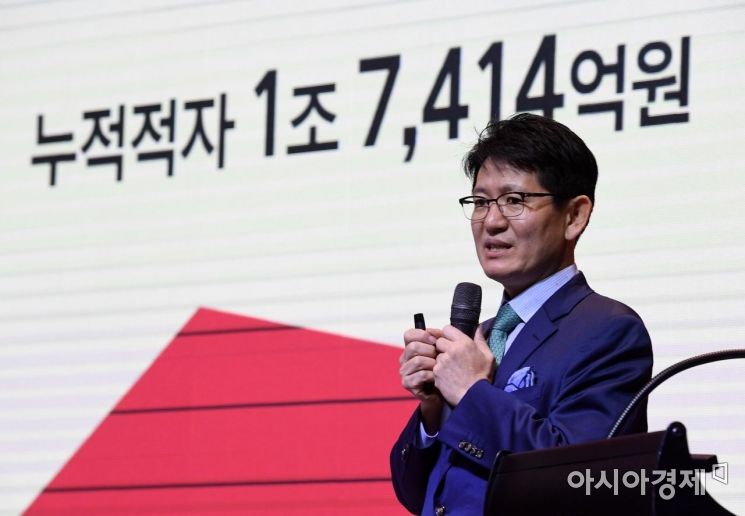 Kang Sung-boo, CEO of KCGI, is making a presentation at a press conference held by the shareholder alliance for the normalization of Hanjin Group at the Glad Hotel in Yeouido, Yeongdeungpo-gu, Seoul on the 20th. Photo by Kim Hyun-min kimhyun81@
On the 20th, Kang Sung-bu, CEO of KCGI, held a 'Shareholders' Alliance Press Conference for the Normalization of Hanjin Group' at the Glad Hotel in Yeouido, Seoul, stating, "So far, the management of Hanjin Group has been a total failure," and pointed out, "The biggest problem is the owner's unilateral decision-making."
Kang cited the acquisition of Hanjin Shipping as an example of management failure. He explained that the increased borrowings due to the acquisition led to a downgrade in credit rating and increased interest expenses. He emphasized that the biggest issues were not only the loss of funds from the 800 billion KRW capital increase but also the increased financing costs.
He said, "The previous generation's legacy as perceived by the Hanjin Group owner, the desire for external growth, and government pressure likely influenced the decision to acquire Hanjin Shipping," adding, "If the board of directors had an independent decision-making structure, they would never have acquired Hanjin Shipping."
He also pointed out that since Cho Won-tae, CEO of Hanjin KAL, joined management in 2014, Korean Air has continued to accumulate deficits. Korean Air accounts for 77% of Hanjin KAL's total assets and 76% of its sales revenue.
According to KCGI, since 2014, Korean Air's cumulative deficit amounts to 1.7414 trillion KRW. Except for the year 2017, it recorded losses every year. Its profitability is 0.1%, significantly lower than Japan Airlines (11.9%) and Delta Air Lines (9.1%).
The debt ratio as of the end of 2018 stands at 861.9%, far exceeding the KOSPI 200 average debt ratio of 91.3%. It is also higher than global airlines such as United Airlines (366%), Delta Air Lines (329%), and Asiana Airlines (264%).
Kang stated, "There are about 1.08 trillion KRW of perpetual bonds within Korean Air alone, and if these are recognized as debt, the debt ratio would surge to 1618%," and argued, "We need to transition to a future-oriented airline that can generate profits even in low-interest and low-oil-price environments by improving financial structure and credit ratings."
© The Asia Business Daily(www.asiae.co.kr). All rights reserved.

![User Who Sold Erroneously Deposited Bitcoins to Repay Debt and Fund Entertainment... What Did the Supreme Court Decide in 2021? [Legal Issue Check]](https://cwcontent.asiae.co.kr/asiaresize/183/2026020910431234020_1770601391.png)














