[Asia Economy Reporter Kwangho Lee] Due to an increase in foreign investment in bonds, external debt at the end of 2019 rose by 25.8 billion dollars compared to the previous year-end, reaching a record high.
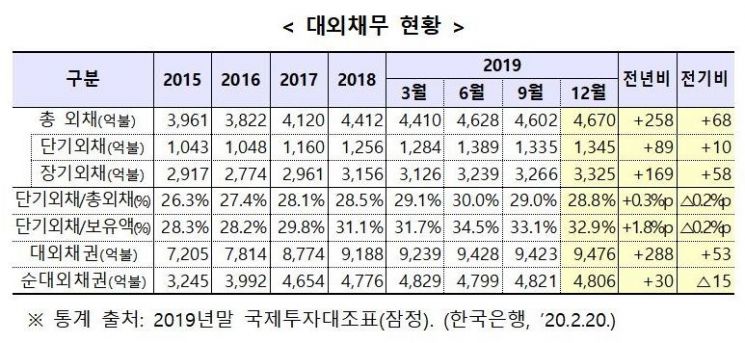
The Ministry of Economy and Finance announced on the 20th that external debt as of the end of last year was 467 billion dollars, an increase of 25.8 billion dollars compared to the previous year-end.
Short-term external debt (maturity within one year) was 134.5 billion dollars, up 8.9 billion dollars from the previous year-end, and long-term external debt (maturity over one year) was 332.5 billion dollars, up 16.9 billion dollars from the previous year-end.
The Ministry explained that the increase in external debt was due to expanded foreign investment in government bonds and increased borrowing by the banking sector.
In fact, the government sector increased by 8.3 billion dollars due to expanded foreign investment in government bonds.
The banking sector rose by 14.8 billion dollars. This was due to increases in short-term borrowings (5.5 billion dollars), non-resident deposits (5.0 billion dollars), and expanded issuance of long-term foreign currency securities (3.3 billion dollars).
Other sectors also increased by 5.5 billion dollars due to expanded issuance of long-term foreign currency securities (6.8 billion dollars).
On the other hand, the central bank sector decreased by 2.6 billion dollars due to maturity repayments of bonds held by foreigners.
The proportion of short-term external debt to total external debt (up 0.3 percentage points) and the ratio of short-term external debt to holdings (up 1.8 percentage points) increased compared to the previous year-end, but declined during the third and fourth quarters (short-term external debt proportion down 1.2 percentage points, short-term external debt ratio down 1.6 percentage points).
Also, external assets reached 947.6 billion dollars, an increase of 28.8 billion dollars compared to the previous year-end, resulting in net external assets (external assets minus external debt) increasing by 3.0 billion dollars to 480.6 billion dollars.
A Ministry of Economy and Finance official said, "As uncertainties in the international financial market are expanding due to the spread of the novel coronavirus infection (COVID-19) and concerns about global economic slowdown, we plan to closely monitor external debt trends and further strengthen external soundness management."
© The Asia Business Daily(www.asiae.co.kr). All rights reserved.