[Asia Economy Reporter Junho Hwang] A study has revealed that the massive sea ice in the Antarctic Ocean made the Earth even colder during the Ice Age. The Antarctic sea ice acted as a lid blocking carbon dioxide coming from deep ocean water, which lowered the atmospheric carbon dioxide concentration and thus made the Earth even colder. This is the first study to identify the role of Antarctic sea ice during the Ice Age, drawing significant attention.
On the 18th, according to the Institute for Basic Science (IBS), a research team led by Axel Timmermann (Distinguished Professor at Pusan National University), head of the Climate Physics Research Group at IBS, announced the results of a joint study with the University of Hawaii. The study, published in the Proceedings of the National Academy of Sciences (PNAS), showed that Antarctic sea ice during the Ice Age accelerated the Ice Age further.
Sea ice acted as a lid blocking carbon dioxide
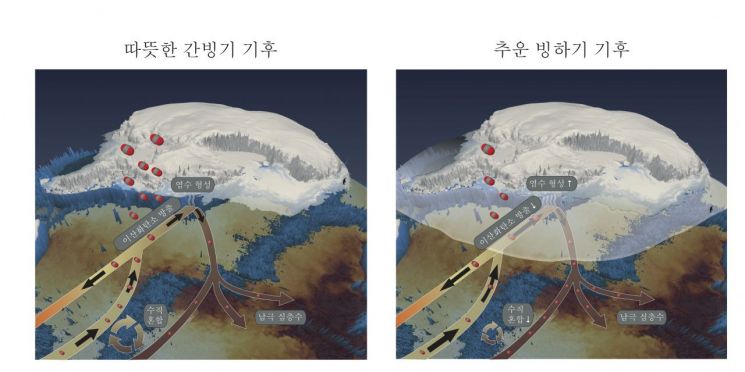
The research team confirmed the existing hypothesis that Antarctic sea ice played a crucial role during the Ice Age through state-of-the-art climate model simulations. The team analyzed the climate over the past 784,000 years, during which eight glacial-interglacial cycles occurred. The results concluded that as Antarctic sea ice expanded during the Ice Age, it trapped carbon dioxide released from the ocean beneath the sea ice, causing the Earth's temperature to drop further.
When temperatures fall and seawater freezes to form sea ice, the salinity of the remaining seawater increases due to water loss. Cold, salty water becomes denser and sinks to the ocean floor, forming Antarctic deep water. As temperatures decrease, the extent of sea ice grows, producing large amounts of deep water. This deep water upwells, releasing carbon to the atmosphere, but the sea ice acts as a lid preventing this release. Consequently, atmospheric carbon dioxide levels decrease, which further lowers the Earth's temperature.
The research team confirmed that at the beginning of the Ice Age, the increase in Antarctic sea ice caused a rise in density differences between deep and intermediate waters, significantly reducing carbon exchange between these water masses. During this process, atmospheric carbon dioxide concentration is estimated to have decreased by about 30 ppm. Later, at the mid-Ice Age, when sea ice extent and thickness reached their maximum, the carbon upwelled was prevented from being released into the atmosphere, causing an additional decrease of about 10 ppm in atmospheric carbon dioxide. According to the team, atmospheric carbon dioxide (CO2) concentration during the Ice Age was about 80?100 ppm lower than the pre-industrial level (280 ppm).
Atmospheric carbon dioxide concentration reduced by up to 40 ppm during the Ice Age
 Kal Stein, Research Fellow at IBS Climate Physics Research Division, lead author (first from the left), and corresponding authors
Kal Stein, a research fellow at the IBS Climate Physics Research Group, explained, "Unlike previous studies that analyzed only isolated past periods or failed to properly simulate the complex dynamics of the Antarctic Ocean, this is the first study to quantify the timing and scale of sea ice effects through a sophisticated dynamic model."
The research team plans to investigate the mechanisms by which the Antarctic Ocean absorbed and stored excess carbon as their next research task.
Axel Timmermann, the group leader, said, "More research is needed to fully unravel the secrets that triggered the Ice Age, such as the initial temperature drop and atmospheric carbon reduction," adding, "We suspect that the increase of Northern Hemisphere ice sheets and the resulting changes in seawater salinity are related to the early Ice Age fluctuations."
© The Asia Business Daily(www.asiae.co.kr). All rights reserved.