Government Announces 'Emergency Support Measures for Aviation Sector' at 'COVID-19 Economic Ministers Meeting'
Refunds Total 300 Billion KRW Since COVID-19... Liquidity Support for LCCs
Various Fee Reductions and Payment Deferrals Also Implemented
Support for New Routes and Postponement of Route Suspension and Fee Reduction Recovery
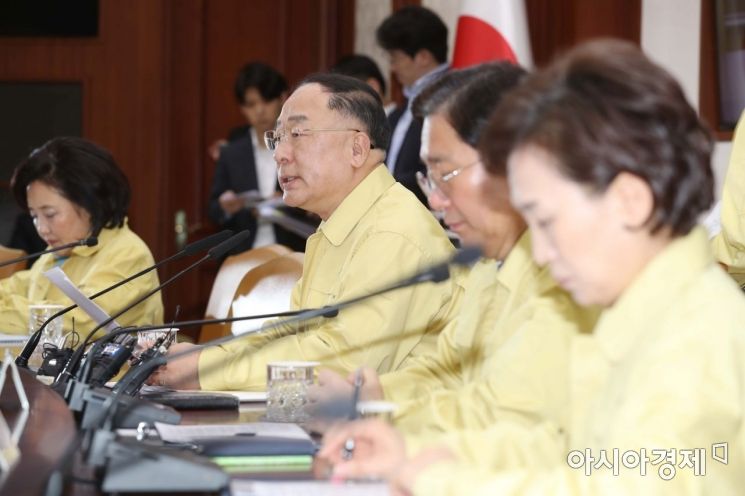 Hong Nam-ki, Deputy Prime Minister and Minister of Economy and Finance, is speaking at the 'COVID-19 Response Economic Ministers Meeting and Japan Export Regulation Related Ministers Meeting' held on the 17th at the government Seoul office video conference room. Photo by Moon Ho-nam munonam@
[Asia Economy Reporter Lee Chun-hee] The government has decided to provide emergency liquidity of up to 300 billion KRW to low-cost carriers (LCCs) facing temporary liquidity shortages due to a sharp decline in sales caused by the COVID-19 pandemic through the Korea Development Bank. It plans to ease the financial burden on airlines by deferring airport facility usage fees for up to three months for airlines whose passenger numbers have decreased compared to the same period last year. Along with this, the government will actively promote the allocation of traffic rights and the discovery of new routes to secure new markets.
On the morning of the 17th, the government announced these emergency support measures for the aviation sector at the 'COVID-19 Response Economic Ministers' Meeting.' Since the COVID-19 outbreak, the business outlook for domestic airlines has rapidly deteriorated. The number of weekly flights on Korea-China routes operated by domestic airlines, which was 546 per week, dropped to 126 per week as of the third week of February, a 77% decrease. With a surge in flight cancellations and refunds, the refund amounts incurred by domestic airlines over the past three weeks have reached approximately 300 billion KRW in total: Korean Air 127.5 billion KRW, Asiana Airlines 67.1 billion KRW, Jin Air 29 billion KRW, T'way Air 22.7 billion KRW, and Jeju Air 22.5 billion KRW. LCCs have been hit harder as they had focused on China and Southeast Asia routes following last year's Japan boycott movement.
Accordingly, the government will provide liquidity to airlines experiencing temporary liquidity shortages due to sharp sales declines and refund surges through loan screening procedures at the Korea Development Bank. It plans to support LCCs with liquidity up to 300 billion KRW.
Various fee reductions and payment deferrals will also be implemented. The government plans to defer airport facility usage fee payments for up to three months for airlines whose passenger numbers have decreased compared to the same period last year. The total deferred payment amount for domestic airlines is expected to reach 87.9 billion KRW. Considering the current average monthly payments of Korean Air 13.9 billion KRW, Asiana Airlines 7.1 billion KRW, and LCCs 8.3 billion KRW, totaling 29.3 billion KRW, the three-month deferred payment amount is expected to reach 87.9 billion KRW.
If air travel demand does not recover in the first half of the year, a 10% reduction in landing fees will be applied starting in June. According to the aviation industry competitiveness enhancement plan announced in December last year, various fees currently being reduced at Incheon Airport will have their reductions extended until next year if demand does not recover. Additionally, if new fines are imposed on airlines due to administrative sanctions, payment of these fines will be deferred for one year.
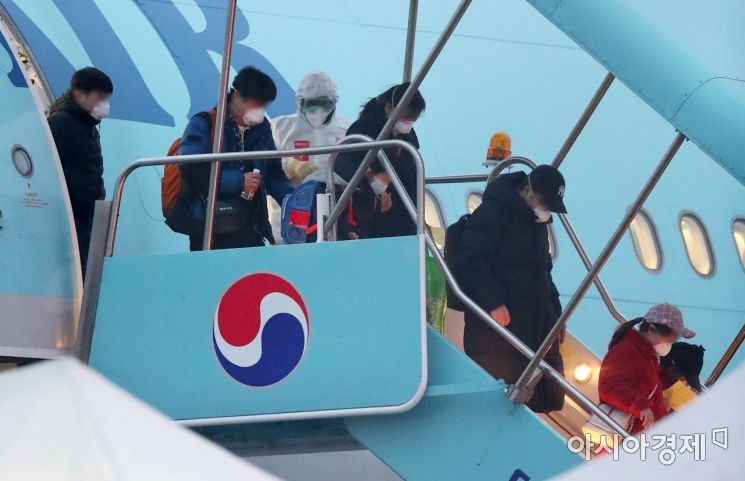 Overseas Koreans and Chinese families who stayed in Wuhan, Hubei Province, China, arrived at Seoul Gimpo International Airport on the 12th and are disembarking from the Korean Air charter flight. Photo by Kim Hyun-min kimhyun81@
The government will also promote the discovery of alternative and new routes. By the end of this month, it will allocate routes such as Paris, Lisbon, and Sydney to secure alternative routes and expand medium- to long-distance routes, and support the discovery of new routes to Vietnam, Laos, and others. Administrative support will be provided to shorten procedures as much as possible if airlines wish to open alternative routes.
To reduce the burden on airlines maintaining operations despite reduced demand, the government plans to expand the exemption of the system that recovers traffic rights and slots if usage falls below certain standards, following the exemption applied to Korea-China routes on the 5th. Currently, routes with traffic rights operated less than 20 weeks or slots used less than 80% are subject to recovery.
Kim Hyun-mi, Minister of Land, Infrastructure and Transport, said, "Aviation is a key means of human and material movement between countries, so it is the sector most directly hit when an international infectious disease occurs. This emergency plan includes emergency funds to overcome liquidity shortages and measures to support early recovery of air travel demand."
© The Asia Business Daily(www.asiae.co.kr). All rights reserved.