Tender for feasibility study and traffic improvement plan
Seoul city official: "Possible to announce as early as February... COVID-19 is a variable"
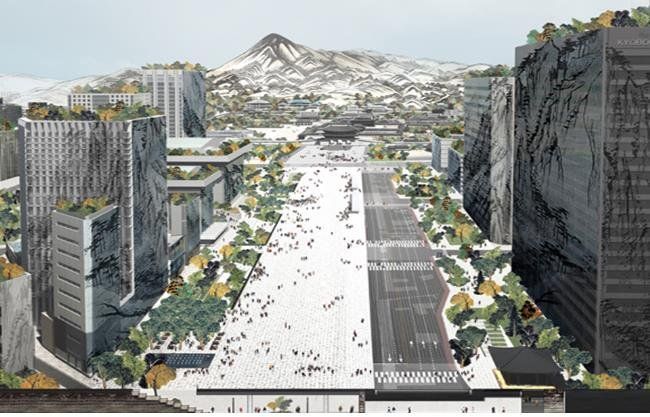
[Asia Economy Reporter Onyu Lim] Seoul City's plan to restructure Gwanghwamun Square is expected to be unveiled as early as this month. Seoul City has begun bidding for a feasibility study to verify the project's viability ahead of the plan's release. The restructuring work of Gwanghwamun Square was originally scheduled to start last month but was halted due to criticisms of rushed implementation and opposition from related government ministries, including the Ministry of the Interior and Safety.
According to Seoul City on the 6th, the city recently announced a bid on the Public Procurement Service's Nara Market for "Traffic Monitoring and Implementation Effect Prediction Analysis following the Creation of a New Gwanghwamun Square." Bids will be accepted until the 25th, with contracts planned thereafter.
A Seoul City Transportation Operations Department official explained, "We plan to conduct surveys and analyses of quantitative indicators related to traffic, society, economy, and culture before, during, and after the project." He added, "Through this, we will identify potential problems during construction, the impact of traffic environment changes on the area, and devise ways to minimize citizen inconvenience." The city intends to verify the benefits and public interest enhancement effects of the Gwanghwamun Square restructuring through this analysis to confirm the project's feasibility and derive traffic improvement measures for the surrounding areas.
The Gwanghwamun Square restructuring plan, announced by Mayor Park Won-soon in April 2018, was designed to restore the square's historic and civic significance. The core of the plan is to reduce Sejong-daero in front of Gwanghwamun from 10 lanes (five lanes each way) to 6 lanes and expand the square's area to 3.7 times its current size, as well as restore the Woldae (a raised platform) in front of Gyeongbokgung Palace, which was damaged during the Japanese colonial period.
The city announced the project design in January 2019 after an international design competition, but faced setbacks due to opposition from civic groups, experts, and the Ministry of the Interior and Safety. Issues cited included inadequate traffic systems, lack of a future vision, and unilateral promotion without communication. Criticism also arose that Mayor Park used Gwanghwamun Square as a political tool and a record of achievements, especially regarding the plan to engrave candlelight images on the ground. Consequently, in September last year, the city decided to halt the planned groundbreaking and administrative procedures scheduled for January 2020 and to reestablish the project's timing and direction by reflecting citizens' opinions.
In over ten expert and citizen discussions held thereafter, traffic issues were particularly emphasized. Opinions diverged on road reduction, full pedestrianization, public transportation, bicycle lanes, and the Greater Seoul Metropolitan Express Railway (GTX-A). A Seoul City Gwanghwamun Square Promotion Team official stated, "Regarding full pedestrianization, we are considering a long-term approach," adding, "We are currently reviewing how to incorporate citizens' demands and will announce the results to the public between February and March."
The city also plans to hold forums based on the new design plan. However, since local government heads are prohibited from holding or sponsoring events from April 15, which is 60 days before the general election, and due to the ongoing spread of the novel coronavirus (COVID-19), there is speculation that the forums may be postponed until after the election.
© The Asia Business Daily(www.asiae.co.kr). All rights reserved.
![Clutching a Stolen Dior Bag, Saying "I Hate Being Poor but Real"... The Grotesque Con of a "Human Knockoff" [Slate]](https://cwcontent.asiae.co.kr/asiaresize/183/2026021902243444107_1771435474.jpg)















