Zigbang Announces Simulation Results of Financial Costs for Apartment Purchases in 4Q Last Year
Potential Demand Shift to Non-Regulated Areas... "Nodogang and Northeast Gyeonggi May Soar"
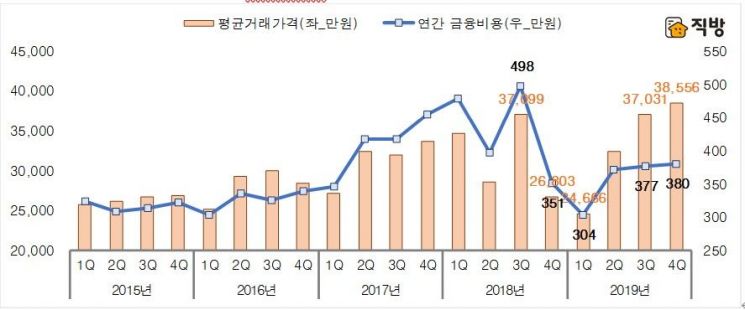
[Asia Economy Reporter Onyu Lim] The increase rate of financial costs due to apartment sales in the fourth quarter of 2019 was only one-quarter of the increase rate of actual transaction prices. Zigbang analyzed that a favorable environment for apartment purchases is being maintained as a result of interest rate cuts. In Seoul, financial costs are decreasing as actual transaction prices have also fallen.
On the 10th, Zigbang simulated the annual financial costs of apartment purchases assuming a loan-to-value ratio (LTV) of 40%. The financial cost in the fourth quarter of 2019 was 3.8 million KRW, a 0.9% increase from 3.77 million KRW in the previous quarter. During the same period, the average actual transaction price rose 4.1% from 370.31 million KRW to 385.56 million KRW. Zigbang analyzed, "The financial burden due to the increase in transaction prices was relatively small."
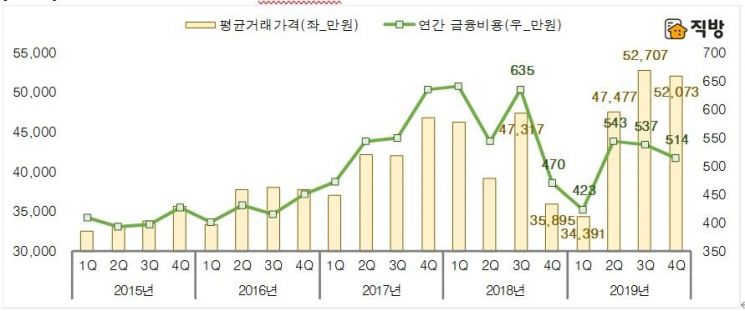 Simulation of Average Actual Transaction Prices and Purchase Financing Costs for Apartments in the Seoul Metropolitan Area
By region, financial costs for apartment purchases in the metropolitan area decreased for two consecutive quarters. In the fourth quarter of 2019, financial costs were 5.14 million KRW, down 230,000 KRW from 5.37 million KRW in the third quarter. Transaction prices fell by 6.34 million KRW from 527.07 million KRW to 520.73 million KRW. Zigbang explained, "Unlike the slight increase in financial costs nationwide, the decrease in financial costs in the metropolitan area was due to both falling interest rates and declining transaction prices."
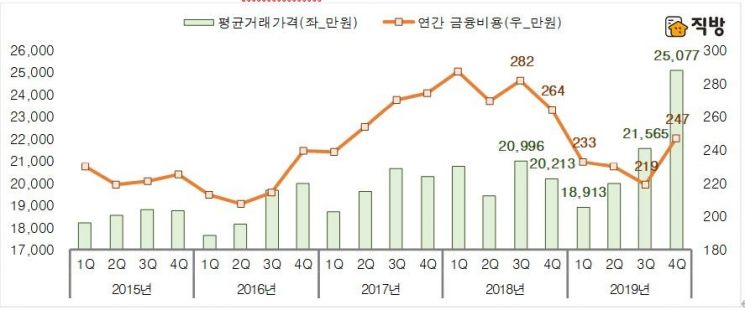 Simulation of Average Actual Transaction Prices and Purchase Financing Costs for Regional Apartments
Financial costs for apartment purchases in provincial areas rose to 2.47 million KRW, marking the first increase since the third quarter of 2018. Although lower than 2.64 million KRW in the fourth quarter of 2018, it was the highest in 2019. Zigbang analyzed, "The increase in financial costs was caused by the rise in apartment transaction prices from 215.65 million KRW in the third quarter to 250.77 million KRW in the fourth quarter."
Breaking down by city and province, financial costs for apartment purchases decreased only in Seoul, Daejeon, and Jeju compared to the previous quarter, while all other regions saw increases. Seoul decreased by 580,000 KRW, Daejeon by 10,000 KRW, and Jeju by 170,000 KRW. Especially in Seoul and Jeju, financial costs decreased due to declines in both interest rates and transaction prices. The region with the largest increase in financial costs was Busan, rising by 510,000 KRW. Sejong followed with an increase of 500,000 KRW. Sejong was the only region where financial costs rose compared to the same period last year.
The region with the highest financial costs was Seoul, analyzed at 8.07 million KRW annually. Sejong was next highest at 4.09 million KRW, followed by Gyeonggi at 3.99 million KRW and Busan at 3.47 million KRW.
Although the government is tightening loan regulations to restrict capital inflows into high-priced housing, low financing costs are being maintained, and leverage investment using jeonse (long-term lease deposits) remains effective, raising concerns that demand may shift to non-regulated areas. In the fourth quarter of 2019, while average transaction prices in Seoul declined, prices in Gyeonggi increased.
Ham Young-jin, head of Zigbang Big Data Lab, said, "If this sales market trend continues, the rapid price surge in mid-to-low priced apartment markets such as the so-called ‘Nodogang’ and ‘Northeastern Gyeonggi’ areas, which occurred in 2007, could be reproduced this year," adding, "It is necessary to monitor market instability outside regulated areas and consider preemptive measures to stabilize prices."
© The Asia Business Daily(www.asiae.co.kr). All rights reserved.



















