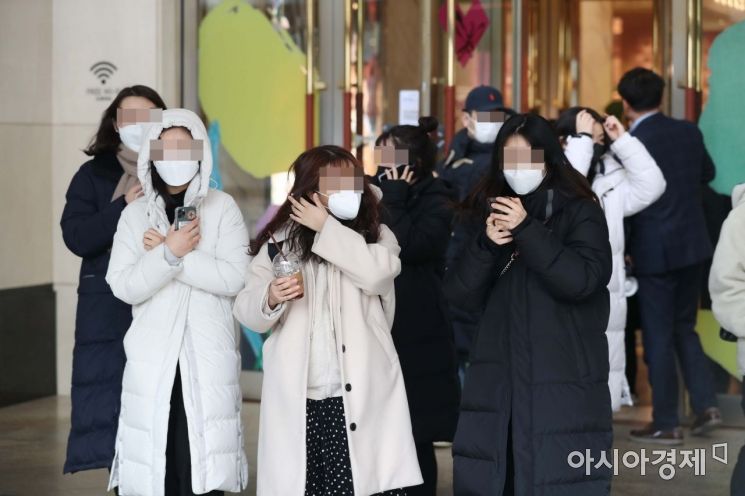
 On the 7th, the Lotte Department Store Main Branch in Jung-gu, Seoul, where a confirmed case of the novel coronavirus infection was identified, will temporarily close until the 9th. Customers are leaving the department store after hearing the closure news. Photo by Mun Ho-nam munonam@
[Asia Economy Reporter Junho Hwang] As the number of confirmed cases of the novel coronavirus infection (Wuhan pneumonia) has increased to 25 as of the 9th, a paper studying the turning point of infectious disease spread is gaining attention. According to the study "Research on Infectious Disease Spread Prediction Model Using Complex Network," co-corresponding authored by Professor Kwang-Hyung Lee of KAIST’s Department of Bio and Brain Engineering and first authored by CEO Ki-Sung Kim of BioBrain Inc., the spread of infectious diseases enters a decline phase when the number of contacts is reduced to seven or fewer.
Novel Coronavirus Declines When 17 out of 100 Recover
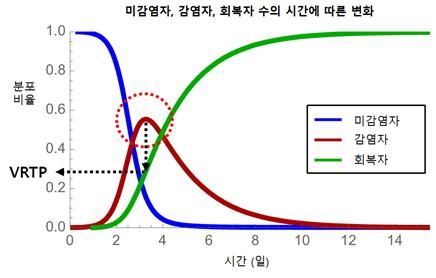 I want to know the point where the infection graph bends, but I do not know it in advance. However, it can be understood that the recovery curve will bend when it reaches the VRTP.
The research team revealed through computer analysis that there is a point where the spread of infectious diseases slows down. Even assuming a 100% fatality rate and maximum infection rate and duration (20 days), if the average daily number of contacts is seven or fewer, the disease cannot infect the entire population. The team explained that this is due to the spread being blocked by recovery or death from the disease.
CEO Kim explained, "If a deadly infectious disease like the Ebola virus spreads and the number of contacts exceeds seven, it could become a disease threatening the entire world like the Black Death. However, if the number of contacts is kept below seven through campaigns and other measures, the spread of the infectious disease can be prevented."
In particular, the research team stated that it is possible to predict the turning point of infectious disease decline. As the cumulative number of recovered patients increases, the decline point is reached. For example, assuming an infectious disease like the novel coronavirus with an infection rate of 33% and a duration of 7.6 days, and an average contact number of 20, the virus spread slows when the cumulative recovery rate reaches 17.35%.
CEO Kim said, "The characteristics of the novel coronavirus were calculated based on data from China," adding, "If we assume there are 100 people on a remote island, after the infectious disease breaks out, the spread slows down once 17 people recover."
The research team also revealed that even for the worst infectious diseases, the spread slows when the cumulative number of recovered individuals reaches 27% of the network (society) population.
Any Infectious Disease Declines When Contacts Fall Below Seven
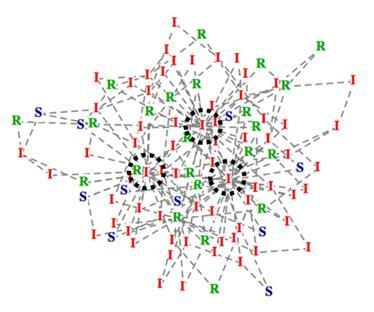 Blue represents susceptible individuals (S), red represents infected individuals (I), green represents recovered individuals (R), and those marked with black circles are super spreaders. When these three groups (susceptible, infected, recovered) are expressed as proportions of the total population, the above graph (showing the change in the number of infected individuals over time) is created.
The research team studied the decline phase of infectious diseases following the outbreak of Middle East Respiratory Syndrome (MERS) in May 2015. They reported that the spread of infectious diseases is determined by three characteristics: infectivity, persistence (recoverability), and social structure, and conducted research using computer simulations.
Infectivity refers to the degree of human-to-human transmission capability, pathogen characteristics, and contact occurrence. Persistence refers to the human immune system’s ability to recover, including the incubation period and the time taken to fully recover. Uninfected individuals become infected based on the infection rate, then go through the persistence period before becoming recovered. Social structure indicates the number of people one person contacts per unit time.
Human Extinction Due to Virus Outbreak? Unlikely
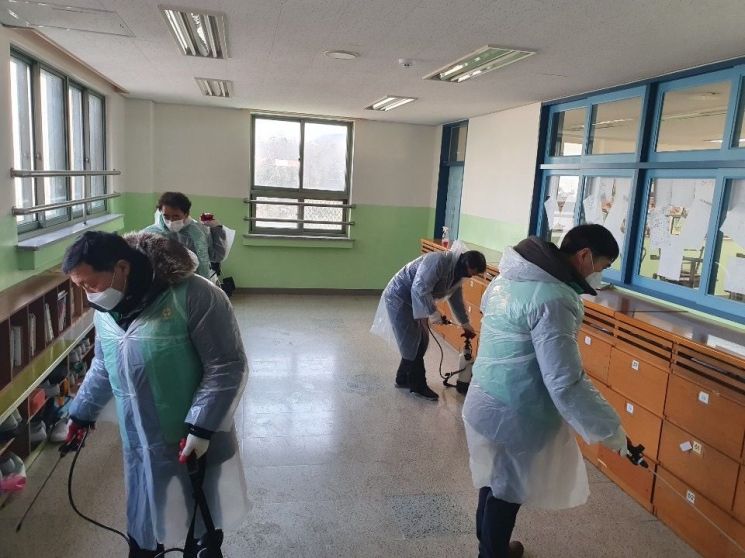
The research team also concluded that it is difficult for humanity to be wiped out by a virus.
Professor Lee said about this study, "We found that there is always a point where the spread of any infectious disease slows down, that this point can be predicted, and that if the average daily number of contacts is reduced to seven or fewer, humans can be safe from any infectious disease."
He added, "Humans can reduce infection rates through preventive vaccines, improve recovery duration through treatment development, and lower the number of contacts through quarantine measures, so survival is never threatened by any disease."
© The Asia Business Daily(www.asiae.co.kr). All rights reserved.
![Clutching a Stolen Dior Bag, Saying "I Hate Being Poor but Real"... The Grotesque Con of a "Human Knockoff" [Slate]](https://cwcontent.asiae.co.kr/asiaresize/183/2026021902243444107_1771435474.jpg)

















