Fear of Novel Coronavirus Causes Seafood Market Gatherings to Plummet
Restaurants Say "Customer Numbers Down 90%... Immediate Concerns Over Rent"
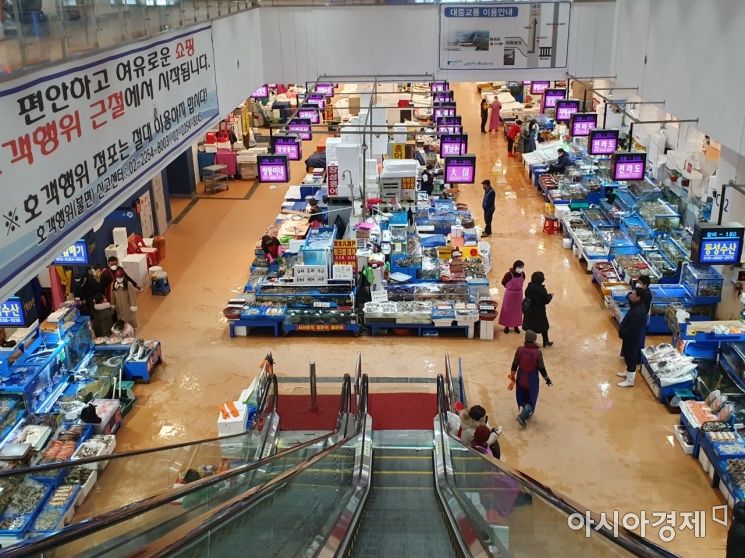 As new coronavirus infections are spreading, the Noryangjin Fishery Wholesale Market located on Nodeul-ro, Dongjak-gu, Seoul, appears quiet around 5 p.m. on the 5th. Photo by Choi Sunghye
[Asia Economy Reporter Choi Sunghye] "Since the new coronavirus issue emerged, not only have domestic customers but also those from China and Vietnam stopped coming altogether. Although it is usually slow after the Lunar New Year holiday, the market has never been this empty. As consumption decreases, fish prices have dropped, but with no customers at all, I’m worried about making ends meet this month."
On the afternoon of the 5th, around 5 p.m., when the number of confirmed cases of the novel coronavirus infection (Wuhan pneumonia) in Korea rose to 19, self-employed worker Park Ji-eun (alias, 55), whom we met at A Shop on the first floor of Noryangjin Seafood Wholesale Market located on Nodeul-ro, Dongjak-gu, Seoul, sighed as she looked at the fish tanks filled with seafood.
Park said, "The price of king crab has plummeted from 60,000 to 65,000 won per kilogram last week to about 10,000 won less this week, only 50,000 to 55,000 won," adding, "But since no customers are coming to the market itself, sales cannot be increased at all." According to the seafood information platform In-eo Gyoju Haejeokdan, the market price of king crab (blue, grade A, large) is 52,000 won per kilogram, about 30% lower than the usual 70,000 to 80,000 won at this time of year. The cause is that the Huanan seafood market, the origin of the coronavirus, was closed, reducing demand in the Chinese seafood market overall, and king crabs that were all imported from Russia and destined for China have been blocked, resulting in cheap king crabs entering the domestic market.
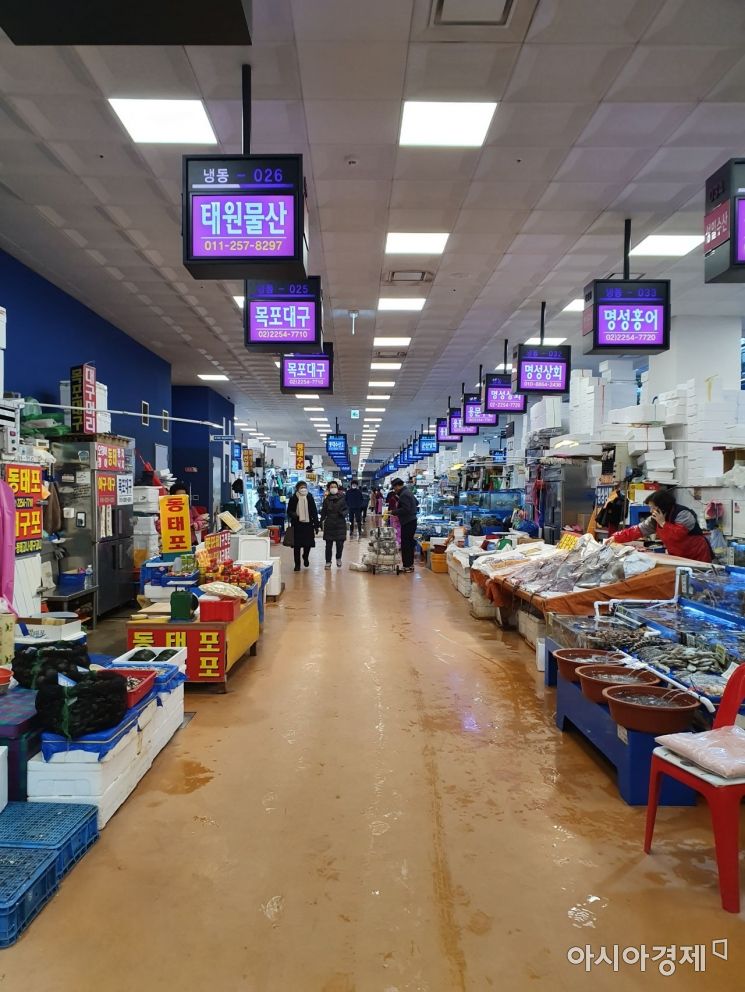 As new coronavirus infections are spreading, the Noryangjin Seafood Wholesale Market located on Nodeul-ro, Dongjak-gu, Seoul, appears quiet around 5 p.m. on the 5th. Photo by Choi Sunghye
Park Min-seok (alias, 60), who sells fish at nearby B Shop, lamented, "Since the new coronavirus issue, not only imported seafood but also domestically caught seafood prices have fallen due to reduced demand, but they simply do not sell." According to the Suhyup Noryangjin Seafood Market, due to reduced fishing volume caused by the spread of the coronavirus, the weekly supply from January 27 to February 1 decreased by 333 tons compared to the previous week, totaling 693 tons, and prices of red sea bream, squid, and mackerel fell by up to 30% compared to the previous week.
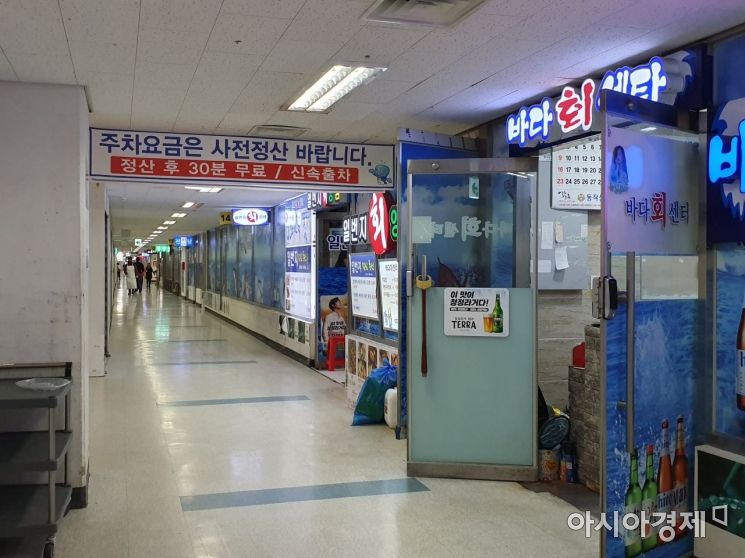 Around 5 PM on the 5th, most of the restaurants located on the 2nd floor of Noryangjin Fisheries Wholesale Market were seen completely empty. Photo by Choi Sunghye
The 2nd and 5th floor sashimi restaurants also showed a deserted atmosphere with few people. This is because many people canceled various gatherings and meetings due to infection concerns. Most of the tables in the 25 restaurants were completely empty, and even few people passed through the corridors. Kim Eun-ju (alias, 52), owner of C Restaurant, said, "It’s 5 p.m., and I just received my first customer," complaining, "Customers have decreased by more than 90% for two weeks." Kim added, "Sales have dropped by 70 to 80%, so I’m worried about this month’s rent and labor costs," and confessed, "No one knows how long this situation will last, so everyone is trembling with anxiety."
The seafood industry expects seafood prices to fall further next week. A representative of In-eo Gyoju Haejeokdan stated, "Ships carrying king crabs that were supposed to go to China are rerouting to Korea, and at least 100 tons of king crab supply will be released in Korea next week alone."
However, as the number of confirmed cases rapidly increases domestically, consumer sentiment is expected to shrink to levels seen during the Middle East Respiratory Syndrome (MERS) outbreak. According to Korea Investment & Securities, during the 2003 Severe Acute Respiratory Syndrome (SARS) epidemic and the 2015 MERS outbreak, household consumption, which had been growing at about 3% quarter-on-quarter, fell by -1.5% and -3.8% in the first and second quarters of 2003, respectively, and recorded 0.1% and -3.6% in the first and second quarters of 2015. Furthermore, according to the Korea Foodservice Industry Research Institute, comparing sales in May 2015 before the MERS outbreak and June 2015 after the outbreak, 84.3% of foodservice businesses experienced a sales decline over one month, with the sales drop reaching 34.3%.
© The Asia Business Daily(www.asiae.co.kr). All rights reserved.
![Clutching a Stolen Dior Bag, Saying "I Hate Being Poor but Real"... The Grotesque Con of a "Human Knockoff" [Slate]](https://cwcontent.asiae.co.kr/asiaresize/183/2026021902243444107_1771435474.jpg)

















