[Asia Economy Reporter Byunghee Park] The Korean Symphony Orchestra's New Year's concert on the 31st of last month was intriguing. It felt fresh and challenging.
For the main performance in the second half of the New Year's concert, the Korean Symphony prepared a unique show that fused media art. Prior to that, the first half featured waltzes and a collaboration with flutist Saetbyeol to lift the mood.
The first piece performed was Johann Strauss II's "Emperor Waltz." This piece was composed by Johann Strauss II as a celebratory dance music for the 40th anniversary of the reign of Austrian Emperor Franz Joseph I. The rhythm of the waltz was perfect for creating a joyful atmosphere at the New Year's concert.
The next piece was Mozart's "Flute Concerto No. 1," featuring flutist Han Yeo-jin (19) as the soloist. This marked the true beginning of the fresh and challenging New Year's concert. Han Yeo-jin delivered a performance so resolute that it gave an impression of boldness.
Han Yeo-jin was selected as the Korean Symphony's "2020 Rising Star." Last year, she was chosen as a rising star by the Kumho Asiana Cultural Foundation and held a solo recital at Kumho Art Hall. Since the age of eleven, she has participated in international competitions, becoming the youngest finalist at the 2014 Carl Nielsen International Music Competition and receiving a special prize, and winning first place at the 2016 Berlin International Competition. Perhaps due to her rich performance experience at a young age, her playing felt unhesitant.
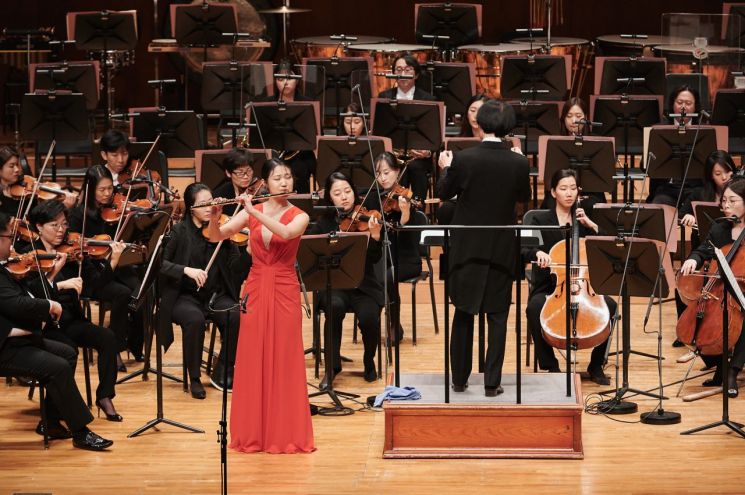
After the concerto, an encore solo followed. When Han Yeo-jin announced, "For the encore, I prepared Paganini's 24 Caprices," small exclamations of "Wow!" quietly erupted throughout the audience.
Niccol? Paganini was a 19th-century Italian violinist and composer, renowned as the greatest virtuoso of his time. His skill was so extraordinary that he was suspected of having sold his soul to the devil, earning him the nickname "the Devil's Violinist." The "24 Caprices" are Paganini's representative pieces showcasing dazzling technique. Han Yeo-jin performed the "24 Caprices" with the same confidence as during the concerto, drawing even greater applause and cheers from the audience.
In the main performance of the second half, the Korean Symphony played "The Planets" by British composer Gustav Holst. The stage production was remarkable.
As the second half began, the concert hall at the Seoul Arts Center gradually darkened, resembling entering a movie theater. The musicians on stage softly lit their sheet music with LED lights. About 20 to 30 lantern-like lights created a subtle atmosphere.
The performance started. "The Planets" is a suite of seven orchestral movements named after the seven planets of the solar system, composed by Holst, who was deeply interested in astrology. John Williams, the film composer famous for "Star Wars," often borrowed themes from "The Planets" for his movie scores. Therefore, the first movement "Mars, the Bringer of War" and the fourth movement "Jupiter, the Bringer of Jollity" feel familiar even to those hearing "The Planets" for the first time.
As the music began, the choir loft surrounding the orchestra was filled with laser visuals. The images changed moment by moment with abstract shapes and vibrant colors, responding to the orchestra's playing in a dance-like, exquisite harmony. The overall background seemed to represent space, fitting well with the theme of the planets. During the second movement, "Venus, the Bringer of Peace," the visuals showed the solar system, and a blazing red planet approached the audience prominently.
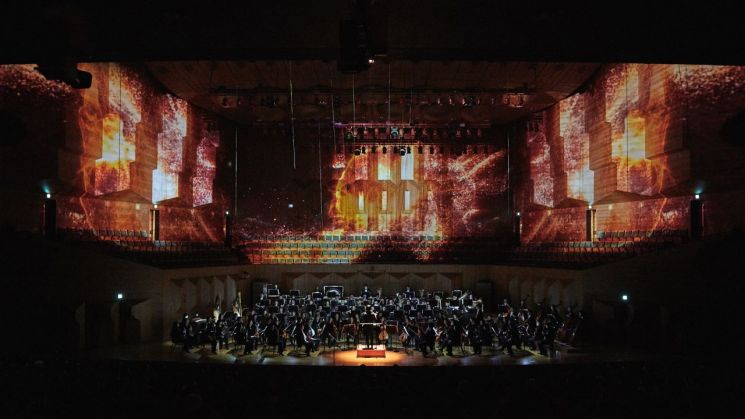
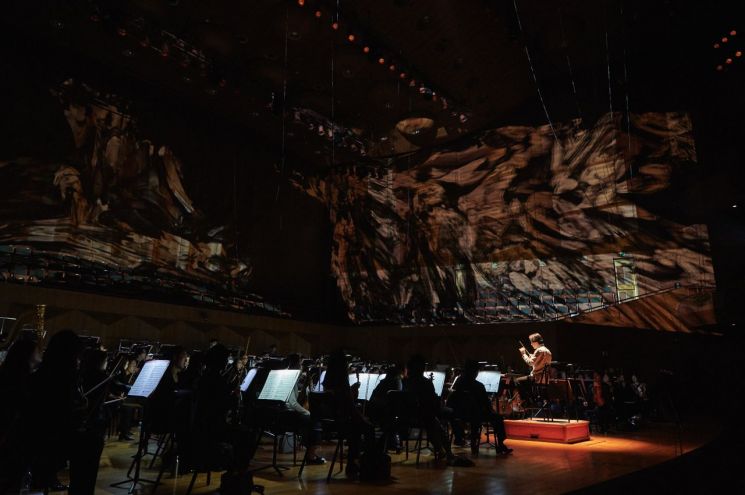
During the final seventh movement, "Neptune, the Mystic," the Wiener Opera Choir added harmonies. The choir did not appear on stage but sang from the side waiting rooms. The audience was inevitably puzzled by the gradually intensifying harmonies in the dim darkness. The choir's harmonies in the faint darkness gave a mysterious feeling as if coming from a distant unknown world, matching well with the piece "The Planets." Only after the doors of the side waiting rooms fully opened could the audience confirm the source of the harmonies. Even after the orchestra finished playing, the choir's harmonies continued for a while. As the doors slowly closed, the harmonies gradually softened, leaving a lingering impression as the scheduled performance concluded.
With the addition of media art visuals enhancing the viewing experience, the audience responded with great applause at the end of the performance. Jung Chi-yong, the artistic director and conductor of the Korean Symphony Orchestra, seemed satisfied with the audience's reaction. While conducting the encore piece Edward Elgar's "Pomp and Circumstance March," he briefly raised both hands as if cheering. Then, choosing Johann Strauss I's "Radetzky March" as the second encore, he led the audience's lively applause and concluded the concert.
© The Asia Business Daily(www.asiae.co.kr). All rights reserved.
![Clutching a Stolen Dior Bag, Saying "I Hate Being Poor but Real"... The Grotesque Con of a "Human Knockoff" [Slate]](https://cwcontent.asiae.co.kr/asiaresize/183/2026021902243444107_1771435474.jpg)

















