Estimated Current Account Balance Ratio to GDP Last Year at 3.5~3.6%
"Cannot Assume Current Account Balance Will Reach 56 Billion USD This Year"
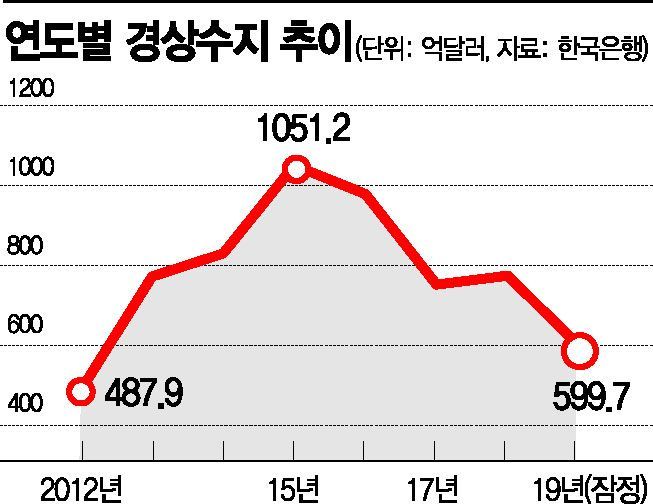
[Asia Economy Reporters Eunbyeol Kim and Sehee Jang] Last year, South Korea's annual current account surplus recorded its lowest level in seven years. The main reason was a sharp decline in the goods trade surplus due to a significant drop in exports, influenced by falling semiconductor prices.
According to the "December 2019 Balance of Payments (Provisional)" released by the Bank of Korea on the 6th, last year's current account surplus was $59.97 billion, down $17.5 billion from the previous year. This is the lowest level in seven years since 2012 ($48.79 billion). The causes were the sharp drop in semiconductor prices and a decrease in global trade volume. Last year, the current account surplus as a percentage of GDP was estimated to be around 3.5?3.6%.
Exports fell to $561.96 billion, marking a 10.3% decrease compared to the previous year. Imports also decreased by 6% year-on-year to $485.11 billion.
However, the deficit in the services account, which had been eroding the current account surplus, improved. Last year's services account deficit was $23.02 billion, with the deficit narrowing every year since 2017 (-$36.73 billion). The primary income account also recorded an all-time high surplus of $12.2 billion as domestic companies earned profits from overseas investments. Both dividend income ($22.68 billion) and interest income ($18.24 billion) reached record highs.
Concerns are growing that the domestic economy could further deteriorate as the current account surplus hits its lowest level in seven years. Given South Korea's economic structure with a high export ratio, a decrease in the current account surplus implies worsening terms of trade, which could lead to reduced domestic consumption. This results in less investment capacity, causing job losses → reduced production and consumption.
In particular, it is problematic that achieving this year's current account forecast ($56 billion) also seems difficult. The spread of the novel coronavirus infection (Wuhan pneumonia) inevitably affects both goods and services accounts comprehensively.
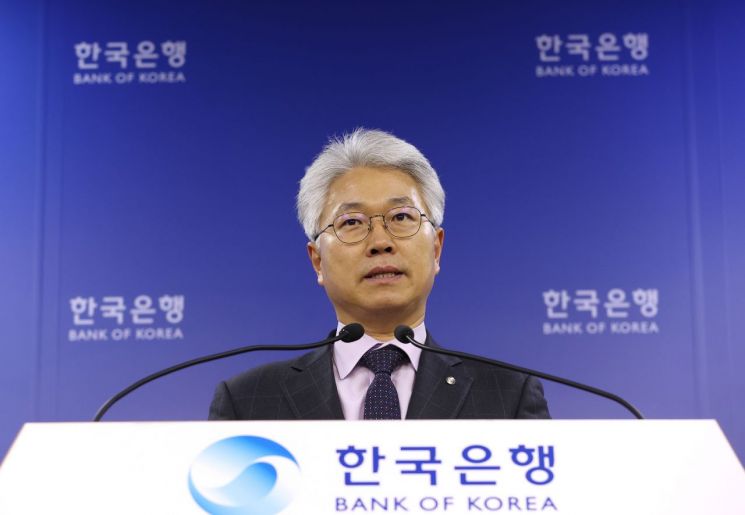
Park Yang-su, Director of the Economic Statistics Bureau at the Bank of Korea, said, "Recently, factory operations in China have been suspended, which could impact our export sectors such as processing and intermediary trade." He added, "The suspension or reduction of flights to China could negatively affect travel and transportation accounts, and if restrictions on Chinese entry and exit are imposed, the travel account could also be impacted."
Professor Shin Se-don of the Department of Economics at Sookmyung Women's University also said, "Although the government denies it, many economists believe that export activity has slowed compared to last year," and "We expect South Korea's exports to be further hit by the novel coronavirus."
Meanwhile, the sharp decline in last year's current account surplus was ultimately influenced by semiconductor prices. The fixed transaction price of 8GB DRAM, which was around $6 at the beginning of last year, fell to the $2.9 range. External factors were also negative. Director Park explained, "The semiconductor supercycle (2016?2018) ended, leading to a significant downturn in the semiconductor market, and global economic slowdown caused by trade conflicts, Brexit (the United Kingdom's withdrawal from the European Union), and the Hong Kong situation severely worsened our goods trade balance."
Imports also decreased by about $31 billion to $485.11 billion compared to the previous year. Although the decrease in imports was smaller than the export decline ($64.31 billion), concerns about a 'recession-type surplus' remain. The drop in oil prices lowered import unit prices, reducing total import amounts. The contraction in the semiconductor market also affected related investments such as machinery and equipment imports.
The improvement in the services account was a positive factor. Last year, the number of Chinese visitors to South Korea increased by 25.8% year-on-year to 6.02 million, and total arrivals increased by 14.0%. Additionally, the boycott of Japanese products led to stagnation in domestic travel to Japan, reducing the travel account deficit. The primary income account's record high of $12.2 billion was also a positive element, as companies' dividends and investment income from overseas subsidiaries increased. Director Park said, "As domestic companies actively expand overseas, the primary income account recorded an all-time high, which is expected to help maintain our current account surplus."
© The Asia Business Daily(www.asiae.co.kr). All rights reserved.
![Clutching a Stolen Dior Bag, Saying "I Hate Being Poor but Real"... The Grotesque Con of a "Human Knockoff" [Slate]](https://cwcontent.asiae.co.kr/asiaresize/183/2026021902243444107_1771435474.jpg)
















