January Consumer Price Index Rises 1.5%... Largest Increase Since December 2018
Impact of Rising Agricultural and Petroleum Prices
Mask Addition Under Review for Survey Items Due to Fine Dust and Other Factors
[Sejong=Asia Economy reporters Kim Hyunjung and Joo Sangdon] In January this year, the Consumer Price Index (CPI) recorded a 1% range increase for the first time in 13 months. This was due to the base effect of agricultural product prices and the end of the government's fuel tax reduction, which had caused the '0% range increase' last year.
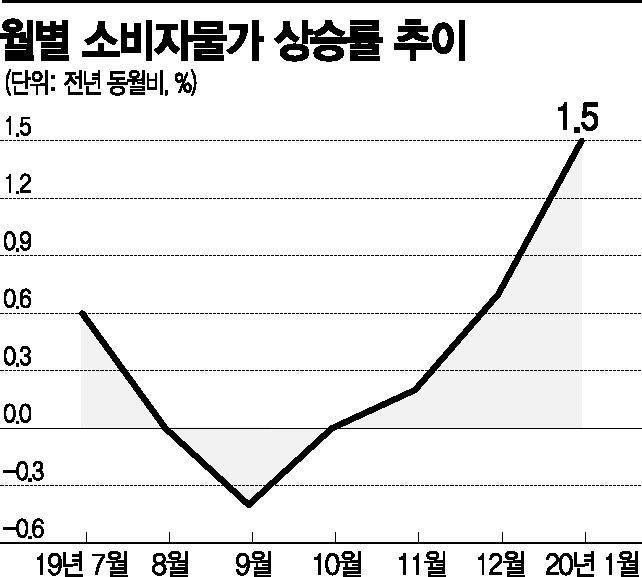
According to the 'January 2020 Consumer Price Trends' announced by Statistics Korea on the 4th, the consumer price in January rose 1.5% compared to the same period last year. This is the first time in 13 months since December 2018, when it recorded 1.3%. The previous highest increase rate was 2.0% recorded in November 2018. The consumer price index was flat (0.0%) in August last year, showed the first-ever negative (-0.4%) in September, remained flat in October, then turned to an increase (0.2%) in November after four months, and increased further in December (0.7%) and January.
An Hyeongjun, Director of Economic Trend Statistics at Statistics Korea, explained, "The 0% range inflation rate last year was largely due to the base effect caused by high prices continuing from the heatwave in the second half of 2018 and the policy effects of strengthened free education and health insurance coverage." He added, "This year, with the base effect ended and crop conditions worsening, prices of vegetables and other agricultural products rose," and "Along with the recent rise in international oil prices, petroleum prices also increased due to the end of the fuel tax reduction that had been in effect from the second half of 2018 to the first half of 2019."
The 'core inflation index' excluding price fluctuations due to seasonal factors or temporary shocks, such as petroleum and agricultural products, rose 0.9% compared to the same month last year. The OECD standard core inflation index, which excludes food and energy, rose 0.8%. These are the largest increases since July last year (1.0%, 0.9%, respectively).
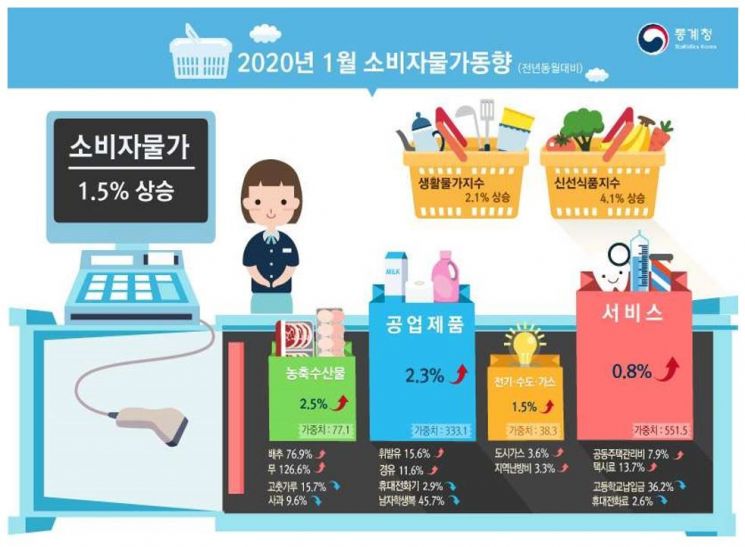
The 'living cost index,' composed of 141 items with high purchase frequency and expenditure share that are sensitive to price changes, rose 2.1% compared to the same month last year. The 'fresh food index,' composed of 50 items with prices highly affected by weather conditions, surged 4.1%. The 'owner-occupied housing cost included index,' which includes service costs incurred while using owner-occupied housing, rose 1.2% compared to a year ago.
Looking at prices by item, due to crop issues, prices of napa cabbage (76.9%) and radish (126.6%) rose sharply, and among industrial products, gasoline (15.6%) and diesel (11.6%) showed notable increases. Among service costs, taxi fares (13.7%) and high school tuition fees (36.2%) increased.
The impact of the novel coronavirus infection (Wuhan pneumonia) was not reflected in this consumer price data. For agricultural and livestock products and petroleum, price surveys are conducted three times a month (early, mid, and late), but for industrial products, only once around mid-month. Considering that the novel coronavirus spread rapidly from the end of last month, it is expected that related price statistics will be reflected starting February. Director An said, "We cannot judge the development situation, but in the case of MERS, it temporarily affected leisure and amusement facility usage fees (in May and June 2015) rather than overall prices, then rebounded in July," and added, "The novel coronavirus will be reflected in next month's prices."
Looking ahead, inflation is expected to continue in the 1% range this year. Director An predicted, "Once the base effect ends, this year will likely be in the low to mid 1% range," and "Since education and health policies will be maintained, it is unlikely to improve (rise) sharply, so around the low 1% range is expected."
Statistics Korea is also considering newly including masks as a consumer price survey item. Masks have already been selected as a preliminary item, and price surveys have been conducted since January this year. However, this is not due to the spread of the novel coronavirus but because of the increased consumption share related to fine dust issues. If confirmed as a survey item, the year-on-year price change rate will be announced starting January next year.
© The Asia Business Daily(www.asiae.co.kr). All rights reserved.
![Clutching a Stolen Dior Bag, Saying "I Hate Being Poor but Real"... The Grotesque Con of a "Human Knockoff" [Slate]](https://cwcontent.asiae.co.kr/asiaresize/183/2026021902243444107_1771435474.jpg)

















