OK Cashback Point Service Section
3.3 Billion Cancellation Request Plaintiff's Defeat Confirmed
2016 Lotte Case Recognized, Contradicts Ruling
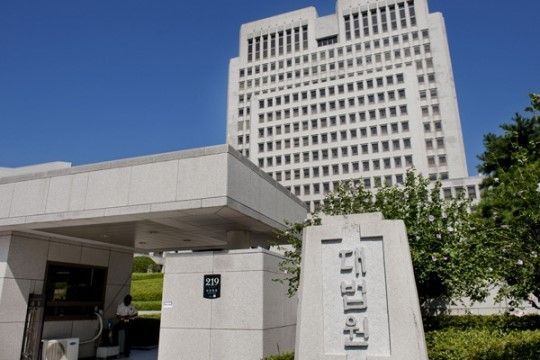
[Asia Economy Reporter Kim Hyung-min] The Supreme Court has ruled that telecommunications companies must pay value-added tax (VAT) on the total amount, even if customers partially pay their telecom bills using 'points.' Telecom companies had argued that VAT should only be paid on the amount excluding the points portion, but this was not accepted.
The Supreme Court's First Division (Presiding Justice Kwon Soon-il) announced on the 31st that it upheld the lower court ruling against SK Telecom in the final appeal case, in which SK Telecom sued Namdaemun Tax Office to cancel the refusal of correction regarding approximately 3.3 billion KRW in VAT.
SK Telecom reported and paid VAT from 2011 to 2013 based on the full amount of customers' telecom bills as the tax base. However, six years later in 2017, SK Telecom filed a correction claim with the tax authorities requesting a refund of VAT on the points accumulated. They asked for the 'OK Cashback Points Service' portion to be excluded. SK Telecom argued that the amount paid using these points corresponded to a 'discount amount' and thus should be refunded.
Both the first and second trials rejected SK Telecom's claims. SK Telecom appealed these rulings, but the Supreme Court agreed with the lower courts. The court stated, "The agreement with customers to convert points into cash under certain conditions has no relation to the supply conditions of the mobile communication services provided by SK Telecom," and added, "Points merely quantify and represent the discounts promised to customers when SK Telecom supplied the mobile communication services."
This ruling draws attention as it contradicts a 2016 Supreme Court decision. At that time, the Supreme Court sided with Lotte in an appeal case where tax authorities imposed VAT on customers repurchasing goods and services from Lotte using 'mileage' accumulated at Lotte-affiliated department stores, marts, and theaters. The court viewed that Lotte's act of granting points during the first transaction with customers at department stores and then deducting the equivalent value of points during the second transaction while receiving cash payment was a prearranged condition between the business and customers, corresponding to a discount amount.
© The Asia Business Daily(www.asiae.co.kr). All rights reserved.
![Clutching a Stolen Dior Bag, Saying "I Hate Being Poor but Real"... The Grotesque Con of a "Human Knockoff" [Slate]](https://cwcontent.asiae.co.kr/asiaresize/183/2026021902243444107_1771435474.jpg)
















