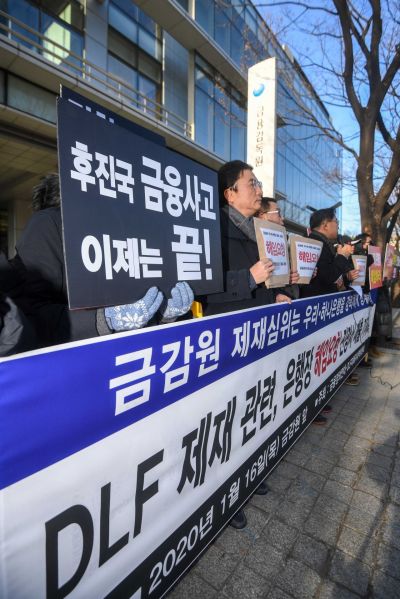
 On the 16th, when the Financial Supervisory Service's Disciplinary Committee regarding the overseas interest rate-linked derivative-linked fund (DLF) incident, which caused large-scale principal losses, was held, members of the DLF Victims Countermeasure Committee and the Financial Justice Solidarity held a press conference in front of the Financial Supervisory Service in Yeouido, Seoul, demanding severe disciplinary actions against Woori Bank and Hana Bank. Photo by Kang Jin-hyung aymsdream@
[Asia Economy Reporter Oh Hyung-gil] In the future, insurance companies will no longer be able to use customer personal information collected through applications (apps) operated by banks or card companies. This creates a significant variable in the use of databases (DB) by financial-affiliated insurance companies.
According to financial supervisory authorities and the insurance industry on the 31st, as online non-face-to-face platforms operated by banks and others have increased recently, insurance companies judged that if customers agree to provide personal information for marketing purposes to third parties, including affiliated companies such as insurance companies, when conducting financial transactions, they can use this to contact customers and utilize it for insurance sales.
However, the Financial Services Commission recently interpreted that it is not permitted for financial institutions to acquire personal information online for insurance marketing purposes and provide it to insurance companies, etc.
In other words, even if consumers agree to use their personal information for marketing on bank apps, insurance companies are not allowed to use it.
Until now, the authorities have judged that asking customers who visit bank counters whether they are interested in insurance and obtaining consent to provide personal information for the purpose of soliciting insurance contracts, then providing it to affiliated insurance companies, is effectively an insurance solicitation activity.
On the other hand, only methods such as soliciting by directly meeting with insurance contract holders at designated places within branches or guiding and explaining insurance products to unspecified many people through online websites were permitted.
Since bancassurance, which allows banks to sell insurance, was permitted in 2003, it has accounted for a significant portion of insurance sales. Among the initial insurance premiums received by life insurance companies from January to October last year, totaling 5.0885 trillion KRW, bancassurance accounted for 3.8296 trillion KRW, or 75%.
However, a regulation has been applied that the share of one insurance company in the annual insurance product sales recruited by financial institution insurance agencies cannot exceed 25%. This was a measure to ensure fairness among recruitment channels and prevent concentration of insurance product sales.
The financial authorities saw a concern that obtaining consent to provide personal information online and providing it to insurance companies or financial institution insurance agencies could have the effect of circumventing the bancassurance regulation known as the '25% rule.'
An insurance industry official said, "To secure customer DB, insurance sales have been conducted by obtaining consent for personal information use while operating sales at banks or card companies," adding, "If customer information cannot be used in a situation where app usage is increasing, it will impose restrictions on insurance sales."
© The Asia Business Daily(www.asiae.co.kr). All rights reserved.

















