Housing Prices in Gwonseon and Yeongtong Districts Rise Over 1%... Boosted by Shinbundang Line Development and Other Positive Factors
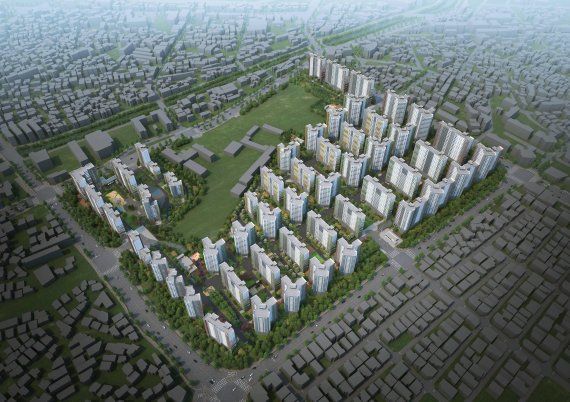
[Asia Economy Reporter Lee Chun-hee] Amid a series of stringent regulatory measures being imposed on Seoul, the balloon effect is concentrating on Suwon City in Gyeonggi Province, where regulations are relatively lighter. Additionally, redevelopment projects in the city center and development benefits such as the Shinbundang Line are fueling the atmosphere of rising housing prices.
According to the weekly apartment sales price index by the Korea Real Estate Board on the 30th, due to the impact of the December 16 real estate measures, apartment prices in the three Gangnam districts of Seoul (Gangnam, Seocho, Songpa) turned to a downward trend for the first time in about seven months as of the 20th. In contrast, Suwon’s Gwonseon District (1.52%) and Yeongtong District (1.02%) are the only areas nationwide showing an increase of over 1%, with housing prices soaring. Recently, Suwon has shown a trend of simultaneous price increases in four districts, including Jangan and Gwonseon Districts, in addition to Gwonseon and Yeongtong.
The biggest positive factor is the expansion of transportation infrastructure. On the 15th, when it was announced that the preliminary feasibility study for the Shinbundang Line extension to Hommaesil had passed, apartment prices in Paldal and Gwonseon Districts, through which the line passes, surged. The 'Hoban Verdiem The First' in Geumgok-dong, considered a station area for Hommaesil Station, saw an actual transaction price of 680 million KRW for an 85㎡ (exclusive area) unit on the day of the announcement, 80 million KRW higher than the previous highest price of 600 million KRW. Similarly, the 'Hwaseo Jugong 4 Complex' in Hwaseo-dong near the newly established transfer station Hwaseo Station recorded a transaction price of 450 million KRW for a 60㎡ unit on the 20th, five days after the announcement, surpassing the previous highest price of 390 million KRW (December 2018).
Urban redevelopment also appears to be fueling the upward trend in housing prices. Currently, redevelopment is underway in four areas in Suwon’s city center: Paldal Districts 6, 8, and 10, and Gwonseon District 6. In the case of 'Hillstate Prugio Suwon' in Paldal District 6, which was supplied last month, 74,519 applications were submitted for 951 households, recording a high competition rate of 73.3 to 1 on average. 'Maegyo Station Prugio SK View' in Paldal District 8 is scheduled to accept applications next month, and District 10 is also expected to complete demolition soon and begin sales.
The fact that it is a non-regulated area also contributes to the balloon effect. Unlike Seoul, which is a speculative overheating district where resale of pre-sale rights is prohibited until move-in, in Suwon, resale is possible six months after being selected as a resident. Even in Paldal District, the only regulated area (adjustment target area) in Suwon, the resale restriction period is the same at six months.
However, the industry suggests that due to the recent rapid price increases, Suwon may also be designated as a regulated area. When Paldal District was designated as an adjustment target area in December 2018, the government took preemptive measures considering market instability factors such as the Shinbundang Line extension and the Indeokwon-Dongtan double-track railway.
© The Asia Business Daily(www.asiae.co.kr). All rights reserved.
![Clutching a Stolen Dior Bag, Saying "I Hate Being Poor but Real"... The Grotesque Con of a "Human Knockoff" [Slate]](https://cwcontent.asiae.co.kr/asiaresize/183/2026021902243444107_1771435474.jpg)
















