SARS Fear Reemerges...China's 2003 2Q GDP Growth Drops 2%
Airline Stocks Fall on Expected Travel Demand Decline, International Oil Prices Plunge Due to Reduced Jet Fuel Demand
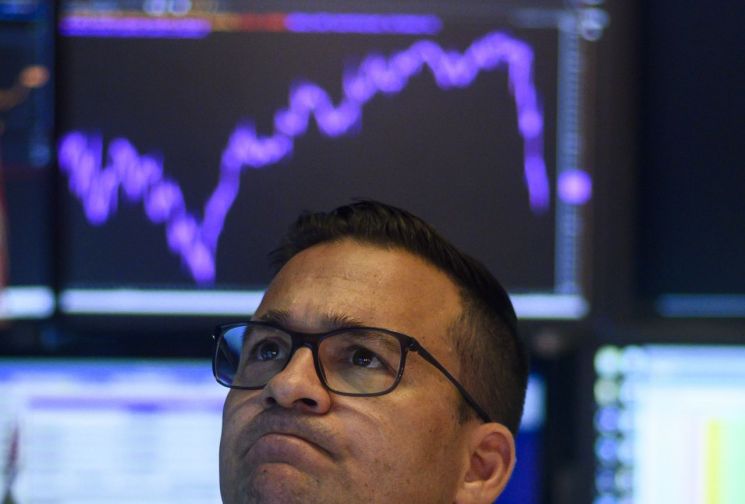
[Asia Economy New York=Correspondents Baek Jong-min and Lee Hyun-woo] As fear of the novel coronavirus infection (Wuhan pneumonia) grows, global financial markets are taking a heavy hit. Amid a broad sell-off in international stock markets, airline stocks plunged sharply due to concerns over declining travel demand, and international oil prices also plummeted amid worries about reduced jet fuel demand. Experts on Wall Street in the U.S. are expressing different forecasts while worrying about a correction across the entire global financial market due to increasing uncertainty.
On the 27th (local time), the global stock markets clearly reflected the shock from the spread of the novel coronavirus originating in China, with all three major U.S. stock exchanges falling. In particular, fear that the economic impact could exceed that of the Severe Acute Respiratory Syndrome (SARS) outbreak in China in 2003 stimulated investor sentiment. According to foreign media such as CNBC, during the second quarter of 2003 when SARS fears peaked, China’s gross domestic product (GDP) growth rate dropped by 2% from 11.1% in the first quarter to 9.1%. At that time, China’s economy was in a high-growth phase, so recovery was swift, but currently, concerns about economic slowdown are significant, raising fears that it could lead to a recession.
The service industry in China is expected to be hit immediately. The Wall Street Journal (WSJ) reported that according to data compiled by China’s Ministry of Transport, total traffic volume within China on the first day of the Lunar New Year holiday on the 25th fell by 28.8% compared to last year. Private air travel decreased by 41.6%, rail travel by 41.5%, and road traffic by 25%. The sharp drop in travel demand within China also affected the stock prices of international airlines. U.S. airline stocks such as American Airlines (5.54%), Delta Air Lines (3.37%), and United Airlines (5.21%) all plunged sharply. France’s Air France-KLM (5.64%) and Germany’s Lufthansa (4.51%) also showed steep declines.
Opinions among U.S. Wall Street experts about future prospects are divided. Alec Young, Director of Global Market Research at FTSE Russell, said in an interview with Bloomberg News, “No one knows how seriously the novel coronavirus will affect the global economy, and this creates the highest level of uncertainty that markets hate the most,” adding, “Since China is currently a driving force of global economic growth, market fear and selling pressure are likely to continue for some time.”
On the other hand, there is also considerable opposition to excessive pessimism. Michael Wilson, Chief Strategist at Morgan Stanley, said in a report released that day, “While the novel coronavirus has increased short-term risks and raised doubts about the first stock market correction since October last year, the Federal Reserve continues to supply liquidity and low interest rates are expected to persist, so the market correction will be short-lived and limited to within 5%.”
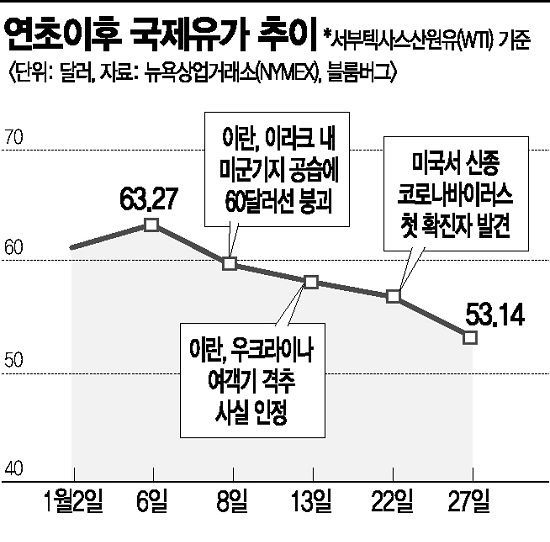
International oil prices are equally unstable. The price of West Texas Intermediate (WTI) crude oil has plunged from the $63 range to the $53 range in just three weeks. According to CNBC, China is the world’s second-largest oil consumer after the U.S. Analysis that jet fuel consumption accounts for 15% of total oil consumption influenced the sharp drop in oil prices. During the SARS outbreak in China in 2003, jet fuel demand decreased by an average of 230,000 barrels per day, resulting in a 35% year-on-year decline in jet fuel consumption.
Energy specialists such as S&P Global Platts have forecast that global jet fuel demand could decrease by about 50,000 to 150,000 barrels per day over the next two months. WSJ also reported that even if the damage from the novel coronavirus is less than that of SARS, its impact on oil prices could be more severe.
© The Asia Business Daily(www.asiae.co.kr). All rights reserved.
![Clutching a Stolen Dior Bag, Saying "I Hate Being Poor but Real"... The Grotesque Con of a "Human Knockoff" [Slate]](https://cwcontent.asiae.co.kr/asiaresize/183/2026021902243444107_1771435474.jpg)
















