Emergency Meeting of Relevant Ministers on Wuhan Pneumonia
New Infectious Diseases Persist... Health and Medical Budgets Stagnate Year after Year
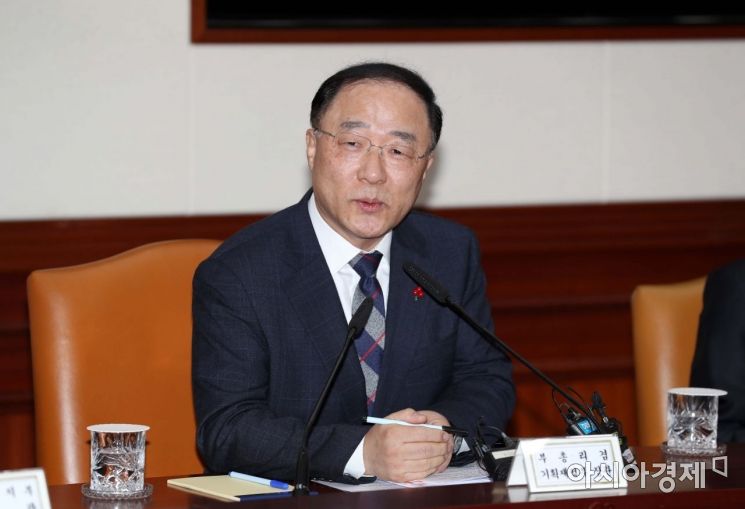 Hong Nam-ki, Deputy Prime Minister and Minister of Economy and Finance, is delivering opening remarks at an emergency meeting of related ministers held on the 28th at the video conference room of the Government Seoul Office in Jongno-gu, Seoul, to review support for quarantine budgets related to the novel coronavirus and minimize economic impact. Photo by Moon Ho-nam munonam@
[Asia Economy Reporters Minyoung Kim, Sehee Jang] The government has decided to promptly execute a quarantine response budget of 20.8 billion KRW related to the spread of the novel coronavirus infection (Wuhan Pneumonia) and to support the contingency reserve fund allocated in this year's budget if additional funds are needed. The government is concerned that if the novel coronavirus situation worsens, it could negatively impact the domestic economic recovery.
Hong Nam-ki, Deputy Prime Minister and Minister of Economy and Finance, held an emergency meeting of relevant ministers on the morning of the 28th at the Government Complex Seoul in Jongno-gu, Seoul, to review support for the quarantine budget and minimize economic impact related to the novel coronavirus. He stated, "We will promptly execute a total of 20.8 billion KRW in quarantine response budgets reflected in this year's budget, including 6.7 billion KRW for establishing and operating the quarantine response system, 5.2 billion KRW for quarantine and diagnosis, and 2.9 billion KRW for isolation treatment, to actively support proactive quarantine measures."
Deputy Prime Minister Hong added, "If the secured budget is insufficient or additional expenses arise, we will support the use of the 2 trillion KRW contingency reserve fund allocated in this year's budget to ensure there are no budgetary setbacks. Also, since the 1 billion KRW budget for dispatching chartered flights to protect overseas nationals is already included in the budget, we are preparing to execute it immediately once the decision to dispatch the chartered flights is made."
The government plans to focus on assessing the potential impact of the novel coronavirus spread on the real economy and minimizing negative effects. Deputy Prime Minister Hong said, "We are closely monitoring the impact of the spread within China on Chinese consumption and production activities, as well as the ripple effects on the global economy and our exports. Referring to past cases such as the 2003 Severe Acute Respiratory Syndrome (SARS) and the 2015 Middle East Respiratory Syndrome (MERS), we will thoroughly analyze the impact on domestic demand sectors like tourism and services by scenario and implement necessary measures."
The government is concerned that this situation might dampen the recovering economic sentiment. Deputy Prime Minister Hong stated, "During the 2003 SARS and 2015 MERS incidents, there were limited but certain impacts, so I cannot say there will be no impact this time either. Economic sentiment was recovering at the beginning of the year, but there are concerns it might be affected by this situation."
Meanwhile, the issue of insufficient quarantine budgets has resurfaced due to this incident. The government's decision to draw on contingency funds if the main budget falls short is because the Korea Disease Control and Prevention Agency's quarantine budget to respond to the novel coronavirus is insufficient. The quarantine budget that the government pledged to execute promptly is part of the health and medical budget, with only 817.1 billion KRW allocated for this year.
Despite the persistence of new infectious diseases such as SARS, novel flu, MERS, and now coronavirus, the health and medical budget remains stagnant. During the 2015 MERS outbreak, the health and medical budget was 2.28 trillion KRW, accounting for only 4.3% of the total health and welfare budget (53.4 trillion KRW). At that time, there were calls to increase the health and medical budget due to issues such as the shortage of epidemiologists at the Korea Disease Control and Prevention Agency, but this year's health budget is 2.7694 trillion KRW, which is only 3.4% of the total health and welfare budget (82.7694 trillion KRW).
© The Asia Business Daily(www.asiae.co.kr). All rights reserved.
![Clutching a Stolen Dior Bag, Saying "I Hate Being Poor but Real"... The Grotesque Con of a "Human Knockoff" [Slate]](https://cwcontent.asiae.co.kr/asiaresize/183/2026021902243444107_1771435474.jpg)















